

Public-Record Analysis | Elections & Public Trust
Democrats Win Texas’ Top Statewide Races as House Control Remains Unsettled
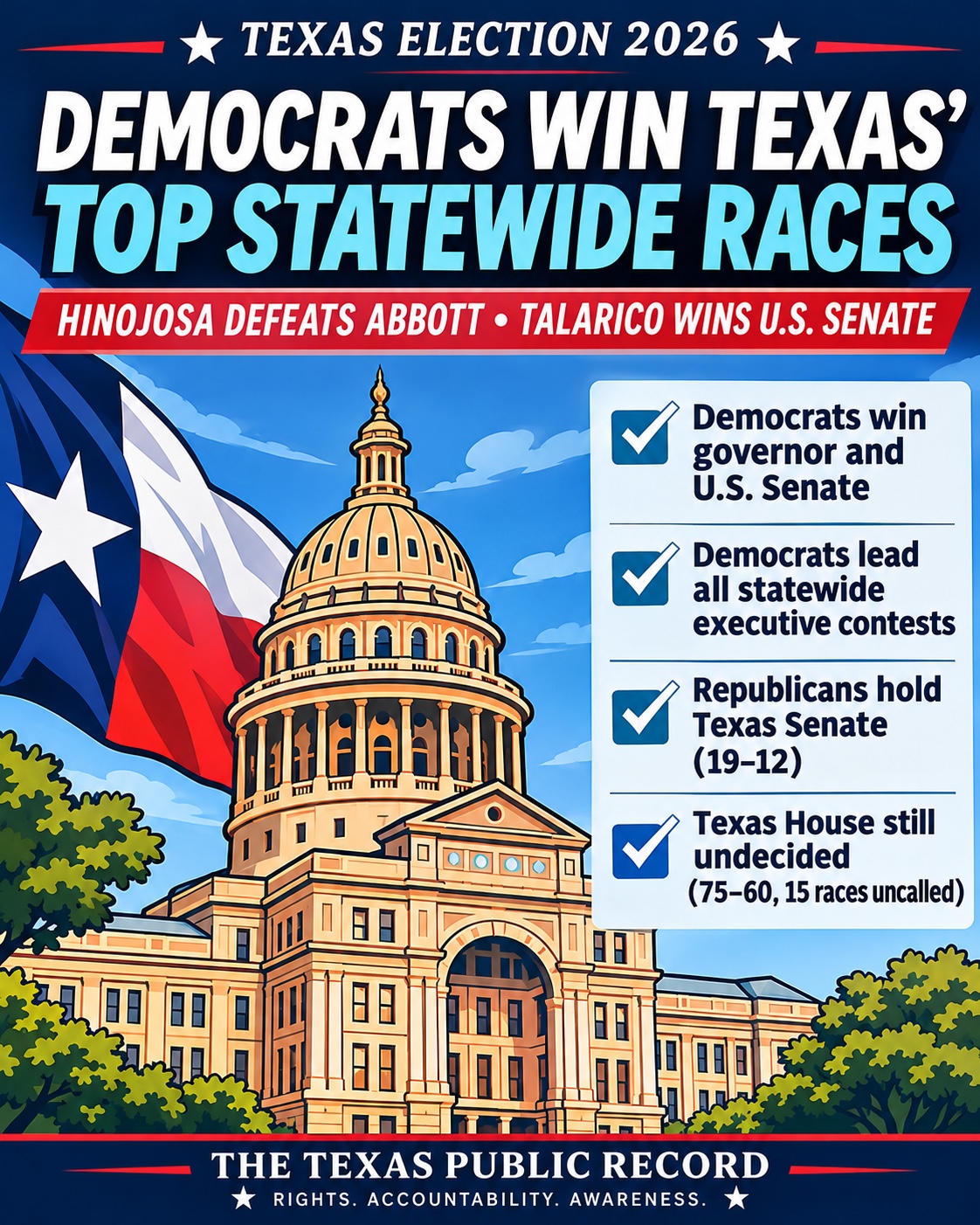
Hinojosa defeats Abbott and Talarico wins U.S. Senate seat; Republicans secure a 19–12 state Senate majority as Democrats reach 75 called House seats
Texas voters elected Democrat Gina Hinojosa governor and James Talarico to the U.S. Senate on Tuesday, breaking decades of Republican dominance in statewide elections while leaving control of the Texas House unresolved.
Hinojosa defeated Republican Gov. Greg Abbott, who was seeking a fourth term, and will become the state’s first Latina governor. Talarico defeated Republican Ken Paxton, giving Democrats their first Texas U.S. Senate election victory since 1988, according to reported race calls and historical election reporting.
The Democratic gains extended down the ballot. The Texas Secretary of State’s unofficial returns showed Democrats ahead in every statewide executive and regulatory contest on the ballot and in seven statewide judicial races.
But statewide victories do not give Democrats control of the Legislature or immediately change existing laws. Republicans have secured their Texas Senate majority, and Democrats remained one called seat short of a Texas House majority in the latest legislative report inspected for this article.
The statewide vote
The Secretary of State’s November 4 results page, marked updated at 1:20 p.m., showed 99% of polling locations reporting in each of the following contests:
| Office | Democratic candidate | Republican candidate | Democratic vote lead |
|---|---|---|---|
| U.S. Senate | James Talarico | Ken Paxton | 1,181,133 |
| Governor | Gina Hinojosa | Greg Abbott | 696,897 |
| Lieutenant governor | Vikki Goodwin | Dan Patrick | 590,066 |
| Attorney general | Nathan Johnson | Mayes Middleton | 622,112 |
| Comptroller | Sarah Eckhardt | Don Huffines | 495,205 |
| Land commissioner | Benjamin Flores | Dawn Buckingham | 429,406 |
| Agriculture commissioner | Clayton Tucker | Nate Sheets | 444,800 |
| Railroad commissioner | Jon Rosenthal | Bo French | 667,558 |
These margins are differences between the two major-party candidates’ reported votes. They are not percentages of all votes cast, and other candidates appeared in several contests.
The reporting percentage measures polling locations, not the percentage of every eligible ballot that has been counted. The totals remain unofficial and may change before the canvass.
Republicans secure the Senate; House control remains open
Democrat Vikki Goodwin defeated Republican incumbent Dan Patrick in the lieutenant governor’s race, according to reported election projections. She would become president of a Texas Senate controlled by the opposing party.
FOX 7 Austin’s legislative report, updated at 1:16 p.m. Central on November 4, attributed a 19–12 Republican Senate majority to Associated Press calls. It reported that AP called the remaining Senate District 2 contest for Republican Bob Hall shortly before 1 p.m.
That supersedes the earlier Wednesday snapshot showing Republicans with 18 seats, Democrats with 12 and one race uncalled.
In the Texas House, the same updated report listed Democrats with 75 called seats and Republicans with 60, leaving 15 races uncalled. The chamber has 150 members, so 76 seats constitute an outright majority.
Democrats were therefore one called seat short of a majority in that snapshot. It did not establish that either party had won control of the chamber.
The distinction matters. A Democratic governor and lieutenant governor cannot enact legislation without the required votes in both chambers. A Republican Senate majority could block Democratic legislative priorities even if Democrats win the House.
The lieutenant governor’s constitutional role and the Senate’s own procedural rules also must be distinguished. The Texas Constitution makes the lieutenant governor Senate president, while allowing each chamber to determine its rules. Committee assignments, scheduling and legislative priorities will depend on those rules and how members exercise their authority.
Seven statewide judicial races also favor Democrats
The Secretary of State’s unofficial returns showed Democrats leading four Texas Supreme Court contests: Maggie Ellis for chief justice, Chari Kelly for Place 2, Kristen Hawkins for Place 7 and Gisela D. Triana for Place 8.
Democrats also led three Court of Criminal Appeals contests: Okey Anyiam for Place 3, Audra Riley for Place 4 and Holly Taylor for Place 9.
The Texas Supreme Court is the state’s highest court for civil matters. The Court of Criminal Appeals is its highest court for criminal matters.
Changes in their membership could affect future decisions. The election itself does not reverse existing rulings, and winning the seats on this ballot is not the same as winning every seat on either court.
What incoming officials could change
The results create the possibility of significant policy changes, but those changes require official action after the winners take office.
As governor, Hinojosa could sign or veto legislation, call special sessions and make appointments within the limits of the Texas Constitution and state law. Some appointments require Senate confirmation.
As attorney general, Nathan Johnson could seek changes in the state’s litigation priorities and legal positions, subject to applicable law and court procedures.
Goodwin would assume the Senate presidency, while Republican senators would retain their majority and their constitutional authority over the chamber’s rules.
Other incoming officials would oversee public finances, agriculture, public lands and energy regulation. Their offices have distinct powers; an election victory does not give any officeholder unrestricted authority to rewrite laws or agency decisions.
For Texans, the practical questions will be which actions the new officials can take themselves, which require legislative approval and which face judicial review.
Talarico’s victory would transfer one Texas U.S. Senate seat from Republican to Democratic control when the new term begins. That federal result is separate from control of the Texas Legislature. The makeup of Congress depends on election outcomes nationwide.
Two different canvass processes
The results are not yet certified. Media race calls and candidate concessions do not replace the legally required canvass.
For the federal, district and statewide offices canvassed by the governor, the applicable state canvass window is November 21 through December 7, 2026. Election Code §67.010 expressly excludes governor and lieutenant governor from that process.
Those two offices follow a separate legislative canvass under Election Code §67.011 and Article IV, Section 3, of the Texas Constitution. Their returns are opened and published before both houses during the first week of the next legislative session, with the official result declared by the House speaker under the Legislature’s sanction.
Election officials must also complete the legally required processing of provisional and qualifying late-arriving ballots before the applicable canvass. A large lead can support a reliable race projection while the reported totals remain unofficial.
What happens next
The immediate electoral checkpoints are the remaining House race calls, completion of ballot processing and the applicable canvasses. The governing checkpoints are the transition into office, selection of House leadership and adoption of legislative rules.
Texas voters changed the leadership of major statewide offices. How much that changes state policy will depend on the authority of those offices, the unresolved House majority and a Republican-controlled Senate.
Sources
FOX 7 Austin — Hinojosa and Talarico wins; attributed AP calls and Abbott concession:
Associated Press — James Talarico’s U.S. Senate victory:
San Antonio Express-News — Texas election results and historical context:
Texas Constitution — Article III, §§1–2, 11; legislative structure, membership and procedural rules:
Texas Constitution — Article V, §§3, 5; highest-court jurisdiction:
Texas Election Code — §1.006; weekend deadline extension:
Verified through November 4, 2026. Statewide margins reflect the Secretary of State page update marked 1:20 p.m. Legislative figures reflect the separately attributed FOX 7/AP report updated at 1:16 p.m. Central. Results remain unofficial; uncalled races and totals may change.
EDITORIAL NOTICE: This report reflects records and information available at publication. Allegations, charges, and disputed claims are not findings of wrongdoing. Submit documented correction or clarification requests to The Texas Public Record. Material errors will be corrected transparently.
The Texas Public Record
Rights. Accountability. Awareness.