
Government & Legislation
Texas Proposes Changes to Carbon-Storage Hearings, Well Rules and Financial Safeguards
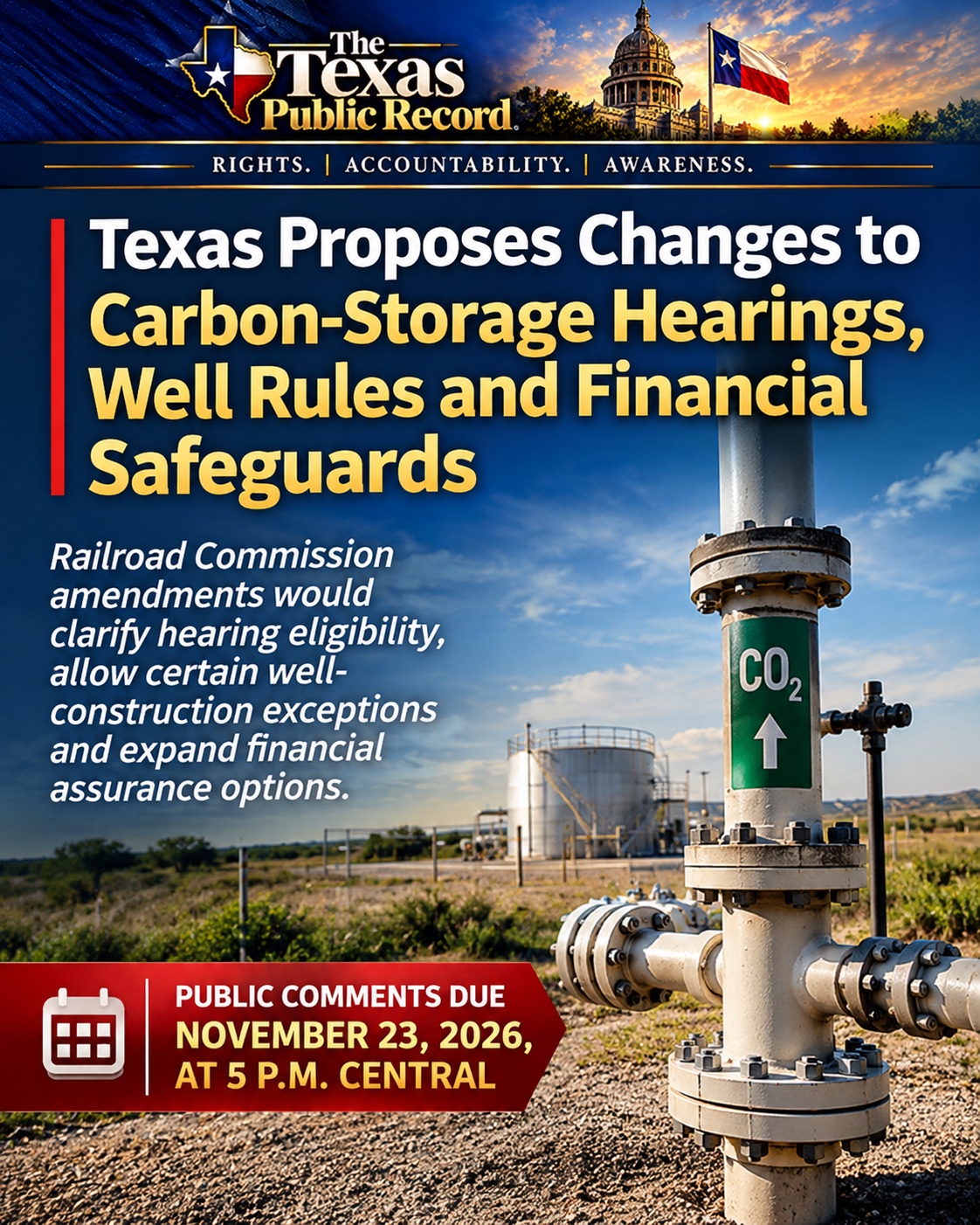
Railroad Commission amendments would clarify who qualifies for formal permit hearings, address certain well-construction exceptions and expand financial assurance options. Public comments are due November 23.
AUSTIN, Texas — The Railroad Commission of Texas is considering changes to its underground carbon dioxide storage regulations that would affect permit hearing procedures, certain well-construction requirements and the financial safeguards operators must maintain.
The proposed amendments concern Class VI injection wells, which are used to place carbon dioxide into deep underground rock formations for long-term storage.
The changes are not final. The commission published the proposal in the October 23, 2026, Texas Register and is accepting public comments until 5 p.m. Central on Monday, November 23.
For Texans living near proposed storage facilities, the rulemaking raises practical questions: Who can challenge a permit through a formal hearing? Under what circumstances may a well be constructed differently from the standard requirements? And what financial protections must remain available if a project requires corrective action, emergency response or closure?
Who can challenge a carbon-storage permit?
One part of the proposal addresses the definition of an affected person — someone who may qualify to protest a Class VI permit application and request a contested-case hearing.
Under the commission’s existing published protest instructions, a person must have suffered, or potentially face, actual injury or economic damage beyond an impact shared with the general public.
The proposed amendment would expressly describe an affected person as someone with a personal, legally recognizable interest connected to a right, duty or privilege, along with actual or potential injury or economic damage resulting from the proposed activity.
That distinction matters, but it should not be mistaken for the creation of an entirely new injury requirement. The commission already uses an injury-based standard in its existing procedures.
The proposal appears intended to clarify the regulatory definition and related hearing procedures. The available record does not establish that it would categorically eliminate hearing rights previously available to a particular group of Texans.
The amendments would also distinguish a public meeting from a contested-case hearing.
A public meeting allows people to present comments on a draft permit. A contested-case hearing is a formal administrative proceeding, similar in important respects to a trial, in which an applicant’s permit may be examined through an adjudicative process.
A person can have an interest in a proposed project and submit public comments without necessarily qualifying for a contested-case hearing.
For residents, landowners and other potentially affected parties, understanding that distinction is important before deciding how to participate in a specific permit proceeding.
What would change in well construction?
The proposed amendments address technical requirements governing the construction of Class VI injection wells, including cemented well strings or liners and the placement of packers.
These components are part of the engineering system used to maintain well integrity and isolate injected carbon dioxide within the intended underground formation.
Cemented casing or liners provide barriers along the wellbore, while a packer helps seal the space between tubing and surrounding well components.
The commission’s explanatory memorandum describes a proposed exception to the requirement for a cemented well string or liner through the injection zone.
However, the corresponding proposed regulatory text refers to packer setting depth in the casing-and-cementing provision, as well as in a separate provision addressing packer placement.
That difference leaves the precise scope of the proposed construction exception unclear.
The inconsistency is significant because an exception involving the extent of cemented casing or a liner is not necessarily the same engineering question as an exception involving where a packer may be placed.
The proposal describes a process involving a written request to the director of the commission’s Oil and Gas Division, supported by pertinent technical information.
The requested exceptions would not be automatic. They would require regulatory consideration and approval.
The proposed language also does not eliminate the broader Class VI permitting and well-integrity framework.
Nevertheless, the commission’s explanatory memorandum and proposed rule text should be reconciled so operators, regulators and potentially affected residents can understand exactly which construction requirements may be excepted and under what circumstances.
The proposal does not establish that any particular well would become unsafe. Nor does it demonstrate that every possible alternative construction arrangement would provide equivalent protection under all circumstances.
The appropriate question is whether the final regulatory language clearly defines the exception authority and the technical showing required to exercise it.
What happens if an operator cannot pay?
Carbon dioxide storage projects can create financial obligations that extend beyond the years when injection is taking place.
Operators may need resources for corrective action, well plugging, monitoring after injection stops, site closure, and emergency or remedial response.
Financial assurance rules are intended to help ensure those obligations can be met without leaving necessary work unfunded.
The commission currently recognizes surety bonds and letters of credit in its rules. Its proposal would expressly expand the available mechanisms to include trust funds, insurance, escrow accounts and other instruments satisfactory to the director.
Operators could also use more than one qualifying instrument for a particular phase of a project, subject to the proposed restrictions.
The commission’s proposal says the financial arrangements must cover at least the applicable current cost estimate. It would require supporting information about certain third-party financial providers and provide for director review of the adequacy of financial instruments.
Other proposed provisions address segregated escrow funds, standby trusts, annual financial-information updates, and the director’s authority to reject an insufficient instrument.
The proposal also addresses what happens when financial backing fails.
Under specified circumstances involving the failure of an institution providing an existing financial assurance instrument, an operator would be required to establish replacement financial assurance within 60 days.
The proposed provisions also include notification requirements concerning specified bankruptcy proceedings.
These safeguards matter because a financial instrument is useful only if it remains enforceable and the required resources are available when needed.
The commission specifically states that it is not proposing to allow operators to rely on self-insurance based solely on their own financial strength.
Expanding the kinds of acceptable financial instruments is therefore not the same as eliminating financial responsibility.
At the same time, the existence of an approved bond, insurance policy or other instrument does not by itself prove that funds will be immediately accessible or sufficient under every future circumstance.
Actual protection depends on the amount required, the instrument’s terms, the provider’s ability to perform and regulatory enforcement.
The proposed 60-day replacement requirement addresses certain failures of financial backing, but it should not be interpreted as a guarantee that all financial obligations would be met under every possible scenario.
How would communities be notified and involved?
The proposed amendments also address public outreach before and during the permitting process.
One change would remove an explicit reference to “Environmental Justice” communities from certain outreach provisions.
The commission explains that its intent is to encourage engagement with all communities in the area of a proposed project, rather than limit outreach to a particular designation.
The proposal would retain language concerning limited-English-speaking households and add or revise provisions related to community engagement and the documentation of meetings.
It also addresses coordination with emergency officials.
The removal of a term is a verifiable textual change. Its practical effect on public participation, however, cannot be determined from the terminology alone.
Whether residents receive timely, understandable and useful information will depend on the requirements ultimately adopted and how those requirements are implemented in individual projects.
Why these rules matter now
Class VI wells operate under the federal Underground Injection Control framework established to protect underground sources of drinking water.
The U.S. Environmental Protection Agency approved Texas to administer the Class VI program, with the state’s authority taking effect December 15, 2025.
That places the Railroad Commission in a central role in evaluating Class VI applications, enforcing applicable requirements and overseeing permitted facilities in Texas.
The current rulemaking concerns the procedures and standards used in that oversight.
It is not approval of a specific carbon-storage project. It does not authorize construction of a particular well, resolve an individual permit dispute or establish that groundwater has been contaminated.
Nor does the proposal alone demonstrate that the overall regulatory program would become either more protective or less protective.
The documented changes concern hearing terminology and affected-person language, construction-exception procedures, financial assurance mechanisms and public outreach provisions.
Those are meaningful administrative decisions because they affect how future applications are reviewed and how regulatory obligations may be enforced.
How Texans can submit comments
The Railroad Commission is accepting comments on the proposed Chapter 5 amendments until 5 p.m. Central on November 23, 2026.
Comments may be submitted through the commission’s official rulemaking form:
Submit comments through the commission’s rulemaking form
The commission also accepts comments by email at rulescoordinator@rrc.texas.gov or by mail addressed to:
Rules Coordinator
Railroad Commission of Texas
Office of General Counsel
P.O. Box 12967
Austin, TX 78711-2967
Commenters should identify the proposed amendments to 16 Texas Administrative Code Chapter 5 concerning Class VI injection wells and explain the provision or concern they want the commission to consider.
Those reviewing the construction provisions may also wish to request clarification of the difference between the commission’s explanatory memorandum and its proposed regulatory language.
These are comments on a proposed statewide rule. They are not the same as a protest or request for a contested-case hearing concerning an individual permit application, which follows separate procedures.
The proposal also calls for a virtual hearing on the statewide rules and directs readers to the commission’s website for participation instructions.
The commission may consider comments before deciding whether to adopt, revise or decline the proposed amendments.
As of November 17, the commission’s published rulemaking page does not list an adoption date or effective date for these amendments.
For Texans following carbon-storage development, the immediate opportunity is to examine the proposed regulatory language and submit comments before the deadline.
Sources
- Railroad Commission — Proposed amendments to 16 TAC Chapter 5, October 6, 2026
- Railroad Commission — Proposed rules and comment deadline
- Railroad Commission — Rulemaking comment form
- Railroad Commission — Class VI affected-person protest instructions
- EPA — Texas Class VI primacy announcement
- Texas Register — October 23, 2026 proposed rules
Verified through November 17, 2026.
EDITORIAL NOTICE: This report reflects records and information available at publication. Allegations, charges, and disputed claims are not findings of wrongdoing. Submit documented correction or clarification requests by messaging The Texas Public Record on the platform where this article appears. Material errors will be corrected transparently.
The Texas Public Record
Rights. Accountability. Awareness.