Government & Legislation | Agriculture
Abdul El-Sayed wants to prohibit pesticides already banned in Europe. His proposal does not identify the chemicals involved, leaving unanswered questions about potential consequences for Texas agriculture, food safety and production costs.
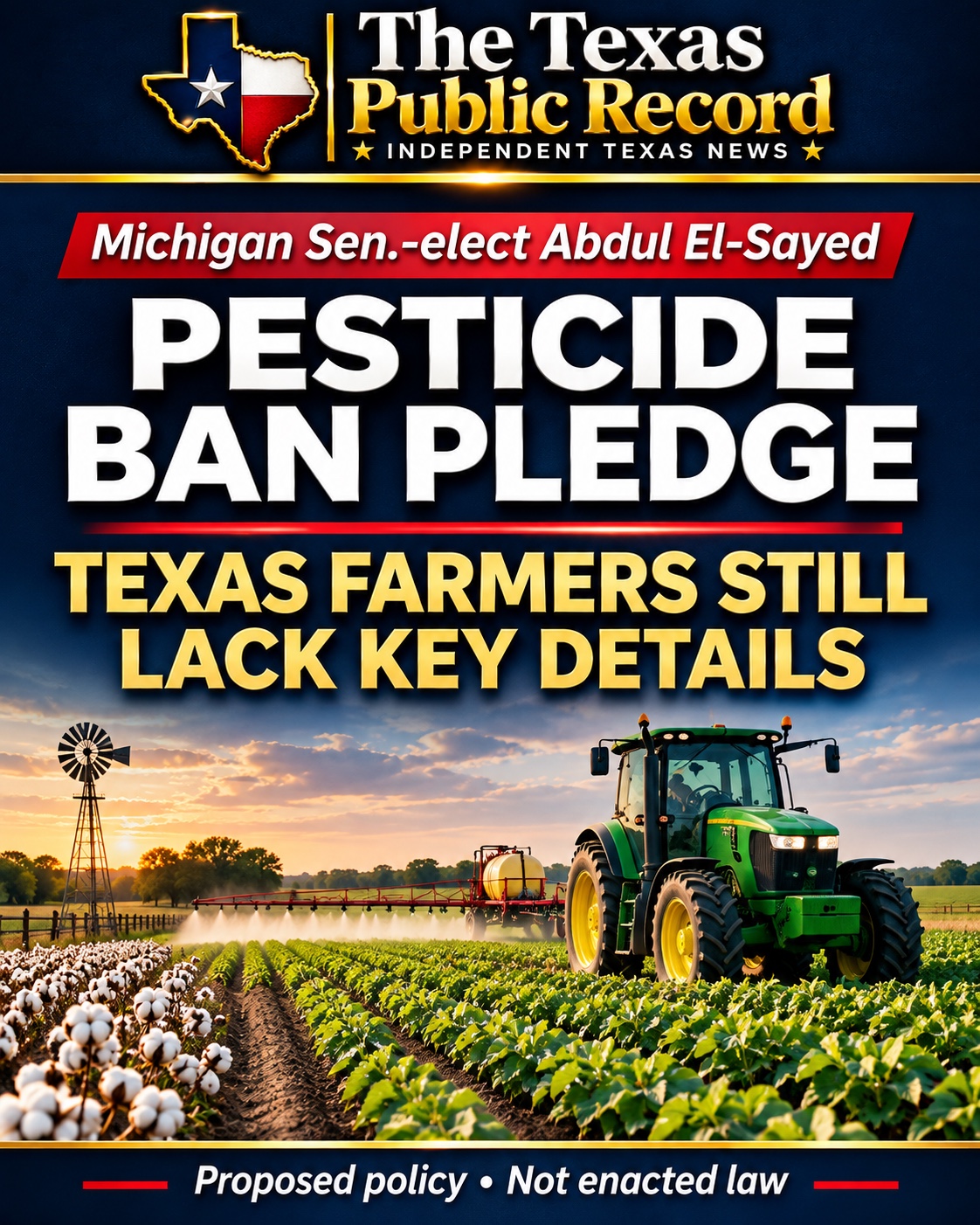
Michigan Sen.-elect Abdul El-Sayed has pledged to introduce federal legislation banning pesticides already prohibited in Europe. But his published proposal leaves a critical question unanswered for Texas agriculture: Which chemicals would actually be affected?
Without that information, Texas farmers cannot determine whether their current pest-management practices would face new restrictions, what alternatives might be required or how much compliance could cost.
El-Sayed outlined the proposal in his September 29 campaign agenda, Building a Healthier America. He subsequently defeated Republican Mike Rogers in Michigan’s November 3 U.S. Senate election.
The proposed ban is not enacted federal law, and The Texas Public Record has not identified an introduced bill implementing El-Sayed’s specific campaign pledge.
For Texas, the issue is whether future restrictions would affect pesticides currently used in the state’s agricultural operations—and what scientific evidence, implementation requirements and economic analysis would support those changes.
What El-Sayed Is Proposing
El-Sayed’s campaign agenda expressly commits him to introducing legislation banning pesticides already prohibited in Europe.
The proposal is part of a broader public-health and agricultural platform that includes reducing dependence on agricultural chemicals, supporting conservation practices and addressing concentration in agricultural supply markets.
His agenda also calls for rebuilding technical-assistance staffing at the U.S. Department of Agriculture’s Natural Resources Conservation Service. That assistance would support practices such as cover cropping, diversified crop rotations, nutrient management and managed grazing. El-Sayed also proposes shifting agricultural subsidies toward soil health and reduced chemical dependence.
Those initiatives are distinct from a federal pesticide ban. They could influence agricultural practices even without prohibiting particular chemicals.
In September reporting by The Washington Post, El-Sayed described his intention to pursue science-based legislation that would substantially restrict pesticide use. However, neither his published agenda nor the accompanying campaign announcement identifies the specific chemicals he intends to prohibit.
The documents also do not establish an implementation timetable, transition period or proposed exemptions. Those details would determine how the policy affects agricultural producers.
Why Texas Agriculture Could Be Affected
Texas produces a wide range of agricultural commodities, including cattle, cotton, corn, wheat, sorghum, fruits and vegetables. Producers face different pest pressures depending on the crop, location, climate and production method.
Pesticides are used for different purposes, including managing insects, weeds and plant diseases. A federal prohibition affecting a chemical currently used in Texas could require producers to change how they manage those problems.
Some might need to adopt alternative pesticides, modify application practices or increase their use of nonchemical pest-management methods. Others might experience little or no direct effect. The outcome would depend on the substances covered, their current uses and the availability of effective alternatives.
For example, a restriction on a pesticide used extensively in a particular crop could have a different impact from a restriction on a substance rarely used in Texas. The campaign proposal does not identify which situation would apply.
It also does not provide enough information to estimate compliance costs, changes in crop yields or potential effects on food prices. Those consequences should not be presumed in either direction.
Before Texas producers can evaluate the proposal, they need to know which chemicals would be targeted and whether those substances are currently used in their operations.
How Pesticides Are Regulated Today
The United States already regulates pesticides through a combination of federal and state laws. Under the Federal Insecticide, Fungicide, and Rodenticide Act, the Environmental Protection Agency regulates pesticide registration, labeling and permitted uses.
EPA also establishes legal limits, known as tolerances, for certain pesticide residues in or on food under the Federal Food, Drug, and Cosmetic Act. A tolerance is a legally permitted residue level under specified conditions. It does not authorize unrestricted pesticide application.
In Texas, the Department of Agriculture administers agricultural pesticide regulatory programs, including applicator licensing and requirements governing restricted-use pesticides, state-limited-use pesticides and regulated herbicides. Farmers and other applicators must follow applicable product-label requirements and federal and state restrictions.
A new federal prohibition could change which pesticide products or uses remain legally available. However, the effects would depend on the actual legislation and how federal regulators implement it.
Does a European Ban Establish That a Pesticide Is Unsafe?
Not by itself.
European and American pesticide regulators operate under different legal frameworks and may reach different regulatory decisions about the same substance. Those differences can involve scientific evidence, exposure assessments, approved uses, statutory requirements and approaches to managing uncertainty.
A substance may also be prohibited for particular applications, lack renewed approval or face a broader restriction. Those distinctions matter.
A meaningful pesticide risk assessment considers both the potential for a chemical to cause harm and the circumstances under which people or the environment may be exposed to it. Relevant factors include the substance involved, exposure levels, duration, route of exposure and potentially affected populations.
A pesticide’s prohibition in another jurisdiction is therefore a reason to examine the underlying regulatory record, not a substitute for that examination.
El-Sayed’s proposal would need to define which European restrictions should be incorporated into U.S. law. Until that happens, the scope of the proposed ban remains uncertain.
A Separate Bill Addresses Pesticide-Injury Lawsuits
El-Sayed’s campaign agenda also supports the Pesticide Injury Accountability Act of 2025. That legislation, introduced as S. 2324 by Sen. Cory Booker of New Jersey on July 17, 2025, is separate from El-Sayed’s proposed pesticide ban.
The bill would amend the Federal Insecticide, Fungicide, and Rodenticide Act to establish a federal private right of action for injuries caused by pesticides. It also includes provisions preserving state-law claims rather than broadly preempting them.
The measure addresses legal accountability and the ability of injured individuals to seek remedies. It does not itself prohibit pesticides already banned in Europe.
The original congressional record shows that S. 2324 was introduced and referred to the Senate Committee on Agriculture, Nutrition, and Forestry on July 17, 2025. No subsequent legislative action was established in the records reviewed for this article.
El-Sayed’s support for S. 2324 should not be confused with the introduction of his own pesticide-ban legislation. The two proposals concern different legal questions.
One addresses which pesticides could remain available for use. The other addresses potential civil remedies when pesticide exposure allegedly causes injury.
The distinction is particularly important because debates over pesticide liability also involve the relationship between federal labeling requirements and state-law lawsuits. Supporters of expanded legal remedies argue that people harmed by pesticide products should retain meaningful access to the courts. Those favoring broader federal preemption argue that nationally uniform pesticide-labeling requirements help prevent conflicting legal obligations.
Neither position, by itself, resolves the scientific and agricultural questions surrounding El-Sayed’s proposed ban.
What the Proposal Could Mean for Food Safety
El-Sayed has presented his pesticide proposal as part of a broader effort to improve public health. His campaign argues that pesticide overuse and corporate influence contribute to environmental contamination and chronic disease. Those assertions are the campaign’s stated rationale, not findings independently established by its policy announcement.
Pesticide exposure can create health and environmental risks, but the magnitude and nature of those risks depend on the chemical and circumstances involved. Whether additional restrictions would improve public health—and by how much—would require evidence about the affected substances, existing exposure levels and the expected effects of reducing their use.
It would also be inaccurate to claim that banning certain pesticides would immediately eliminate pesticide residues from American food. Restrictions on future applications do not necessarily remove existing environmental contamination or eliminate every potential exposure pathway.
Similarly, detecting a pesticide residue in food does not automatically establish that the food poses an unacceptable health risk. A scientifically grounded assessment must consider the particular substance and level of exposure.
The proposal does not yet identify the chemicals or provide the analysis necessary to estimate measurable public-health benefits.
A Debate That Crosses Political Lines
El-Sayed’s campaign has also sought support from voters concerned about food quality, agricultural chemicals and chronic disease, including people associated with the Make America Healthy Again movement. That movement has been closely associated with Health Secretary Robert F. Kennedy Jr.
The Washington Post and CBS News reported in September on El-Sayed’s efforts to connect those concerns with his broader public-health platform. Agreement that food safety deserves attention does not establish agreement about which pesticides should be restricted or what regulatory standards should apply.
Farmers, public-health advocates, manufacturers and government regulators may disagree about the scientific evidence, available alternatives, economic consequences and appropriate level of federal authority. Those disagreements become more meaningful when a proposal identifies specific substances and enforceable requirements.
For Texas, the practical consequences matter more than the political alignment of the proposal’s supporters.
What Congress Has—and Has Not—Done
As of November 9, 2026, The Texas Public Record has not identified an introduced federal bill implementing El-Sayed’s specific pledge to ban pesticides already prohibited in Europe. That finding is limited to the congressional records available for review. It is not a claim that an exhaustive live congressional docket search has established the absence of every potentially related proposal.
The separate Pesticide Injury Accountability Act, S. 2324, was introduced in July 2025. The latest action established in the reviewed records is its referral to the Senate Agriculture, Nutrition, and Forestry Committee.
Neither the existence of that bill nor El-Sayed’s election establishes that his proposed pesticide ban has advanced through Congress.
El-Sayed is scheduled to begin his Senate term in January 2027. If he introduces legislation, its text would provide the first concrete opportunity to evaluate which substances and agricultural uses could be restricted. Any proposed federal ban would then have to proceed through the legislative process before becoming law.
The Questions Texas Farmers Need Answered
- Chemical scope: Which specific pesticides would be prohibited, and how would European restrictions be defined?
- Texas exposure: Are those substances currently registered and used in Texas agriculture, and for which crops?
- Agricultural alternatives: Would effective substitutes or other pest-management methods be available?
- Implementation: Would producers receive transition periods, exemptions or technical assistance?
- Economic effects: What evidence would support estimates of compliance costs, production changes and food-price consequences?
- Public-health effects: What exposure reductions and health benefits would the proposed restrictions be expected to produce?
- Food imports: Would equivalent requirements apply to imported agricultural products?
The answers would determine whether the proposal produces substantial changes for Texas agriculture or has more limited effects. Until the substances and requirements are identified, neither outcome can be established.
The Bottom Line
Abdul El-Sayed has made a documented commitment to pursue federal legislation banning pesticides already prohibited in Europe. His election gives him an opportunity to advance that policy, but the campaign pledge has not itself changed federal pesticide law.
For Texas farmers and consumers, the most important information remains unavailable: which chemicals would be restricted, where they are currently used and what changes would be required.
The next consequential development will be the legislative details—not the campaign promise itself.
Sources
Primary records
- Abdul El-Sayed for U.S. Senate, Building a Healthier America, September 29, 2026.
- El-Sayed campaign announcement, September 29, 2026.
- U.S. Congress, Pesticide Injury Accountability Act of 2025, S. 2324.
- S. 2324 introduced bill text.
- U.S. Environmental Protection Agency, Summary of the Federal Food, Drug, and Cosmetic Act.
- Texas Department of Agriculture, Agricultural Applicators.
Independent reporting
- Associated Press, Michigan Senate election report, November 2026.
- The Washington Post, September 29, 2026.
- CBS News, September 29, 2026.
Editorial notice: This report distinguishes a documented campaign policy commitment from introduced legislation and enacted federal law. Potential effects on Texas agriculture and public health remain conditional because specific chemicals and implementation requirements have not been identified. The congressional-status finding reflects the records available for review as of November 9, 2026.
The Texas Public Record
Independent Texas Public-Information Journalism
Rights. Accountability. Awareness.