Public Money & Accountability | Environment & Energy
Texas Well-Plugging Deadline Nov. 9: What the $134.1M Program Covers
Texas oil and gas operators have until 5 p.m. Central Monday to apply for a federally funded program that will plug qualifying low-producing wells and measure methane emissions.
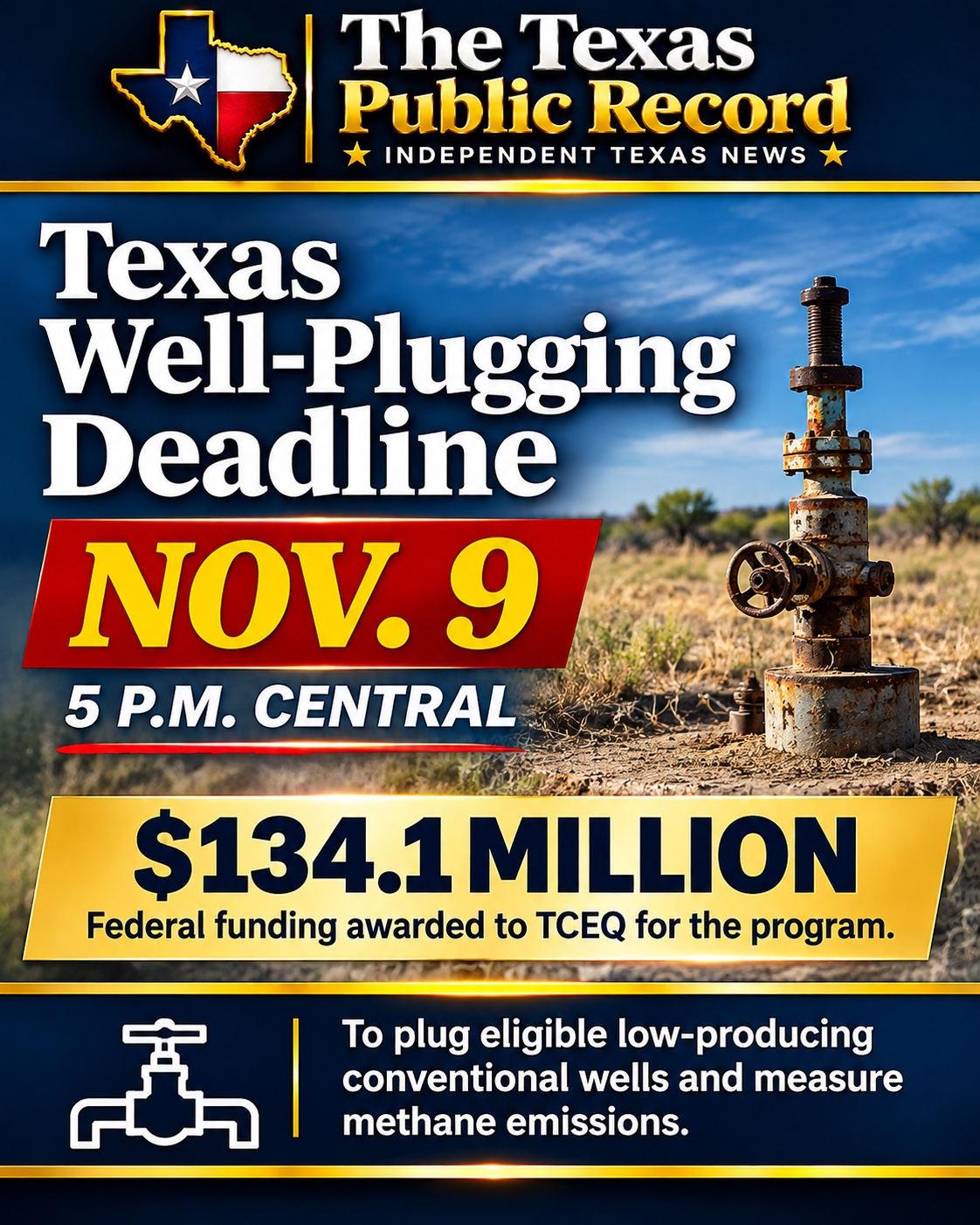
Texas oil and gas operators have until 5 p.m. Central on Monday, November 9, 2026, to apply for a state-administered program that will permanently plug eligible low-producing wells using federal funding.
The Texas Commission on Environmental Quality (TCEQ) received $134.1 million to establish the Texas Voluntary Marginal Conventional Well Plugging Program, which is designed to reduce methane emissions and other environmental risks associated with qualifying wells.
The application deadline marks the beginning of a longer accountability process. TCEQ must evaluate applications, determine which wells qualify, arrange plugging work and document the results.
For Texans, the central questions are which wells will receive publicly funded assistance, what the work will cost and whether the environmental benefits can be measured.
Which Texas wells qualify?
The program focuses on marginal conventional oil and gas wells—generally older, low-producing wells that meet specific federal and state eligibility requirements.
Under the program’s production criteria, qualifying wells generally must produce no more than:
- 15 barrels of oil equivalent per day, or
- 90 thousand cubic feet of natural gas per day.
Eligible wells must be onshore, have known operators and meet the program’s location, access and technical requirements.
Applicants also must satisfy applicable statutory and regulatory requirements, including Railroad Commission of Texas reporting obligations.
Not every low-producing well qualifies.
TCEQ excludes several categories, including horizontal, deviated, shale, tight-gas, orphaned and previously plugged wells. Additional restrictions apply to wells that have undergone previous plugging attempts.
An October 26 program addendum further clarified certain eligibility definitions.
These distinctions mean that production volume alone does not determine whether a well can participate.
How will the $134.1 million be spent?
TCEQ received the federal award through the Methane Emissions Reduction Program established under the Inflation Reduction Act.
The agency previously announced that more than $100 million would be available for plugging eligible wells.
However, the $134.1 million award is not an accounting of money already spent.
The award establishes program funding. It does not establish how much has been committed to individual projects, paid to contractors or used to complete plugging operations.
The program also does not provide unrestricted grants directly to participating operators.
Instead, TCEQ will arrange for contractors to perform approved plugging work.
Those contractors will carry out activities associated with well preparation, permanent plugging and methane measurement.
Operators must provide required information, enter into applicable agreements and allow authorized access to participating wells.
What expenses are excluded?
The federal program does not pay for every possible expense associated with a well site.
TCEQ excludes post-plugging environmental restoration, construction of new access roads and certain equipment-removal and maintenance expenses.
That distinction matters because permanently plugging a well is not necessarily equivalent to restoring the surrounding property.
The eventual public accounting should distinguish between funded plugging work, expenses outside the program and any environmental remediation that remains necessary.
Why does plugging these wells matter?
Low-producing oil and gas wells can present environmental risks when they are improperly maintained, deteriorating or no longer economically viable.
Methane emissions are a particular concern because methane is a potent greenhouse gas.
Depending on a well’s condition, additional concerns may include underground leakage, air pollution and fire hazards.
Permanently plugging a qualifying well can help address some of those risks.
But the environmental benefit cannot be established simply by counting the number of wells selected.
TCEQ’s program includes methane detection and measurement before and after plugging activities.
Those measurements are intended to document emissions associated with participating wells and changes following the work.
The actual benefit of any individual project will depend on its initial conditions and measured results.
How will TCEQ select participating wells?
Submitting an application does not guarantee selection.
TCEQ’s application solicitation establishes an evaluation and prioritization process for eligible wells.
The agency identifies factors such as production rates, available emissions information, the number of wells associated with an operator and potential environmental or human-health considerations.
The agency will use its criteria to rank qualifying applications and determine which projects advance.
That creates a public-accountability interest extending beyond Monday’s deadline.
Meaningful oversight will require records establishing which wells applied, which were selected, how much each project cost and what environmental outcomes were documented.
Those figures are not established by the federal award announcement alone.
How operators can apply before the deadline
TCEQ requires a separate application for each well.
Applicants must submit supporting documentation concerning the well, its regulatory records, eligibility and site access.
Applications must be received by 5 p.m. Central on November 9, 2026. Under the solicitation, late applications will not be considered for this grant round.
Official application instructions are available through TCEQ:
https://www.tceq.texas.gov/airquality/txmcw
TCEQ lists the following program contacts:
Email: TxMCW@tceq.texas.gov
Telephone: 512-239-4950
How this differs from Texas’ orphaned-well program
The voluntary marginal conventional well program is separate from the Railroad Commission of Texas’ orphaned-well plugging efforts.
That difference is important because the TCEQ program generally requires a known operator and excludes orphaned wells.
It is also separate from pending Railroad Commission rulemaking concerning plugging requirements.
The existence of those separate initiatives does not expand eligibility for this federal program or alter its published application requirements.
What happens after November 9?
After applications close, TCEQ must evaluate submissions and determine which eligible wells will participate.
Contractor assignments, plugging operations and methane measurements will follow for approved projects.
The public record reviewed for this article establishes the program’s funding, application deadline and operating framework.
It does not yet establish the final number of participating wells, total project expenditures or verified reductions in methane emissions.
The bottom line: Texas has federal funding to plug eligible low-producing wells, but the amount awarded is not a measure of completed work. The program’s success will depend on which wells are selected, how funds are spent and whether documented environmental improvements follow.
SOURCES
Verified through: November 9, 2026.
EDITORIAL NOTICE: This report reflects records and information available at publication. Allegations, charges, and disputed claims are not findings of wrongdoing. Submit documented correction or clarification requests by messaging The Texas Public Record on the platform where this article appears. Material errors will be corrected transparently.
The Texas Public Record
Rights. Accountability. Awareness.