Public Money & Accountability
Texas Audit Finds UnitedHealthcare Failed Medicaid Fraud-Investigation Requirements
State auditors identified widespread reporting deficiencies, incomplete investigations and questions involving $46.3 million in provider overpayment recoveries. The insurer disputes key findings.
AUSTIN, Texas — Texas auditors found that UnitedHealthcare failed to operate an effective system for investigating and reporting potential fraud, waste and abuse in its Medicaid and Children’s Health Insurance Program operations, identifying deficiencies in investigations, referrals, financial reporting and employee training.
The Texas Health and Human Services Office of Inspector General publicly announced the findings November 17, 2026. Its audit report, dated August 4, examined activities from September 1, 2023, through August 31, 2024.
The findings raise questions about how effectively UnitedHealthcare identified potential wrongdoing, investigated suspicious claims and supplied information to state regulators responsible for protecting public health care funds.
Among the findings:
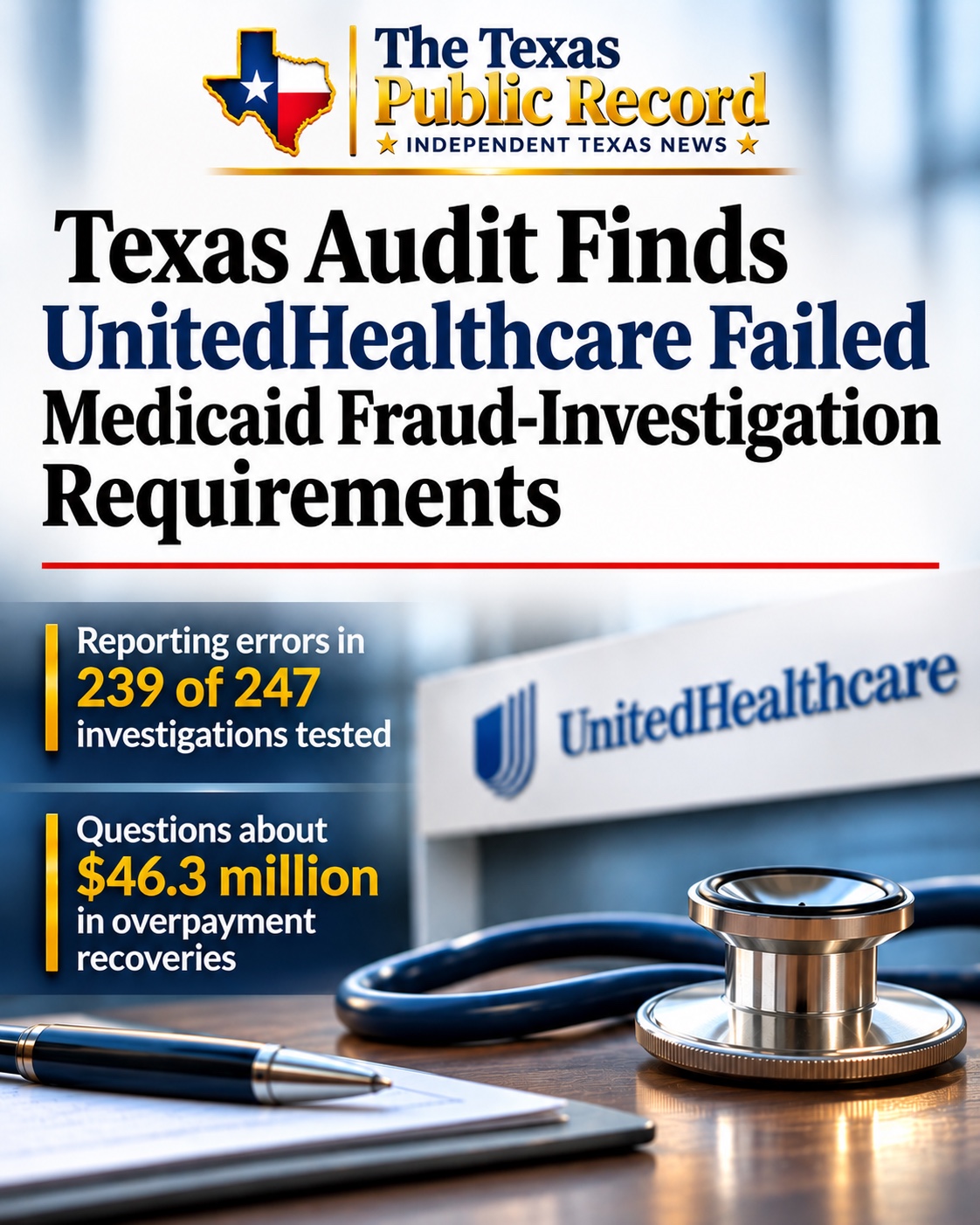
- Required reporting information was inaccurate or incomplete in 239 of 247 closed investigations tested.
- UnitedHealthcare could not demonstrate completion of required elements or timely completion in all 14 preliminary investigations tested.
- Eight of 10 expanded investigations tested failed minimum sampling requirements, while timely completion could not be demonstrated for any of the 10.
- The company could not adequately demonstrate why approximately $46.3 million in provider overpayment recoveries handled outside its special investigative unit had not been classified as possible fraud, waste or abuse.
The findings concern the insurer’s oversight systems. The audit did not establish that the $46.3 million was fraudulent, that UnitedHealthcare committed fraud or that patients experienced a specific amount of financial or medical harm.
UnitedHealthcare disputes important portions of the audit, including the state’s interpretation of requirements governing overpayment recoveries and special investigative unit responsibilities.
Billions in public funds depend on effective oversight
Texas contracts with managed care organizations to coordinate medical services for eligible Medicaid and CHIP members.
These insurers receive monthly payments from the state and are responsible for maintaining systems to detect and investigate potential fraud, waste and abuse.
The audit covered UnitedHealthcare Community Plan of Texas, L.L.C., and UnitedHealthcare Insurance Company, Inc., collectively identified as UnitedHealthcare in the report.
During fiscal 2024, UnitedHealthcare served an average of 355,676 Texas Medicaid and CHIP members.
Its reported financial activity included approximately $4.94 billion in capitation payments and $4.59 billion in paid claims.
UnitedHealthcare reported having one investigator dedicated to Texas Medicaid cases, with approximately 100 investigators working in Medicaid markets in other states who could assist with Texas investigations.
That staffing arrangement does not independently establish inadequate staffing. The auditors’ findings instead focus on whether the company’s investigative and reporting operations satisfied applicable requirements.
What auditors found involving $46.3 million
UnitedHealthcare reported recovering $46,471,679 in provider overpayments during fiscal 2024.
Of that amount, $194,141 originated from its special investigative unit, commonly called the SIU. The remaining $46,277,538 originated outside that unit.
Auditors found that UnitedHealthcare could not adequately demonstrate why those outside recoveries did not represent possible fraud, waste or abuse.
Examples identified in the report included:
- $1,427,886 involving services that did not occur.
- $3,467,140 involving duplicate services.
- $27,617,812 involving insufficient documentation to support billed services.
Such findings can indicate potential billing irregularities, but they do not automatically establish intentional fraud.
Fraud generally involves intentional deception or misrepresentation. Waste and abuse are distinct regulatory categories, and ordinary billing or documentation errors do not necessarily constitute fraud.
The auditors’ central concern was whether UnitedHealthcare had adequate procedures to recognize these differences, investigate potential wrongdoing and report matters requiring state oversight.
UnitedHealthcare challenged the finding in its formal management response.
The company argued that the audit relied on an unsupported interpretation that all provider overpayments must be treated as potential fraud, waste or abuse and that all such matters must be investigated by the SIU.
Auditors responded that the applicable managed care contract required an SIU to investigate possible fraud, waste or abuse involving services provided under the contract.
The OIG expressly stated that it had not concluded the approximately $46.5 million in total provider overpayment recoveries represented discoveries of fraud, waste or abuse.
The $46.3 million is money recovered from providers, not a finding that taxpayers lost that amount to fraud or that half of it is automatically owed to Texas.
Investigations failed required procedures and timelines
The audit identified problems with the investigations themselves, separate from the financial classification dispute.
For all 14 preliminary investigations tested, UnitedHealthcare could not demonstrate completion of required investigative elements or compliance with applicable completion deadlines.
In expanded investigations, eight of 10 tested cases failed minimum sample-size requirements.
Auditors also found that UnitedHealthcare could not demonstrate timely completion of any of the 10 expanded investigations tested.
Texas requirements call for preliminary reviews of relevant billing activity, program policies and provider education. Expanded investigations can require claims sampling, medical or dental record requests and review of supporting records within specified timeframes.
Without those procedures, investigators may be less able to determine whether suspicious claims represent errors, waste, abuse or possible fraud.
UnitedHealthcare acknowledged that some required elements were not completed in the investigations reviewed. However, the company disputed broader conclusions about its investigative effectiveness, noting that the audit used nonstatistical samples.
That limitation is important.
The auditors selected risk-based samples to examine particular compliance concerns. They expressly cautioned that those samples were not necessarily representative of all investigations and that the findings should not be projected across the entire population.
The results establish deficiencies in the cases tested. They do not establish that the same proportion of deficiencies occurred in every UnitedHealthcare investigation.
State regulators did not receive all required referrals
The OIG also found failures involving referrals of potential fraud, waste and abuse.
According to the report, UnitedHealthcare did not refer any of 45 pharmacy benefit manager SIU investigations to the OIG.
Auditors also identified missing referrals in 12 of 22 behavioral health investigations and five of 10 tested investigations involving overpayments.
The pharmacy benefit manager and behavioral health investigations involved subcontractors.
The audit further reported that UnitedHealthcare conducted 52 non-SIU waste and error investigations but referred only one to the OIG.
These findings matter because the state depends on referrals from managed care organizations to identify potential patterns of improper billing or misconduct across programs and providers.
An insurer may recover an overpayment without establishing fraud. But when information indicates possible fraud, waste or abuse, the applicable investigation and referral requirements become important safeguards.
Auditors concluded that UnitedHealthcare’s practices limited the OIG’s ability to identify and address such patterns.
Reporting deficiencies affected 239 investigations tested
The audit found inaccurate or incomplete required information in 239 of 247 closed investigations examined.
The reporting requirements include information about investigation status, overpayment determinations and recovery amounts.
Auditors also found that UnitedHealthcare had reported certain preventive provider-credentialing activities as SIU investigations even though those activities did not meet the requirements of an investigation.
UnitedHealthcare told auditors that it had misunderstood some reporting requirements and that its reporting processes did not retrieve all necessary information from its case-management system.
The company also identified records from other lines of business that had been incorrectly included in Texas Medicaid and CHIP reporting.
These problems have consequences beyond recordkeeping.
Incomplete or inaccurate information can make it harder for state officials to evaluate investigative activity, identify potential wrongdoing and determine whether recoveries are being handled appropriately.
The 239-of-247 finding concerns the investigations examined by auditors and should not be interpreted as an independently established failure rate across every investigation conducted by UnitedHealthcare.
CHIP investigations had separate compliance problems
The audit also found that UnitedHealthcare did not conduct CHIP-specific investigative activities during fiscal 2024.
Although CHIP claims and members were not necessarily excluded from broader investigations, auditors found that UnitedHealthcare lacked a process ensuring compliance with CHIP’s separate requirements.
One difference involves investigation sampling.
The report identifies a minimum sample of 30 Medicaid members for certain investigations, compared with 50 members for CHIP investigations.
Auditors reported that UnitedHealthcare’s SIU case-management system could not distinguish between Medicaid and CHIP.
UnitedHealthcare disputed the conclusion that no adequate CHIP process existed, stating that its investigations included both programs when applicable. The company nevertheless acknowledged the different sampling requirements.
UnitedHealthcare reported enhancing procedures to distinguish CHIP sampling requirements and identified September 1, 2026, as its target for completing associated training.
The audit does not independently establish that state regulators subsequently verified those improvements.
Auditors identify $48,410.50 not remitted in 2024
A separate financial finding involved recoveries that UnitedHealthcare had already classified and reported as fraud and abuse recoveries.
For fiscal 2024, UnitedHealthcare reported collecting $96,821 in those recoveries.
Under the requirements cited by auditors, 50 percent of qualifying fraud and abuse recoveries must be remitted to the OIG.
Auditors found that UnitedHealthcare had not remitted the $48,410.50 due from those reported collections during fiscal 2024.
The report separately states that UnitedHealthcare subcontractor Optum Behavioral Health remitted $19,853.50 associated with behavioral health investigations in 2025.
These figures concern different reported recovery activities and should not be combined or treated as interchangeable.
The report does not establish whether UnitedHealthcare subsequently remitted the outstanding $48,410.50.
That remains an unresolved accountability question.
Employee training did not meet all job-specific requirements
Texas requires managed care organizations to provide fraud, waste and abuse training to relevant employees and subcontractors.
The training must address responsibilities associated with particular job functions, rather than relying exclusively on general instruction.
Auditors found that UnitedHealthcare provided general training and tailored instruction for claims-processing personnel but did not provide all required job-specific training for employees in other functions.
Those functions included data collection, provider enrollment, encounter data, utilization review, quality assurance and marketing.
UnitedHealthcare acknowledged the finding and described plans to expand its training materials.
The company identified September 30, 2026, as the target implementation date.
The available audit does not establish whether the OIG subsequently confirmed completion.
UnitedHealthcare disputes findings and describes corrective actions
UnitedHealthcare’s responses, included in the final audit, present a combination of disagreement, acknowledgment and proposed corrective measures.
The insurer challenged the state’s interpretation of requirements involving overpayments recovered outside its SIU.
It also disputed broader conclusions drawn from nonstatistical investigation samples while acknowledging that some required investigative elements were incomplete.
UnitedHealthcare reported updating procedures, documentation and case-tracking systems and providing additional employee instruction.
The company identified July 1, 2026, as the implementation date for certain investigative improvements, September 1 for CHIP-related training and September 30 for expanded job-specific training.
For its broader plan to improve classification, reporting and referral procedures, UnitedHealthcare declined to identify a responsible manager or target implementation date in the audit response.
These statements establish the company’s reported actions and plans. They do not independently prove that all deficiencies have been corrected or that state regulators have accepted the remedies as sufficient.
What happens next?
The OIG issued six numbered recommendations, with separate components addressing referrals, investigations, CHIP requirements, investigative procedures, recoveries and training.
The report states that identified compliance issues may be subject to contractual financial remedies or administrative enforcement.
It does not establish that such measures were imposed.
Three questions remain central to determining the outcome:
First, has UnitedHealthcare completed the corrective actions described in its responses, and has the OIG verified their effectiveness?
Second, has the company remitted the $48,410.50 identified as due for fiscal 2024?
Third, have state regulators taken additional enforcement or contractual action arising from the audit?
The official records examined for this article do not conclusively answer those questions.
For Texans, the larger issue is whether the private companies administering publicly funded health care maintain reliable systems for detecting possible misconduct and reporting it to the state.
The audit establishes significant deficiencies in UnitedHealthcare’s oversight operations during the period examined. It does not establish that all those deficiencies continue today.
The distinction is essential: accountability requires identifying documented failures, determining whether corrective actions worked and making the results available to the public.
Sources
- Texas HHS Office of Inspector General — Public announcement, November 17, 2026
- Texas HHS Office of Inspector General — Audit AUD-26-029, August 4, 2026, including UnitedHealthcare management responses
Reporting status: Official audit findings and management responses verified against the cited records. Subsequent enforcement, remittance and corrective-action acceptance remain unverified.
The Texas Public Record
Rights. Accountability. Awareness.