

Rights & Justice | Texas Transportation
I-10 Leads Texas Highways in 2024 Highway Patrol Citation Analysis
A Texas Public Record analysis of more than 4.6 million DPS violation records identifies Interstate 10 as the leading highway for citation-bearing tickets under a documented roadway-classification method.
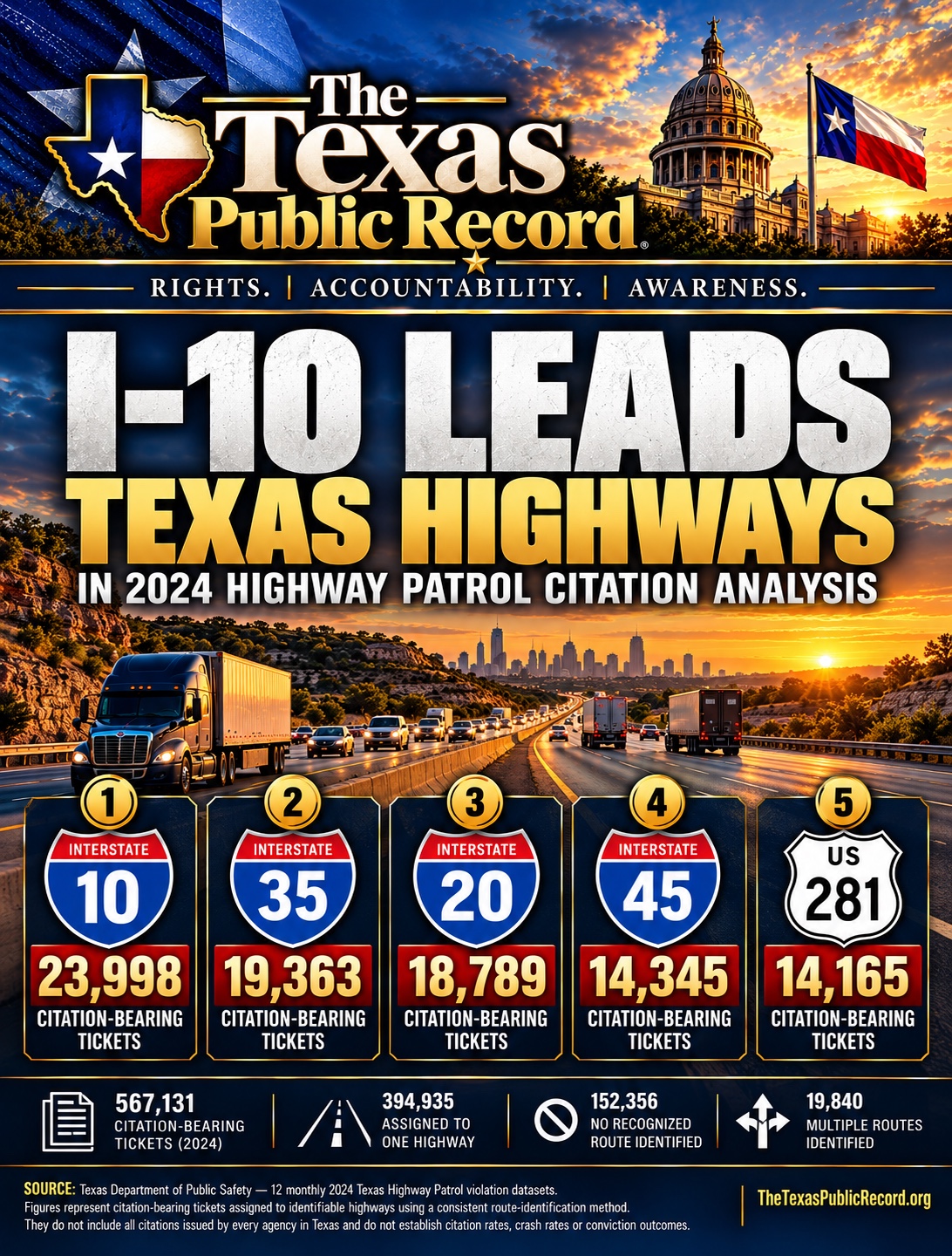
AUSTIN, Texas — Interstate 10 recorded more citation-bearing tickets than any other highway identified in an analysis of Texas Highway Patrol’s 2024 enforcement records.
The Texas Public Record examined 12 monthly violation datasets from the Texas Department of Public Safety, covering January through December 2024.
The files contained 4,623,857 violation records, including 843,706 entries classified as citations and 3,555,726 classified as warnings.
Because a single ticket can contain multiple violations, those entries do not represent an equivalent number of separate tickets.
After identifying distinct ticket numbers associated with at least one citation, the analysis found 567,131 citation-bearing tickets.
The next step was determining which highways those tickets could be assigned to reliably.
The highways with the most citation-bearing tickets
Under the analysis’s roadway-classification method, the 10 leading highways were:
| Rank | Highway | Citation-bearing tickets |
|---|---|---|
| 1 | Interstate 10 | 23,998 |
| 2 | Interstate 35 | 19,363 |
| 3 | Interstate 20 | 18,789 |
| 4 | Interstate 45 | 14,345 |
| 5 | U.S. Highway 281 | 14,165 |
| 6 | U.S. Highway 77 | 9,799 |
| 7 | U.S. Highway 59 | 9,616 |
| 8 | U.S. Highway 181 | 9,062 |
| 9 | U.S. Highway 83 | 8,300 |
| 10 | Interstate 69 | 7,769 |
I-10 exceeded I-35 by 4,635 tickets and I-20 by 5,209.
The figures represent tickets associated with identifiable highways in DPS’s records. They do not include citations issued by every municipal police department, county sheriff’s office or other law enforcement agency in Texas.
Why the records require careful counting
The DPS datasets contain individual violation entries.
A driver receiving a ticket involving multiple alleged violations can appear in more than one row under the same ticket number.
Simply counting citation rows would therefore overstate the number of separate citation-bearing tickets.
To address that problem, The Texas Public Record counted each distinct ticket number containing at least one citation entry once.
Warnings were not counted as separate citations. A ticket containing both warning and citation entries remained eligible because it included a citation.
The resulting 567,131-ticket total provides the starting point for the highway comparison.
How highway locations were classified
DPS records include roadway descriptions that are not always formatted consistently.
Some identify a highway directly. Others include direction of travel, mile markers, intersections, exits or additional road names.
The analysis standardized recognizable interstate, U.S. highway, state highway and farm-to-market road designations.
For I-35, the analysis combined I-35E and I-35W with the broader I-35 designation. The parser also groups recognized I-69 branch designations under I-69.
Each citation-bearing ticket was evaluated using the route description from its first citation entry encountered in the monthly files.
The classification produced three groups:
| Classification | Tickets |
|---|---|
| Assigned to one recognized route | 394,935 |
| No recognized route identified | 152,356 |
| Multiple distinct routes identified | 19,840 |
| Total | 567,131 |
Tickets with no recognized highway designation were excluded from the highway ranking.
Tickets naming multiple distinct recognized highways were also excluded rather than arbitrarily assigning them to one roadway. This can include descriptions mentioning another highway at an intersection or exit.
That conservative approach reduces the risk of misattributing a ticket, although it also means the ranking does not capture every ticket associated with a particular highway. Recognition depends on the parser’s supported route formats; it is not a manual verification of every roadway location.
The roadway descriptions can include frontage roads and service roads. Consequently, the figures should not be interpreted as counts restricted to interstate mainlanes.
What the findings establish
The central finding is that I-10 recorded the largest number of citation-bearing tickets among highways identified through this classification method in the 2024 Texas Highway Patrol records.
The analysis also places I-35 and I-20 second and third, followed by I-45 and U.S. 281.
The findings describe recorded enforcement activity, not the relative danger of traveling on those highways.
They do not establish which highway had the highest number of citations per vehicle, which had the greatest percentage of speeding drivers or where an individual motorist was most likely to receive a ticket.
The records also do not establish whether every citation resulted in a conviction, dismissal or payment of a fine.
Those questions require different records and additional analysis.
Why the findings matter
Texas Highway Patrol operates across a highway network connecting major cities, rural communities and interstate commerce.
Understanding where its citations were recorded provides a measurable picture of enforcement activity.
The statewide datasets also offer opportunities to examine which violations were most commonly cited on individual highways and how enforcement varied by county.
For now, the clearest finding is the roadway ranking itself.
I-10 led the analyzed DPS highway records in 2024, with 23,998 citation-bearing tickets under the documented classification method.
Sources
Texas Department of Public Safety — Texas Highway Patrol monthly violation datasets, January–December 2024:
https://www.dps.texas.gov/section/highway-patrol/texas-highway-patrol-high-value-data-sets
The Texas Public Record — Independent analysis of the 12 monthly DPS files, including ticket-number deduplication and roadway classification. The verification script and results are available below.
Methodology
The analysis counted unique ticket numbers containing at least one citation entry. It assigned each ticket using the first encountered citation entry’s Route field, standardized recognized highway designations and excluded descriptions containing multiple distinct recognized routes.
The resulting figures are analytical counts derived from DPS records, not separately published DPS highway rankings. Citation-bearing ticket numbers are not interchangeable with the separately defined citation-stop counts in DPS’s annual traffic-stop report.
Verification date: October 28, 2026.
EDITORIAL NOTICE: This report reflects records and information available at publication. Allegations, charges, and disputed claims are not findings of wrongdoing. Submit documented correction or clarification requests through The Texas Public Record’s corrections page. Material errors will be corrected transparently.
The Texas Public Record
Rights. Accountability. Awareness.
The record doesn’t blink. Keep your eyes on Texas.
Analysis records: verification script (Python) · results and source-file list (JSON excerpt)