Public Money & Accountability | Public Services & Infrastructure
Dallas ISD Agrees to $1 Million Federal Settlement and Three Years of Student-Safety Reforms
Federal prosecutors allege the district failed to make required educator-misconduct reports while receiving special education funding. The agreement imposes new spending, reporting, training and oversight requirements, but Dallas ISD denies the allegations.
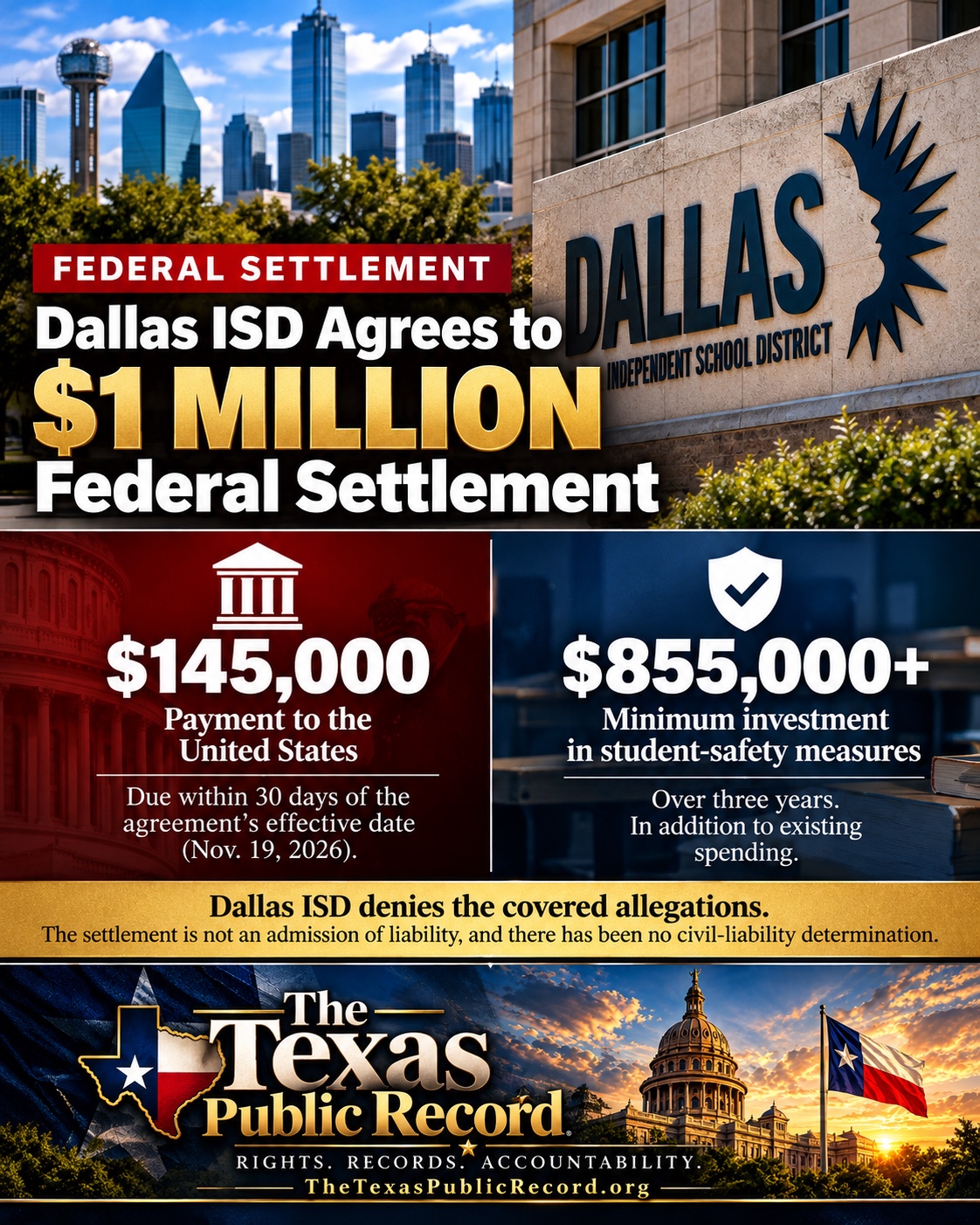
DALLAS, Texas — A federal investigation into how Dallas Independent School District handled allegations of educator sexual misconduct has ended in a $1 million settlement that will require the district to change its reporting procedures, review years of past allegations and invest additional money in student safety.
The agreement, announced October 20 by the U.S. Department of Justice, follows allegations that Dallas ISD failed to comply with Texas educator-reporting requirements while certifying compliance with state and federal law to receive federal special education funding.
The settlement does not establish that Dallas ISD committed civil fraud or violated the law. The district expressly denies the federal allegations.
But the obligations it accepted are binding.
Over the next three years, Dallas ISD must spend at least $855,000 beyond its existing student-safety expenditures, strengthen coordination with outside law enforcement, implement new disclosure and reporting procedures, and examine its handling of educator sexual-misconduct allegations dating back to 2022.
The district must also pay $145,000 to the United States.
Together, those obligations make up the $1 million settlement.
Four investigations and a dispute over reporting requirements
At the center of the federal case is Michael Roell, also known as Johnathan Michael, a former Dallas ISD special education teacher.
According to the executed settlement agreement, Dallas ISD opened four separate investigations during or following Roell’s employment after receiving allegations of sexual misconduct involving minors.
Federal prosecutors contend that the district failed to report information about those allegations to the State Board for Educator Certification, the state body responsible for educator credentials and disciplinary matters.
The Justice Department alleges that Dallas ISD relied on its internal investigative procedures, including Title IX determinations, when deciding whether allegations warranted reporting.
That distinction became central to the federal case.
Title IX investigations and state educator-misconduct reporting serve different legal purposes. A determination that conduct was not established under one investigative process does not necessarily resolve whether a separate reporting obligation exists.
The federal government contends Dallas ISD improperly treated internal findings as grounds for withholding reports that Texas law required.
The agreement identifies April 1, 2024, when Roell submitted notice of his intent to resign, as a consequential date. Federal prosecutors contend that the resignation triggered a reporting obligation under the law then in effect.
Dallas ISD accepted his resignation and placed him on an internal list prohibiting his rehiring by the district.
An internal restriction, however, is not the same as a report to the state educator-certification system.
The Justice Department says Roell subsequently worked in Plano ISD and Forney ISD. He later faced state charges involving alleged child abuse and grooming, and a federal grand jury indicted him in September 2026 on wire-fraud allegations related to obtaining a teaching position.
Those criminal allegations are separate from the civil settlement. An indictment or criminal charge does not establish guilt.
The federal agreement also records important limitations in the earlier history. Roell was acquitted by a jury of state charges arising from a 2016 allegation during his Garland ISD employment. That arrest was subsequently expunged. When he reapplied to Dallas ISD in 2022, he disclosed his prior Garland termination, and Dallas ISD confirmed that his state educator credentials remained intact.
The settlement further documents that Dallas ISD’s Professional Standards Office referred one September 2023 allegation to the Dallas ISD Police Department and the Texas Department of Family and Protective Services. The district police department determined that the alleged conduct fell outside its jurisdiction, while the state agency determined that the allegation was outside its investigative authority.
The federal dispute therefore is not accurately described as a case in which no agency was ever contacted. It concerns whether Dallas ISD fulfilled its specific state reporting obligations and adequately coordinated with outside authorities.
What the $1 million settlement actually requires
The agreement divides the financial obligation into two distinct components.
Dallas ISD must pay $145,000 to the United States within 30 days of the agreement’s October 20 effective date. That makes November 19, 2026, the contractual deadline.
The remaining $855,000 is not a payment to the federal government.
Instead, Dallas ISD must invest at least that amount in additional student-safety measures over the three-year agreement period.
The settlement expressly requires this spending to be above what the district already spends on student safety.
Eligible investments include additional investigative and human-resources personnel, expanded background checks, training, education and software intended to improve the detection, investigation and reporting of abuse, neglect and educator misconduct.
The agreement also requires a district self-audit, which may be funded from the $855,000 commitment.
That distinction matters for public accountability. The settlement establishes both a federal payment and a minimum new spending obligation. It does not establish that the district has already spent the money or completed the required reforms.
Dallas ISD must review allegations dating back to 2022
One of the agreement’s most consequential provisions reaches beyond the investigations described in the federal case.
Dallas ISD must conduct a self-audit of educator sexual-misconduct allegations from 2022 to the present, examining compliance with the reporting laws applicable to those cases.
The district must submit its findings to the Texas Education Agency within one year of the settlement’s effective date, establishing an October 20, 2027, deadline.
The review will require Dallas ISD to examine its own past handling of allegations under both the former Texas Education Code Section 21.006 and the reporting framework subsequently established in Chapter 22A.
Those laws cannot be treated as interchangeable.
During the period central to the federal allegations, former Section 21.006 permitted districts to investigate certain allegations before determining whether a report was required. Under specified circumstances, a superintendent could determine that an educator had not engaged in the alleged misconduct and that no report was necessary.
The law changed in 2025.
Chapter 22A introduced earlier reporting triggers and reduced the discretion districts previously had to complete an investigation before making an initial report.
The audit must therefore account for which legal requirements applied when each allegation arose.
New reporting procedures and outside law-enforcement coordination
The settlement also requires substantial changes to Dallas ISD’s procedures going forward.
Within 90 days of October 20, the district must contact outside law-enforcement agencies serving its campuses and, where appropriate, the Texas Rangers to pursue formal agreements defining responsibilities, notification triggers, information-sharing expectations and joint responses to student-safety allegations.
The requirement specifically addresses agencies outside the Dallas ISD Police Department.
The agreement recognizes that Dallas ISD cannot force another agency to sign a memorandum of understanding. Its obligation is to make the required contacts and take good-faith steps toward formalizing those arrangements.
Dallas ISD must also report mandatory-reporting events arising under Texas Education Code Chapter 22A to the Dallas Police Department.
Other required measures include a districtwide civil-liability disclosure form for people beginning work involving student contact, posted notices explaining child-abuse reporting obligations, and standardized checklists for administrators responding to reports of abuse.
Title IX decision-makers, Professional Standards Office investigators, human-resources personnel and the district’s Title IX coordinator must receive mandatory instruction on educator-misconduct reporting.
The training must include annual refreshers, documented attendance, assessments of understanding and periodic compliance audits.
These requirements are intended to address a central concern raised by the federal investigation: whether information about alleged misconduct can move through a district’s internal procedures without reaching the authorities responsible for statewide educator oversight.
Federal grant money faces additional restrictions
The settlement also contains a separate public-money safeguard.
Dallas ISD must identify and account for certain costs associated with the federal investigation, its defense, settlement negotiations and the settlement payment itself.
Under the agreement, those designated costs cannot be charged directly or indirectly to federal awards.
Within 90 days, the district must also identify and repay any such prohibited costs previously included in requests for federal payment, if any exist.
The agreement does not establish that Dallas ISD improperly charged those expenses. It creates an accounting obligation and preserves federal authorities’ ability to review the district’s calculations.
Dallas ISD disputes the government’s allegations
The district has not admitted civil wrongdoing.
The executed settlement expressly states that Dallas ISD denies the conduct alleged by the United States. It also makes clear that federal prosecutors have not withdrawn their allegations.
In a statement reported by KERA, Dallas ISD said it could not corroborate the allegations against its former teacher and disputed the federal government’s interpretation of the applicable reporting law.
The district nevertheless acknowledged a shared objective of protecting students and ensuring their safety.
The Justice Department similarly states that the settlement resolves allegations rather than an adjudicated finding of civil liability.
Those distinctions do not eliminate the district’s new obligations. They define what the settlement establishes and what remains disputed.
The next test is compliance
The agreement took effect October 20, 2026, when the final party signed it.
Its principal checkpoints are now established.
The $145,000 federal payment is due November 19, 2026. The initial 90-day requirements, including specified training, disclosures and reporting procedures, fall due January 18, 2027. The historical self-audit report to the Texas Education Agency is due October 20, 2027.
The three-year compliance period runs through October 20, 2029.
Whether Dallas ISD meets those deadlines, how it documents the additional spending and what its review of past allegations finds will determine what the agreement accomplishes beyond the federal announcement.
For families, educators and taxpayers, the central question is no longer simply why federal prosecutors challenged the district’s past decisions.
It is whether the reporting safeguards now required by the settlement will operate when the next allegation reaches a school administrator.
The agreement sets the obligations. Their implementation remains to be demonstrated.
Sources
- U.S. Department of Justice — Northern District of Texas: Project Safe Schools investigation uncovers reporting failures at Dallas ISD, leading to $1 million settlement. October 20, 2026.
- U.S. Department of Justice — executed settlement agreement, United States and Dallas ISD; effective October 20, 2026. Recitals A–F; Terms and Conditions, Paragraphs 1–2, 7 and 18.
- KERA, via KETR — Dallas ISD to pay $1 million settlement tied to former teacher accused of sexual abuse. October 21, 2026; district response.
Verification date: October 22, 2026.
EDITORIAL NOTICE: This report reflects records and information available at publication. Allegations, charges, and disputed claims are not findings of wrongdoing. Submit documented correction or clarification requests. Material errors will be corrected transparently.
The Texas Public Record
Rights. Accountability. Awareness.
The record doesn’t blink. Keep your eyes on Texas.