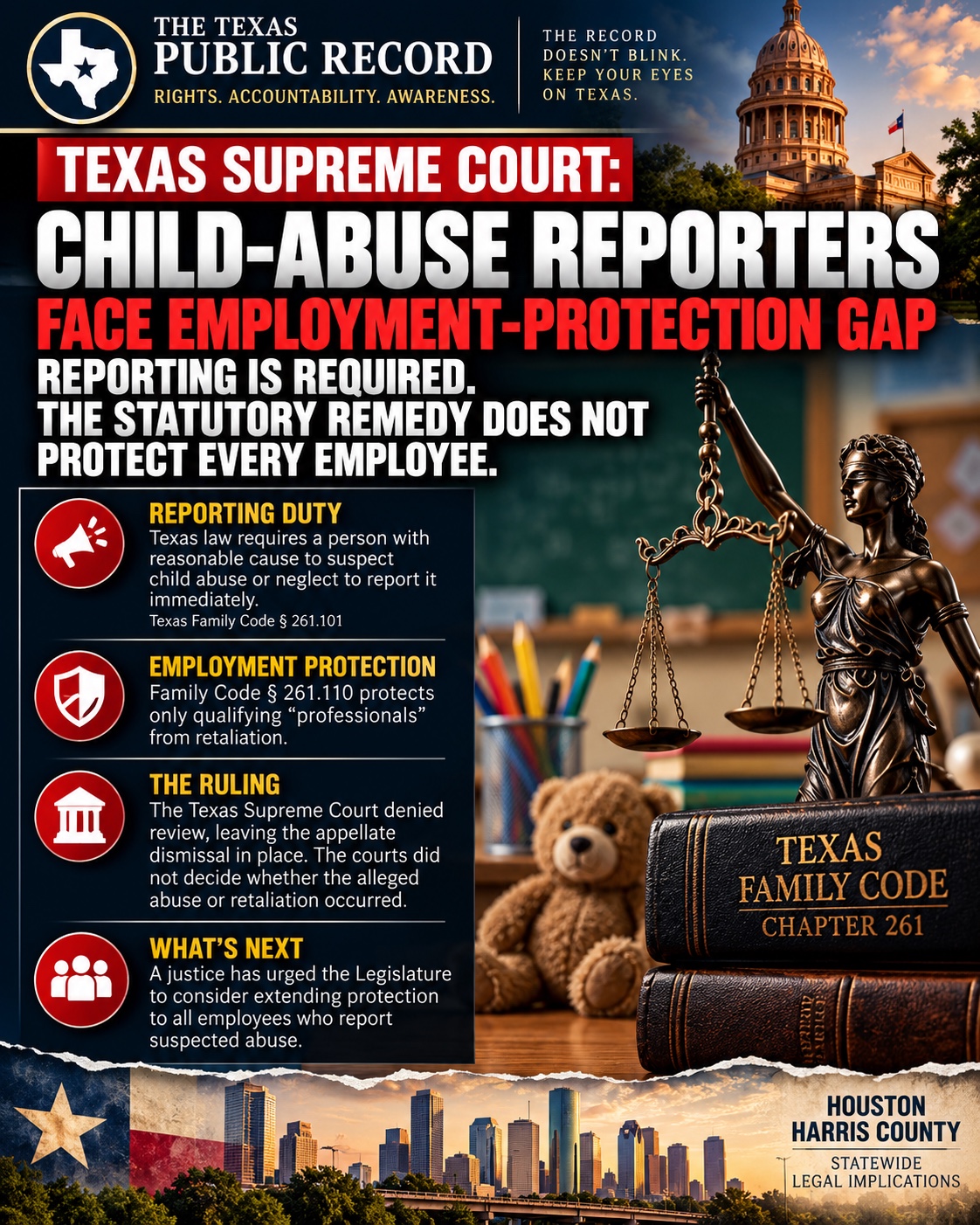
Supplied TPR illustration; not a photograph of the parties or proceedings. Select to view full size.
Texas law requires a person with reasonable cause to believe that a child’s physical or mental health or welfare has been adversely affected by abuse or neglect to report it immediately. Knowingly failing to make a required report can carry criminal penalties, subject to the elements and classifications set out in the statute.
But the law does not extend the specific employment-retaliation remedy in Family Code §261.110 to every employee who fulfills that reporting obligation.
That distinction came into focus Friday when the Texas Supreme Court denied review in a Houston charter-school employment dispute. A former employee alleged she was fired after reporting suspected child abuse involving the school’s founder and chief executive officer.
The appellate court dismissed her statutory retaliation claim because it concluded that she did not qualify as a protected professional under the applicable Family Code definition.
The Supreme Court left that judgment in place by denying review. It did not issue a merits opinion independently adopting every aspect of the appellate court’s reasoning.
Justice Debra Lehrmann separately identified a broader concern: Texas imposes reporting duties on persons covered by Family Code §261.101, while the particular employment-retaliation remedy in §261.110 is limited to qualifying professionals.
She urged lawmakers to consider whether that statutory coverage should be expanded.
The case raises a consequential question for Texas employees who work around children: What protection exists when an employee complies with a legal reporting duty but falls outside §261.110’s definition of a professional?
THE HOUSTON CASE
Kimberley Richards formerly served as director of operations at Houston Classical Charter School, an open-enrollment charter school serving kindergarten through eighth grade.
According to the appellate opinion, Richards alleged that she reported suspected child abuse involving the school’s founder and CEO, Deyvis Salazar. She further alleged that she was subsequently terminated because she made the report.
Richards sued Houston Classical under Texas Family Code §261.110. That section prohibits specified retaliatory employment actions against a professional who, in good faith, reports child abuse or neglect under Chapter 261 or initiates or cooperates with a governmental investigation or proceeding relating to a report.
Houston Classical challenged the trial court’s jurisdiction. The school argued that Richards did not meet the statutory definition of a professional and therefore could not invoke §261.110’s waiver of governmental immunity.
The trial court denied that jurisdictional challenge. Houston Classical appealed.
On October 28, 2025, the Fourteenth Court of Appeals reversed the trial court’s order and rendered judgment dismissing Richards’s claim for lack of subject-matter jurisdiction. Richards sought review from the Texas Supreme Court.
On September 25, 2026, the Supreme Court denied her petition.
Neither the appellate judgment nor the Supreme Court’s denial determined whether the alleged abuse or retaliation occurred. The appellate dismissal turned on statutory coverage and the resulting jurisdictional consequences of governmental immunity, not on a factual determination of the underlying allegations.
WHY THE APPELLATE COURT SAID RICHARDS WAS NOT A PROTECTED PROFESSIONAL
Family Code §261.101(b) addresses professionals who have reasonable cause to believe a child has been abused or neglected. The definition includes a person licensed or certified by the state who, in the ordinary course of duties, has direct contact with children. It also includes an employee of a facility licensed, certified or operated by the state who has that direct contact.
The parties did not dispute that Richards lacked the individual state licensing or certification necessary to satisfy the first part of that definition. Her claim therefore depended on whether Houston Classical qualified as a facility licensed, certified or operated by the state and whether the remaining requirements were met.
Richards argued that the school’s public status brought it within the statute. The appellate court disagreed.
Open-enrollment charter schools are part of Texas’s public-school system and receive governmental immunity under applicable law. Those facts, however, do not necessarily make a charter school a facility “licensed, certified, or operated by the state” for purposes of §261.101(b).
The court explained that open-enrollment charter schools operate under charters issued through contracts with the Commissioner of Education, rather than through the type of license or certification identified in the statute. Although the state provides funding and regulatory oversight, the appellate court concluded that the state does not thereby operate the charter school in the statutory sense.
Because the facility requirement was not satisfied, the court did not decide whether Richards’s duties involved sufficient direct contact with children. It also rejected the argument that other reporting requirements applicable to school employees expanded the Family Code’s definition of professional.
A broader reporting duty does not, by itself, expand the class of employees entitled to sue under §261.110.
WHY GOVERNMENTAL IMMUNITY MATTERED
The case was not simply a dispute over the meaning of an employment-protection statute. It also involved governmental immunity.
Texas law provides an open-enrollment charter school with immunity from liability and suit to the same extent as a school district, subject to the statutory framework governing charter schools and any applicable waiver. Governmental immunity generally protects governmental entities from suit and liability unless the Legislature has waived that immunity.
Family Code §261.110 contains an express waiver of immunity to the extent of liability created by that section. That waiver is limited by the statute’s substantive requirements. It does not create a cause of action for a person who does not qualify for the protection provided by §261.110.
The appellate court therefore dismissed the claim for lack of subject-matter jurisdiction. It did not find that Houston Classical lawfully terminated Richards, that retaliation occurred, or that the suspected abuse occurred.
THE REPORTING DUTY IS BROADER THAN THE RETALIATION REMEDY
Texas Family Code §261.101(a) requires a person who has reasonable cause to believe that a child’s physical or mental health or welfare has been adversely affected by abuse or neglect to immediately make a report. The general duty applies to a “person,” not only to a licensed professional.
Section 261.101(b) separately addresses professionals and imposes a corresponding reporting duty subject to the statutory definition. Section 261.109 establishes criminal consequences for knowingly failing to make a required report. The offense is generally a Class A misdemeanor, but the statute provides for a state-jail felony in specified circumstances. The precise classification depends on the facts and statutory elements.
Section 261.110 addresses a different issue: employment retaliation. It prohibits an employer from suspending, terminating or discriminating against a qualifying professional who, in good faith, reports child abuse or neglect or participates in a related governmental investigation or proceeding. It provides a civil cause of action and specified relief.
The mismatch is straightforward: the reporting obligation in §261.101(a) applies more broadly than the particular employment remedy in §261.110.
An employee may have a legal duty to report suspected abuse without qualifying for the specific retaliation protection in §261.110. That does not mean the employee necessarily lacks every possible legal remedy. It means this particular statutory remedy has eligibility requirements that the general reporting duty does not.
WHAT JUSTICE LEHRMANN SAID
Justice Lehrmann agreed with the Supreme Court’s decision to deny review. She did not decide the merits of Richards’s individual claim or hold that Richards was entitled to relief under another legal theory.
Instead, she examined the broader relationship between the reporting duty and the statutory employment remedy. Her concern was that Texas imposes reporting obligations on persons covered by §261.101, with criminal penalties for knowingly failing to make a required report, while §261.110 provides its specific employment-retaliation remedy only to qualifying professionals.
Lehrmann acknowledged that the Legislature has authority to define the scope of statutory causes of action. She nevertheless urged lawmakers to consider whether the employment remedy should extend to employees who comply with a legal duty to report child abuse and subsequently experience retaliation, even if they do not satisfy the statutory definition of a professional.
Her recommendation is not a new legal rule. The concurrence represents one justice’s analysis. The Supreme Court did not amend the Family Code, expand the statutory definition of professional or establish a new cause of action.
COULD TEXAS COMMON LAW PROVIDE ANOTHER REMEDY?
Lehrmann also addressed an unresolved question involving Texas’s employment-at-will doctrine. One narrow exception comes from Sabine Pilot Service, Inc. v. Hauck. It recognizes a wrongful-discharge claim when an employee is terminated solely for refusing to perform an illegal act.
The doctrine is narrow. It generally requires proof that the employee was the sole source of the employer’s obligation to perform the illegal act, that the employee refused to perform it, that the employer discharged the employee, and that the discharge was solely because of that refusal.
The Texas Supreme Court has recognized that the doctrine may apply when an employee refuses to remain silent and the failure to report would itself constitute a crime. That does not mean every employee who makes a report automatically has a Sabine Pilot claim.
Richards alleged she was terminated because she complied with her reporting duty. She did not allege that her employer first expressly instructed her to violate that duty. Lehrmann discussed whether the Sabine Pilot principle might extend to a discharge for making a legally required report without an express instruction to violate the law.
Richards had not pleaded a Sabine Pilot claim, so the Supreme Court did not decide that issue. Lehrmann expressed no definitive view. The question remains unresolved.
WHAT ABOUT THE TEXAS WHISTLEBLOWER ACT?
Government Code chapter 554 protects a public employee who reports in good faith a violation of law by the employing governmental entity or another public employee to an appropriate law-enforcement authority. The Act contains specific definitions, reporting-authority requirements, causation standards and grievance or appeal procedures.
A report to an employer, supervisor or regulatory body is not automatically a report to an “appropriate law-enforcement authority” under chapter 554. Richards did not assert a claim under the Texas Whistleblower Act. Lehrmann did not decide whether it would apply.
The Act therefore cannot be treated as an established remedy in this case. Its application elsewhere requires a separate analysis of employee status, the reported legal violation, recipient, causation and procedural requirements.
WHAT THE SUPREME COURT ACTUALLY DECIDED
The Supreme Court denied Richards’s petition for review. That leaves the Fourteenth Court of Appeals’ judgment in place.
The denial does not constitute a Supreme Court merits opinion adopting every aspect of the appellate court’s reasoning. Lehrmann’s concurrence separately identifies the reporting-duty and employment-protection mismatch, recommends legislative consideration and discusses a possible common-law question. Those observations are not holdings of the full court.
The statutory framework remains unchanged by the September 25 action.
WHAT THE RULING MEANS FOR TEXAS EMPLOYEES
Employees who work around children may be legally required to report suspected abuse under §261.101(a) even when their positions do not satisfy §261.101(b)’s professional definition.
Whether a particular employee qualifies for §261.110 protection depends on the statutory requirements and the circumstances of employment and reporting. The ruling does not establish that every charter-school employee is excluded, nor that employees outside §261.110 necessarily lack protection under every other law.
What the appellate court decided is narrower: Richards did not qualify for the statutory remedy she asserted, and the associated waiver of Houston Classical’s governmental immunity did not apply.
Lehrmann’s concurrence identifies the broader policy question that remains. Texas imposes a broad reporting duty under Family Code §261.101(a), while the specific retaliation remedy in Family Code §261.110 protects a narrower class of employees. The statute has not changed.
THE RECEIPTS
THE RECORD: Kimberley Richards v. Houston Classical, Inc., No. 25-1072, Supreme Court of Texas; and Houston Classical, Inc. v. Richards, No. 14-24-00696-CV, Fourteenth Court of Appeals.
THE REPORTING DUTY: Family Code §261.101(a) generally requires a person with reasonable cause to believe that a child’s physical or mental health or welfare has been adversely affected by abuse or neglect to report it immediately.
THE EMPLOYMENT REMEDY: Family Code §261.110 establishes specified retaliation protections and a civil cause of action for qualifying professionals. It does not extend that statutory cause of action to every person covered by §261.101(a).
THE APPELLATE RULING: The Fourteenth Court of Appeals concluded that Houston Classical did not qualify as a facility licensed, certified or operated by the state under the relevant statutory definition. Because Richards therefore did not qualify as a professional under §261.101(b), the court held that she could not proceed under §261.110.
WHAT THE RECORD PROVES: Richards’s statutory claim was dismissed for lack of subject-matter jurisdiction, and the Supreme Court declined to review that judgment.
WHAT IT DOES NOT PROVE: That the alleged abuse occurred, that retaliation occurred, or that the allegations were false.
THE UNRESOLVED COMMON-LAW QUESTION: Whether a properly pleaded Sabine Pilot wrongful-discharge claim could apply when an employee allegedly loses employment for making a legally required report without first receiving an express instruction to violate the law.
THE LEGISLATIVE QUESTION: Whether the specific employment-retaliation remedy should extend to employees who comply with the general reporting duty but do not qualify as professionals.
WHAT HAPPENS NEXT
The September 25 denial leaves the appellate judgment in place, subject to any applicable rehearing proceedings.
No statutory expansion resulted from the Supreme Court’s action. The next developments to watch are any rehearing filing, legislation addressing the relationship between §§261.101 and 261.110, or future litigation presenting the unresolved common-law question.
Neither outcome has been established.
For now, the legal distinction remains: Texas requires a broad report, while the specific statutory retaliation remedy protects a narrower class of employees. Justice Lehrmann has placed that distinction before lawmakers. The statute has not changed.
EDITORIAL NOTICE: This report reflects records and information available at publication. Allegations, charges, and disputed claims are not findings of wrongdoing. Submit documented correction or clarification requests by messaging The Texas Public Record on the platform where this article appears. Material errors will be corrected transparently.
The Texas Public Record Rights. Records. Accountability.
A Collin County default judgment finds 27 consumer-protection violations, orders an initial $500,626.64 restitution deposit and restricts specified roofing practices. Whether affected homeowners have received money remains unknown.
Texas issued civil investigative demands to Hanes and Fruit of the Loom. No product-specific test results or findings of unlawful conduct have been announced.
Judge Kathleen Cardone’s preliminary injunction stays three federal waivers and requires compliance with applicable laws for covered work throughout the Big Bend Sector.