
Public Trust | Consumer Protection
Texas Touts Lululemon Chemical-Safety Settlement, but Filing Says State Identified No PFAS
Texas Attorney General Ken Paxton announced an agreement intended to maintain chemical-safety compliance. The underlying court filing tells a more specific story: the alleged lapse involved missing supplier acknowledgments, while the State did not identify PFAS after reviewing documents supplied in the investigation.
AUSTIN, Texas — When Texas Attorney General Ken Paxton announced a settlement with athletic apparel retailer Lululemon on October 22, the message centered on protecting consumers from potentially harmful chemicals.
The announcement described an agreement intended to enforce chemical-safety standards and ensure the company maintains safeguards against restricted substances.
But the underlying legal filing establishes a narrower set of findings than the announcement’s emphasis might suggest.
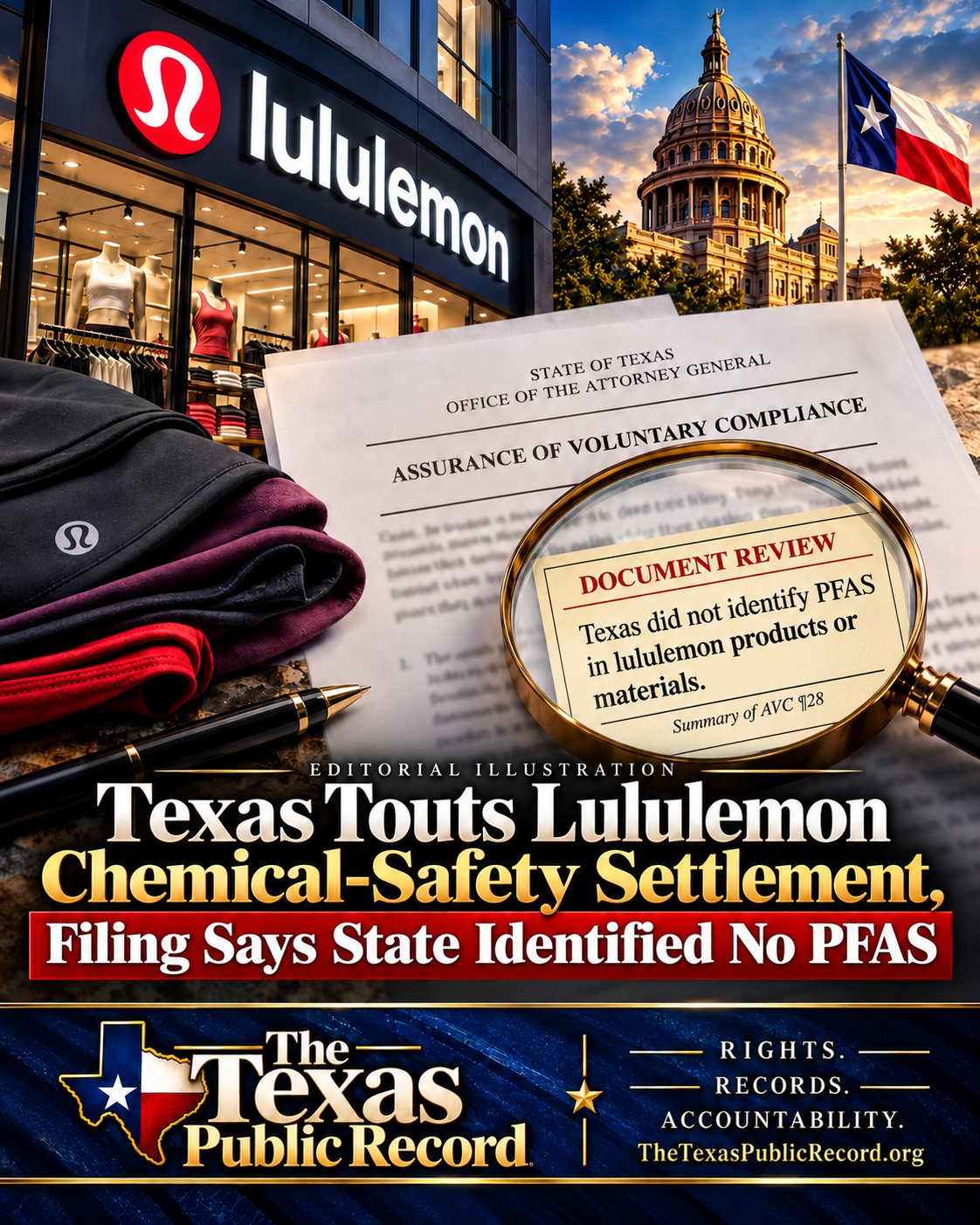
Texas investigators did not identify per- and polyfluoroalkyl substances, commonly known as PFAS, in Lululemon products or materials after reviewing documents the company provided in response to the State’s investigation.
Instead, the agreement identifies an alleged compliance lapse involving Lululemon’s failure to collect and maintain signed acknowledgments from two vendors for one edition of its Restricted Substances List.
Those acknowledgments were subsequently signed.
The distinction matters because the public announcement and the legal agreement address different aspects of the same investigation. One emphasizes chemical-safety protections. The other documents what investigators identified through their review.
What Texas announced
In its October 22 news release, the Office of the Attorney General described the settlement as an effort to enforce chemical-safety standards and protect consumers.
The investigation was publicly announced in April. The agreement records that the State had issued a civil investigative demand on March 26, 2026. The inquiry concerned possible misleading representations about Lululemon’s products, including their safety and potential PFAS content.
PFAS are a broad class of synthetic chemicals used in various industrial and consumer applications. The Environmental Protection Agency says studies have linked exposure to some PFAS with harmful health effects, while research continues into the risks posed by different compounds and exposures.
The attorney general’s announcement emphasized continued compliance with Lululemon’s Restricted Substances List, supplier oversight, testing or certification procedures, and corrective measures when problems arise.
Those provisions address chemical-safety compliance. They do not establish that investigators discovered PFAS in the company’s merchandise.
The agreement itself expressly addresses that question.
What investigators documented
The Assurance of Voluntary Compliance, filed in Collin County on October 19, provides the most direct account of the investigation’s documented findings.
Paragraph 28 states that, following its review of documents produced by Lululemon in response to a civil investigative demand, the State did not identify PFAS in the company’s products or materials.
That statement has limits.
It describes the result of the State’s review of the documents produced during this investigation. It does not establish that every product manufactured or sold by Lululemon is free of PFAS, nor does it establish that Texas independently tested every product.
The filing also identifies a supplier-documentation issue.
Under paragraph 24, Texas alleged that Lululemon failed to collect and maintain signed Certificates of Acknowledgement from two vendors for one edition of its Restricted Substances List.
Those certificates document receipt of the list and agreement to follow it.
According to the agreement, the missing acknowledgments were subsequently signed.
The filing does not equate those missing signatures with a finding that the vendors supplied contaminated products.
Nor does it establish that the company knowingly sold merchandise containing prohibited chemicals.
Lululemon expressly denied violating the law and did not admit liability.
What Lululemon agreed to do
The filed agreement addresses how Lululemon would continue administering its chemical-compliance program.
Vendors would continue demonstrating that materials comply with the Restricted Substances List through laboratory testing reports or valid third-party certifications, on the schedule specified in the list. Several operative provisions describe the continuation of existing practices rather than the creation of entirely new safeguards.
The background provisions distinguish that evidence from vendor acknowledgments. Beginning in October 2025, vendors who signed an acknowledgment during onboarding were no longer asked to sign another with each new edition of the list. Supply agreements still require compliance with current and future versions.
The prospective terms also address verification of certifications, testing when certifications expire or are not renewed, and commercially reasonable corrective measures when compliance problems arise.
These provisions focus on the company’s systems for managing supplier compliance.
They do not impose a guarantee that every supplier will comply perfectly at every moment.
The agreement recognizes that an isolated vendor failure does not necessarily establish a breach when specified conditions are met. Those conditions include lack of prior awareness, commercially reasonable corrective action after actual knowledge, and no pattern or practice of failing to enforce the standards.
It also requires the State to provide written notice and a 60-day opportunity to cure alleged noncompliance or show that none occurred before initiating the enforcement action or seeking contempt described in the agreement.
Paragraph 34 provides for automatic termination three years after court entry. Paragraph 49 separately makes the agreement effective on the date the court signs it.
The parties’ signatures, filing date and public announcement do not by themselves establish either court action.
The difference between an announcement and a finding
A settlement can serve a regulatory purpose even when an investigation does not establish the suspected underlying misconduct.
Companies may agree to formalize compliance procedures, provide assurances, or resolve disputes without admitting that they violated the law.
That is the framework reflected in this agreement.
Texas investigated possible chemical-safety and consumer-protection concerns. The resulting filing identifies a supplier-acknowledgment issue, records that the missing documentation was subsequently completed, and sets out prospective compliance commitments submitted for court approval.
It also expressly states that the State did not identify PFAS in Lululemon products or materials through its review of the documents produced.
Those facts do not make the settlement meaningless. They define what the public record supports.
There is a difference between announcing safeguards against a potential hazard and establishing that the hazard was discovered.
For consumers evaluating the State’s announcement, that difference is central to understanding the outcome.
What remains unanswered
The reviewed copy of the Assurance of Voluntary Compliance bears an October 19 filing stamp and provides for submission to a Collin County district court for approval.
It does not, by itself, establish that a judge subsequently signed or entered the agreement. The Texas Public Record has not independently confirmed those actions and cannot establish the effective date or the beginning of the three-year term.
The filing also leaves questions about the broader investigation. It does not establish that Texas independently conducted laboratory testing of Lululemon merchandise, and it does not support a conclusion that PFAS contamination was discovered.
The Texas Public Record requested comment from the attorney general’s press office and Lululemon’s counsel on October 23, including requests for the signed court order, the scope of the investigation and an explanation of which safeguards changed. No responses had been received in the checked correspondence as of approximately 4:31 p.m. Central that day.
What the record establishes
The October 22 announcement presented the settlement as a consumer-protection achievement.
The filed agreement provides the evidence needed to evaluate that characterization.
Texas did not identify PFAS through its document review. The alleged supplier-acknowledgment deficiencies were subsequently corrected. Lululemon denied violating the law. The parties agreed to prospective compliance terms whose effectiveness depends on court signature and whose three-year duration is measured from entry.
The settlement may strengthen formal oversight of Lululemon’s chemical-safety procedures. The public record reviewed does not establish that Texas uncovered PFAS contamination in the company’s products.
Consumers need both the safeguards the government announced and the findings its agreement documents to understand what the investigation accomplished.
Sources
Office of the Attorney General of Texas — October 22, 2026 announcement:
https://www.texasattorneygeneral.gov/news/releases/attorney-general-paxton-secures-settlement-lululemon-enforce-chemical-safety-standards-and-protect
Office of the Attorney General of Texas — Assurance of Voluntary Compliance, filed October 19, 2026, Collin County, cause 380-08492-2026. Relevant provisions: paragraphs 12–17, 24–39 and 49.
https://www.texasattorneygeneral.gov/sites/default/files/images/press/Lulu%20AVC.pdf
U.S. Environmental Protection Agency — PFAS Explained:
https://www.epa.gov/pfas/pfas-explained
Verification date: October 23, 2026. Court signature and entry remain independently unconfirmed.
EDITORIAL NOTICE: This report reflects records and information available at publication. Allegations, charges, and disputed claims are not findings of wrongdoing. Submit documented correction or clarification requests by messaging The Texas Public Record on the platform where this article appears. Material errors will be corrected transparently.
The Texas Public Record
Rights. Accountability. Awareness.