The record doesn’t blink. Keep your eyes on Texas.
All coverage areas
Rights & Justice / Consumer Protection
Texas Court Orders $1.52 Million in Penalties Against Rubinsky Roofing; Consumer Repayment Remains Unverified
A Collin County default judgment finds 27 consumer-protection violations, orders an initial $500,626.64 restitution deposit and restricts specified roofing practices. Whether affected homeowners have received money remains unknown.
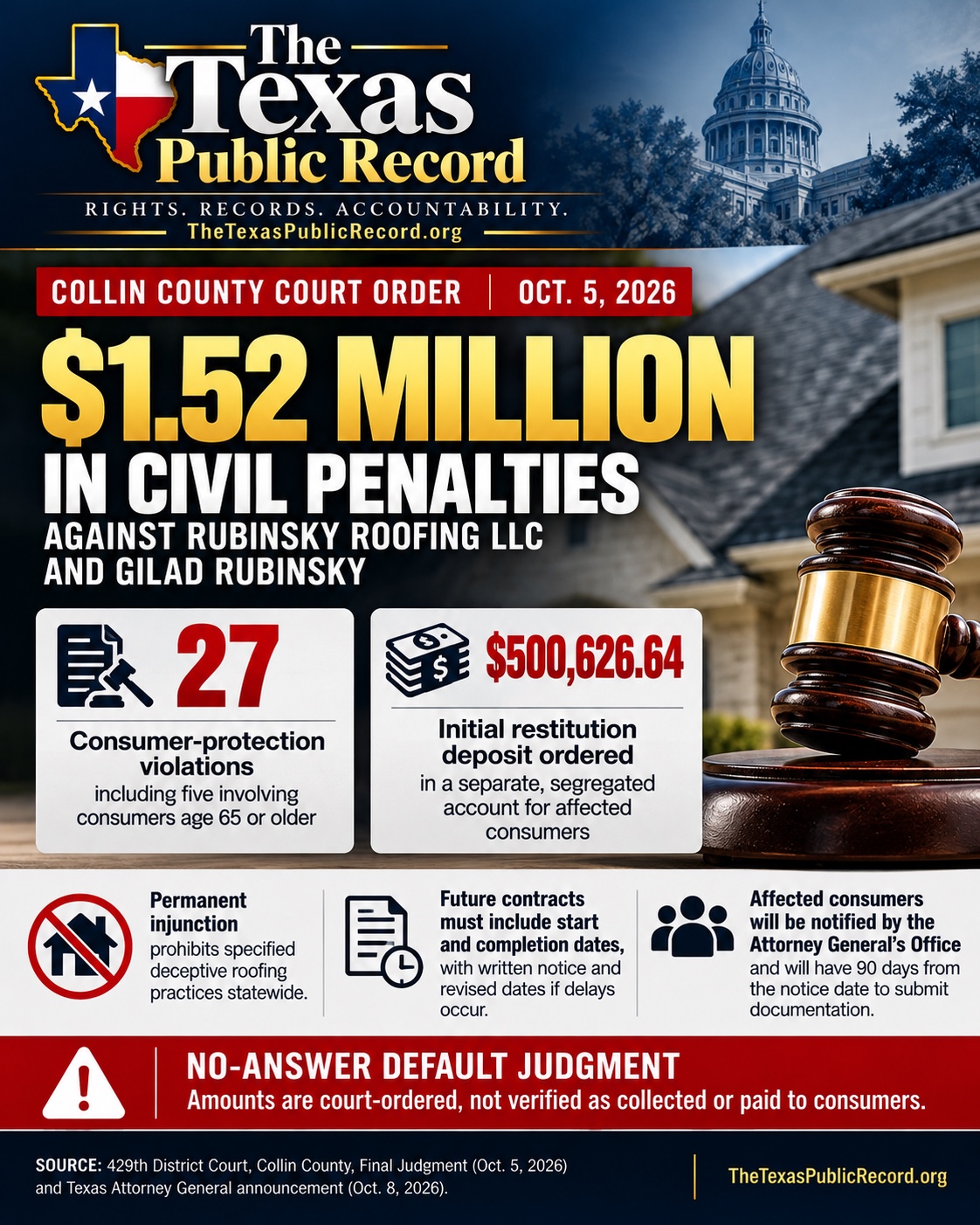
Owner-supplied explanatory graphic with illustrative roofing and gavel imagery, not documentary photographs of the case. It summarizes the October 5 order; subsequent procedural status remains unverified. Select to view the complete graphic.
A Collin County judge has ordered Rubinsky Roofing LLC and its managing member, Gilad Rubinsky, to pay $1.52 million in civil penalties after both defendants failed to answer a lawsuit brought by the Texas Attorney General’s Office.
The October 5 judgment also requires an initial $500,626.64 deposit into a consumer-restitution account, awards $53,440 in attorney’s fees and imposes a permanent injunction against specified deceptive roofing practices.
Attorney General Ken Paxton announced the ruling on October 8.
The judgment establishes substantial financial obligations. It does not establish that the penalties have been collected, the restitution account has been funded or affected homeowners have received reimbursement.
This report describes the findings and terms of the October 5 order. The complete subsequent docket has not been independently authenticated; this account does not establish whether later proceedings have changed the order or its enforcement.
For consumers who paid for roofing work that was unnecessary, incomplete or never performed, that distinction is consequential.
What the Collin County Court Found
The case, State of Texas v. Rubinsky Roofing LLC and Gilad Rubinsky, was decided in the 429th District Court of Collin County under Cause No. 429-03480-2026.
The court found 27 violations of the Texas Deceptive Trade Practices Act, including five qualifying violations involving consumers age 65 or older.
The judgment addresses deceptive representations about roof repairs and replacements, payments for roofing services, and failures to disclose material information affecting consumers’ decisions.
It also addresses representations about the defendants’ ability or willingness to perform promised work.
Those findings carry legal consequences. The procedure through which they were established, however, is an essential part of the record.
Why the Default Judgment Matters
The ruling was a no-answer default judgment, not the outcome of a contested trial.
The court determined that both defendants had been properly served with the state’s lawsuit but failed to file the required answers.
Under the applicable default-judgment procedure, properly pleaded material allegations were treated as admitted. The court also considered the state’s submissions concerning monetary relief.
The resulting judgment is a signed court order. It should not be described as a verdict reached after both sides presented and contested their evidence at trial.
The judgment describes itself as final and appealable. That language does not establish whether the defendants subsequently pursued post-judgment relief.
The Texas Public Record has not independently authenticated the complete post-judgment docket as of October 9, 2026. Whether any motion for new trial, notice of appeal or stay request has been filed remains unverified.
What the Court Ordered the Defendants to Pay
The judgment identifies three principal monetary components.
Monetary relief specified in the October 5 judgment
Court-ordered component
Amount
Civil penalties
$1,520,000
Initial consumer-restitution deposit
$500,626.64
Attorney’s fees
$53,440
Combined specified components
$2,074,066.64
The civil penalties consist of $270,000 for 27 violations and an additional $1.25 million for five qualifying violations involving consumers age 65 or older.
The judgment provides for joint-and-several responsibility for the penalties and attorney’s fees. The amounts must not be doubled when calculating the combined obligations.
The $2,074,066.64 figure is not a single fine. It combines different categories of monetary relief and excludes court costs, applicable interest and potential restitution obligations beyond the initial deposit.
The court ordered the civil penalties and attorney’s fees paid within 30 days of the judgment.
The initial restitution deposit is not a ceiling on the defendants’ potential restitution liability.
None of these court-ordered amounts should be presented as money already collected or distributed.
How the Consumer-Restitution Process Works
The judgment establishes a process for identifying potentially affected Texas consumers, documenting losses and making restitution payments.
Within 30 days of the judgment, the defendants must compile information about Texas consumers who paid them for roofing services. The information must address payments and whether the contracted work was completed, partially completed or never begun.
The defendants must provide that information to the court and the Attorney General’s Office within 35 days after the judgment.
The October 5 order also requires the initial $500,626.64 restitution deposit within 30 days after entry of the judgment.
The Attorney General’s Consumer Protection Division must notify potentially affected consumers within 15 days after receiving the list.
Consumers then have 90 days after notice is sent to submit documentation supporting their restitution claims under the court-ordered process.
The 90-day period does not begin automatically on October 5.
The judgment directs consumers to submit supporting documentation to the defendants. Affected homeowners should rely on authenticated official notification instructions before providing contracts, insurance information or other sensitive financial records.
The court also requires preservation of specified consumer records, including contracts, payment information, insurance-related documentation, complaints, communications and refunds.
The defendants remain responsible for qualifying restitution even if documented losses exceed the initial $500,626.64 deposit.
The records reviewed do not establish when consumer notices will be sent, how many consumers will qualify or how much money has actually been returned.
What the Permanent Injunction Prohibits
The permanent injunction became effective when the judgment was signed.
It prohibits Rubinsky Roofing, Gilad Rubinsky and other persons covered by the order from engaging in specified deceptive roofing practices in Texas.
The restrictions address misleading representations about necessary repairs, material costs, promised services and material information concerning the ability or willingness to complete roofing work.
The judgment also imposes requirements on future roofing contracts, including identifying project start and completion dates and providing written notice and revised dates when delays occur, subject to the order’s restrictions.
These provisions do not amount to a categorical prohibition against all roofing business activity. The injunction applies according to its stated terms.
Separately, the court ordered the defendants to remove a specified lien affidavit against a consumer’s property within 30 days.
Whether that requirement has been satisfied has not been independently verified.
What Remains Unanswered
The Attorney General’s announcement presents the judgment as a consumer-protection victory. The court’s order provides a legal mechanism for financial penalties, restitution and restrictions on future conduct.
But the outcome for affected homeowners depends on what happens next.
The outstanding questions include whether the required restitution account has been funded, whether consumers have received notices, whether claims have been processed, whether payments have been distributed and whether subsequent court proceedings affect the judgment.
Those are separate questions requiring separate evidence.
A court can order money returned. The order itself does not prove that repayment has occurred.
For homeowners awaiting restitution, the decisive measure will be the amount actually recovered, not simply the amount entered into the judgment.
Verification scope — October 9, 2026: The signed October 5 judgment and October 8 Attorney General announcement were inspected. Subsequent court proceedings, collections, compliance and consumer payments remain unverified.
Editorial notice: This report distinguishes the court’s findings and orders from verified collections, compliance and consumer payments. The complete current post-judgment docket has not been independently authenticated as of October 9, 2026. No subsequent appeal, stay, modification, payment or reimbursement is asserted.
The Texas Public Record Rights. Records. Accountability.
Texas issued civil investigative demands to Hanes and Fruit of the Loom. No product-specific test results or findings of unlawful conduct have been announced.
Judge Kathleen Cardone’s preliminary injunction stays three federal waivers and requires compliance with applicable laws for covered work throughout the Big Bend Sector.