The record doesn’t blink. Keep your eyes on Texas.
All coverage areas
Texas Energy | Public Records & Accountability
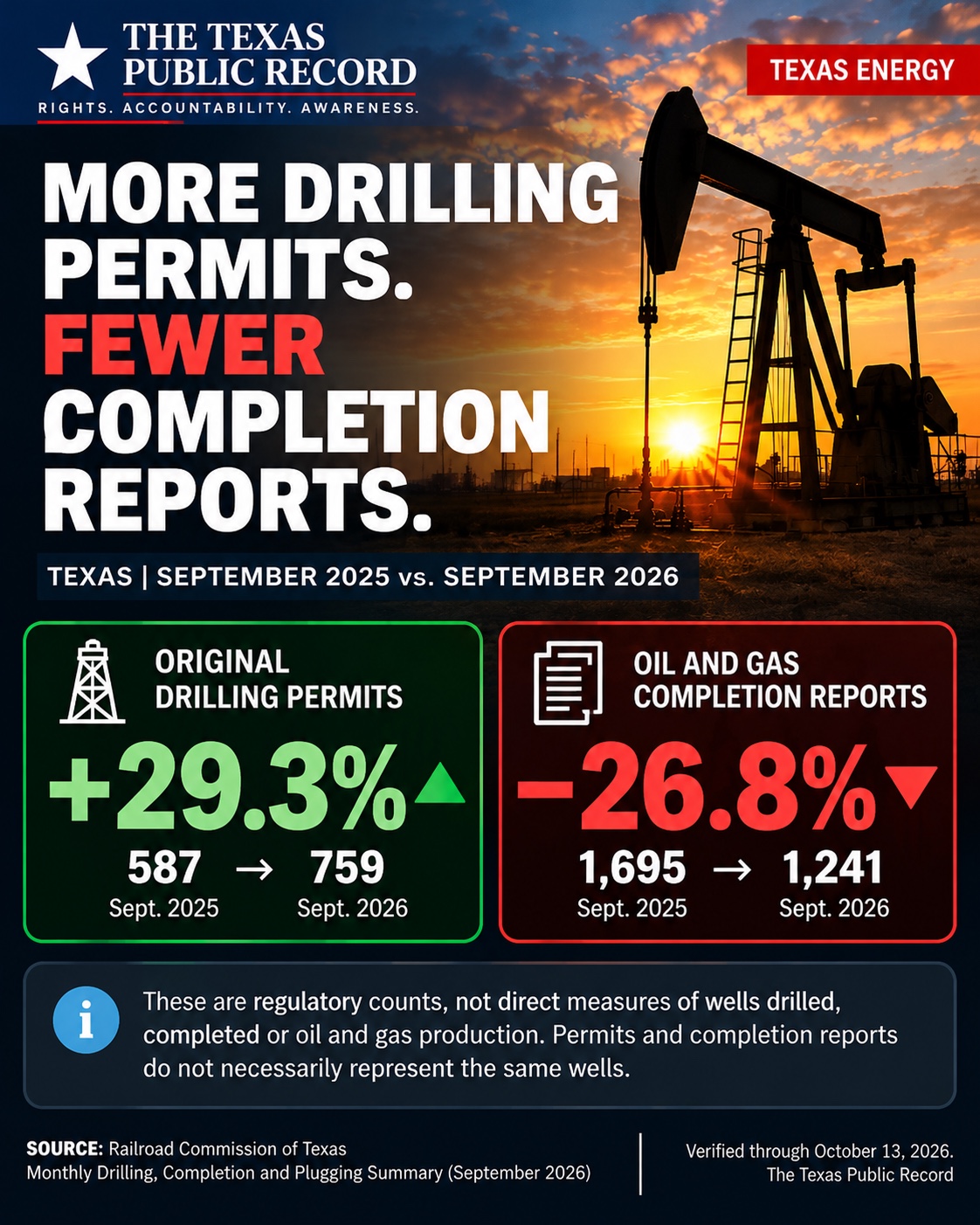
Texas Drilling Permits Rise 29% as Oil and Gas Completion Reports Fall Nearly 27% From Last Year
Railroad Commission records show more drilling permits issued in September 2026, even as the number of oil and gas completion reports processed by state regulators remained substantially below September 2025 levels.
AUSTIN, Texas — Texas issued considerably more drilling permits in September than it did a year earlier. But another measure of oil and gas regulatory activity moved sharply in the opposite direction.
According to the Railroad Commission of Texas, the state issued 759 original drilling permits in September 2026, up from 587 in September 2025. That represents an increase of 29.3%.
During the same period, the commission processed 961 oil completion reports and 280 gas completion reports, a combined total of 1,241.
A year earlier, the combined total stood at 1,695.
That is a decline of 454 reports, or 26.8%.
The figures present a notable contrast in the state’s monthly oil and gas records. They also illustrate why drilling permits, completion reports and actual production cannot be treated as interchangeable measures.
More Permits Than Last Year
The September 2026 drilling-permit total included 684 permits for new oil or gas wells.
That compares with 516 new-drill permits in September 2025, an increase of approximately 32.6%.
The month-to-month figures also show an increase.
The commission issued 695 original drilling permits in August 2026, compared with 759 in September, a 9.2% rise.
New-drill permits increased from 594 in August to 684 in September.
These figures establish that more drilling authorizations were issued. They do not establish that all authorized wells were subsequently drilled.
Completion Reports Tell a Different Story
The annual comparison for completion reports moves in the opposite direction.
The commission processed 1,301 oil completion reports and 394 gas completion reports in September 2025.
In September 2026, those figures were 961 and 280, respectively.
Combined, the categories declined from 1,695 to 1,241.
The preceding-month comparison, however, is different.
August 2026 recorded 939 oil and 287 gas completion reports, totaling 1,226. September’s combined total of 1,241 was slightly higher, an increase of approximately 1.2%.
Both comparisons are relevant. The September total was substantially below its year-earlier level while remaining slightly above August.
What the Records Do and Do Not Establish
The Railroad Commission’s monthly summaries reflect regulatory reporting activity.
Drilling permits authorize proposed activity. Completion figures reflect reports processed or approved through the agency’s regulatory system.
The records do not establish that every well associated with a September completion report was physically completed during September.
Nor do the drilling permits and completion reports necessarily concern the same wells.
It would therefore be inaccurate to subtract one category from the other and characterize the difference as unfinished wells.
The data also do not independently establish changes in Texas oil production, natural gas output, industry employment or the financial condition of operators.
Those conclusions would require additional records and analysis.
Plugging Reports Increase
Another category moved upward.
The commission recorded 861 plugging reports in September 2026, compared with 650 in September 2025.
That represents a 32.5% annual increase.
The August 2026 figure was 709.
As with completion reports, the September plugging total should be understood as a measure of reports processed, not necessarily the number of wells physically plugged during that calendar month.
The commission separately reported 95 injection completion reports for September. Those classifications overlap with other completion categories and cannot simply be added to the oil and gas total as additional distinct wells.
Why the Difference Matters
Texas oil and gas activity has implications for public revenue, local economies, infrastructure and communities across the state.
But the public record must be read according to what it measures.
A permit is not a completed well. A completion report is not a production figure. And a change in monthly administrative totals does not, by itself, explain the underlying industry’s direction.
The September records establish a narrower but consequential finding: Texas issued substantially more drilling permits than a year earlier while processing substantially fewer oil and gas completion reports.
Whether that divergence persists, and what it means for actual drilling and production, remains a question for subsequent records.
EDITORIAL NOTICE: This report reflects records and information available at publication. Allegations, charges, and disputed claims are not findings of wrongdoing. Submit documented correction or clarification requests by messaging The Texas Public Record on the platform where this article appears. Material errors will be corrected transparently.
The Texas Public Record Rights. Accountability. Awareness.
TxDOT says competitive awards will make better use of federal transportation money. Earlier application instructions show projects were already scored and ranked. The significant change is removal of a formula that helped determine how funding was distributed across Texas.
Austin, Barbers Hill, El Paso and Prosper ISDs were selected for state spending reviews. A final report is expected December 31; selection is not a finding of wrongdoing.