The record doesn’t blink. Keep your eyes on Texas.
All coverage areas
Public Money & Accountability
Texas Railroad Commission Assesses $1.24 Million in Enforcement Penalties Against Regulated Operators
The October 6 enforcement actions cover oil-and-gas, pipeline-safety and other regulated activities across Texas. The amount assessed is not necessarily the amount collected.
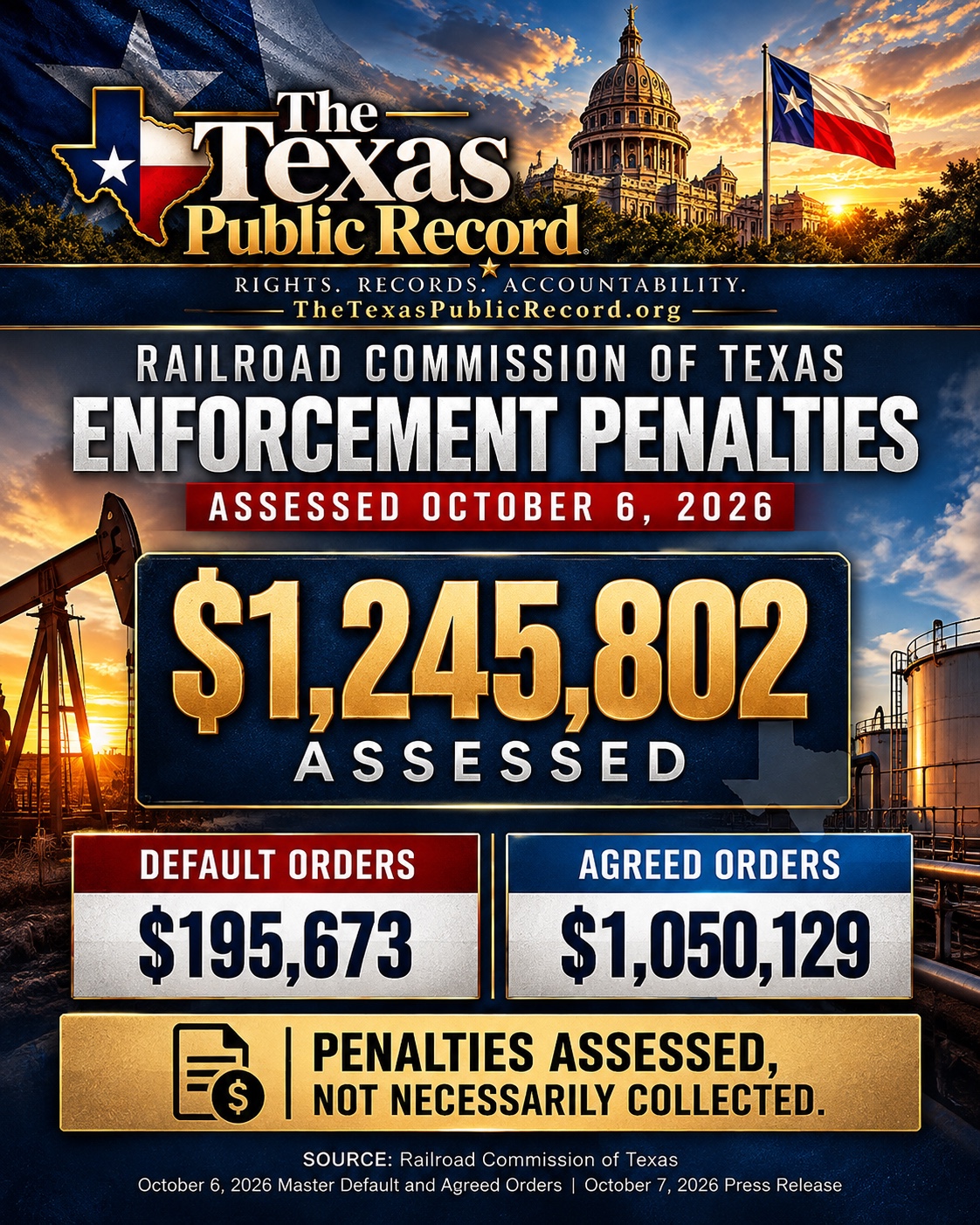
Owner-supplied TPR editorial illustration, not a photograph of a particular enforcement site. Select to view full size.
Texas railroad commissioners assessed $1,245,802 in enforcement penalties against regulated operators and businesses during their October 6 meeting, according to official orders and an announcement released by the Railroad Commission of Texas the following day.
The penalties reflect enforcement actions involving industries the agency regulates, including oil and gas operations, intrastate pipeline safety and liquefied petroleum gas activities.
The total is substantial, but it carries an important distinction: the Commission assessed the penalties. Its announcement does not establish that every dollar has been collected or that every operator has completed the corrective work required by its orders.
The October 6 actions were recorded in two separate master orders, reflecting different enforcement procedures.
How the $1.24 million breaks down
The Railroad Commission reported $195,673 in penalties through master default orders and $1,050,129 through master agreed orders.
Together, those assessments total $1,245,802.
Default orders generally arise when respondents fail to appear in enforcement proceedings after receiving the required notice. Agreed orders reflect cases resolved through negotiated terms accepted by the Commission.
That procedural distinction matters. A default order should not be described as a negotiated settlement, and an agreed order should not automatically be characterized as a finding reached after a contested hearing.
Both categories represent official regulatory enforcement actions, but their procedural histories differ.
The master orders incorporate individual enforcement matters involving regulated operators and businesses. Those matters may carry separate compliance requirements, payment obligations and opportunities for further procedural review.
Penalties do not necessarily mean payments collected
The Commission’s announcement identifies the total amount assessed, not a comprehensive accounting of money received.
Some entries within the agreed-order records are marked as paid or in compliance. Those notations establish particular statuses for the entries concerned, but they do not establish that every penalty in the October 6 enforcement package has been paid or that all corrective work is complete.
Other matters may involve continuing obligations.
A penalty assessment establishes an enforcement action and a monetary obligation under the applicable order. Collection and compliance are separate questions that require payment records, inspection results or other subsequent documentation.
The distinction matters when assessing the outcome of regulatory enforcement.
A public announcement of more than $1.2 million in penalties tells Texans what the Commission assessed. It does not, by itself, show how much the state has ultimately recovered or whether the conditions underlying every enforcement action have been corrected.
The orders remain subject to procedural review
The Commission’s October 7 announcement also cautioned that its orders become final if no timely motions for rehearing are filed.
That qualification means the October 6 assessments should not be described as beyond further administrative challenge merely because the commissioners signed the orders.
The orders establish what the agency approved at its meeting. Subsequent rehearing proceedings, modifications or other legally authorized actions could affect particular cases.
The Texas Public Record has not independently authenticated subsequent rehearing filings or modifications for every matter included in the two master orders.
Accordingly, this report describes the penalties as assessed on October 6. It does not characterize every individual enforcement order as procedurally final.
Why the enforcement records matter
The Railroad Commission regulates much of Texas’ oil and gas industry and has authority over intrastate pipeline safety, among other responsibilities.
Its enforcement process is one mechanism for addressing violations of state regulations and applicable safety requirements.
The October 6 records demonstrate the breadth of that process, but a statewide penalty total cannot establish the severity of every individual violation.
A relatively small assessment may involve an important corrective obligation. A larger assessment may reflect multiple violations or the circumstances of a particular enforcement proceeding.
Determining the public significance of an individual case requires examination of its underlying findings, the facilities involved, the applicable regulatory requirements and the operator’s subsequent compliance history.
For communities near regulated facilities, those details can be more consequential than the statewide dollar total alone.
What comes next
The next accountability questions concern the individual enforcement cases.
Those include whether respondents seek rehearing, whether penalties are paid, whether corrective work is completed and whether the Commission takes additional action.
The Texas Public Record is separately examining enforcement matters involving pipeline permits and well-plugging obligations in North Texas. Those investigations require additional case-level verification before conclusions can be drawn about particular facilities or present conditions.
The statewide finding is narrower and firmly documented: on October 6, the Railroad Commission approved enforcement orders assessing $1,245,802 in penalties.
What the agency assessed is established. What it ultimately collects, and how individual operators satisfy their obligations, requires further records.
Verified through: October 8, 2026. The assessment totals and master orders are established by official Railroad Commission records. Subsequent payment, compliance, rehearing and modification status has not been independently established for every individual case.
EDITORIAL NOTICE: This report reflects records and information available at publication. Allegations, charges, and disputed claims are not findings of wrongdoing. Submit documented correction or clarification requests by messaging The Texas Public Record on the platform where this article appears. Material errors will be corrected transparently.
The Texas Public Record Rights. Accountability. Awareness.
Railroad Commission records show more drilling permits issued in September 2026, even as the number of oil and gas completion reports processed by state regulators remained substantially below September 2025 levels.
TxDOT says competitive awards will make better use of federal transportation money. Earlier application instructions show projects were already scored and ranked. The significant change is removal of a formula that helped determine how funding was distributed across Texas.
Austin, Barbers Hill, El Paso and Prosper ISDs were selected for state spending reviews. A final report is expected December 31; selection is not a finding of wrongdoing.