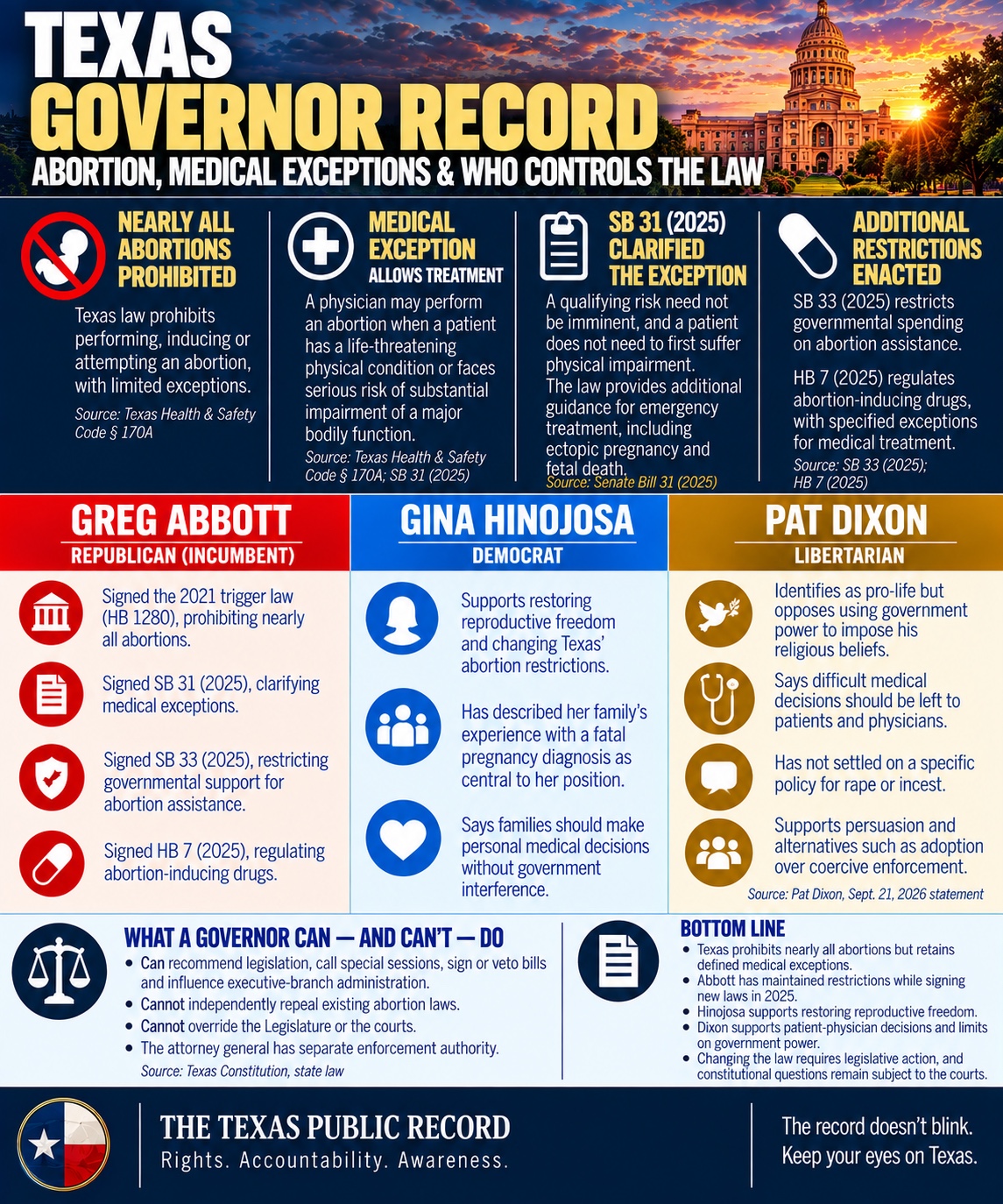
Supplied TPR editorial illustration. Select to view the complete graphic. The article explains the statutory qualifications behind this summary.
Texas prohibits nearly all abortions but retains defined medical exceptions. Abbott signed legislation clarifying those exceptions while maintaining restrictions on abortion assistance and abortion-inducing drugs. Hinojosa wants reproductive rights restored. Dixon distinguishes his personal opposition to abortion from the use of government power.
Gina Hinojosa made a deeply personal experience part of her campaign for Texas governor.
In 2003, during her first pregnancy, she learned that her daughter had a fatal condition. She and her husband considered their options and chose to continue the pregnancy. Their daughter did not survive.
Hinojosa has described that experience as central to her position on reproductive rights: she believes families facing devastating pregnancy complications should make those decisions without government interference.
Her campaign released an advertisement about the experience on August 31.
The account brings a consequential question into the governor’s race.
What does Texas law actually permit when a pregnancy becomes dangerous, and what authority would the next governor have to change it?
Abbott has signed legislation maintaining Texas’ abortion restrictions while clarifying when physicians may intervene in medical emergencies. Hinojosa advocates restoring reproductive freedom and changing the state’s abortion policies.
Libertarian Pat Dixon identifies as pro-life but says politicians should not impose personal religious convictions through government or intrude into difficult medical decisions between patients and physicians.
Their disagreement concerns the scope of legal abortion, the treatment of medical emergencies and the role of government in decisions involving pregnancy.
WHAT TEXAS LAW CURRENTLY SAYS
Texas Health and Safety Code Chapter 170A prohibits performing, inducing or attempting an abortion, subject to statutory exceptions.
The central medical exception applies when a licensed physician, exercising reasonable medical judgment, determines that a patient has a life-threatening physical condition aggravated by, caused by or arising from pregnancy that places her at risk of death or serious risk of substantial impairment of a major bodily function unless an abortion is performed.
Texas law does not provide general abortion exceptions based solely on rape or incest.
Those distinctions matter.
A medical exception exists. But it is not an unrestricted health exception, and it does not automatically authorize abortion for every serious pregnancy complication.
The applicable statutory requirements must be satisfied.
ABBOTT’S RECORD: RESTRICTIONS AND MEDICAL CLARIFICATION
Abbott signed Texas’ 2021 trigger law, House Bill 1280. Its prohibition took effect in August 2022 following the U.S. Supreme Court’s decision overturning Roe v. Wade.
His administration has continued to support the state’s abortion restrictions.
In 2025, however, the Legislature also addressed uncertainty surrounding emergency medical treatment.
Abbott signed Senate Bill 31, known as the Life of the Mother Act, on June 20, 2025. The law took effect immediately.
SB 31 clarified the existing medical exception and added provisions addressing physicians’ reasonable medical judgment.
Among its changes, the law establishes that a qualifying risk need not be imminent and that a patient need not first suffer physical impairment or damage before a physician acts.
It also specifies that a life-threatening condition may be potentially fatal without already causing active injury.
The legislation addresses treatment involving ectopic pregnancy, removal of a fetus that died through spontaneous abortion and accidental or unintentional fetal death resulting from qualifying medical treatment.
These are substantive statutory provisions, not merely statements of legislative intent.
But SB 31 did not repeal Chapter 170A or establish a general right to elective abortion.
CLAIM VS. RECORD: TEXAS HAS A MEDICAL EXCEPTION, NOT A GENERAL ABORTION EXCEPTION
Two descriptions of Texas law would be inaccurate.
The first is that physicians can never perform an abortion to protect a pregnant patient’s life or major bodily functions.
The second is that any pregnancy complication automatically qualifies for an abortion.
Chapter 170A establishes a defined medical exception. SB 31 clarified when physicians may act and how certain risks must be evaluated.
The law also directs physicians treating qualifying conditions to provide the best opportunity for fetal survival when doing so does not create greater danger to the patient. It expressly states that treatment need not be delayed or withheld when doing so would increase the risk of death or substantial impairment of a major bodily function.
The existence of these protections does not establish that every medical dispute has been resolved.
The law’s application depends on the patient’s condition, the physician’s judgment and the statutory requirements.
ABBOTT ALSO SIGNED RESTRICTIONS ON PUBLIC ABORTION ASSISTANCE
Senate Bill 33, signed in 2025 and effective September 1 of that year, restricts governmental transactions and expenditures supporting abortion.
It prohibits specified transactions with abortion-assistance entities and governmental spending on logistical support for procuring abortions, subject to the statute’s provisions.
The restrictions encompass assistance such as transportation, lodging and other specified support.
This legislation concerns public resources.
It should not be described as a general prohibition on every person’s interstate travel.
Nor does it establish that a government entity may spend public money on abortion assistance merely because the abortion itself would occur outside Texas.
MEDICATION ABORTION: ANOTHER ENACTED RESTRICTION
Abbott signed House Bill 7 in September 2025.
The legislation created Chapter 171A of the Health and Safety Code, addressing the manufacture, distribution and provision of abortion-inducing drugs.
It establishes specified prohibitions and a private civil enforcement mechanism. Its provisions include exceptions and exclusions for certain medical treatment, including qualifying emergencies, ectopic pregnancies and miscarriage management.
The statute took effect December 4, 2025.
It is therefore part of Texas’ operating legal framework in the 2026 election, not a proposal awaiting legislative passage.
HINOJOSA: RESTORE REPRODUCTIVE RIGHTS
Hinojosa has made restoring reproductive freedom an explicit campaign commitment.
Her January 2026 campaign statement emphasized privacy, dignity and medical care. Her August advertisement connected that position to her family’s experience with a pregnancy involving a fatal fetal condition.
Her account is important to represent accurately.
Hinojosa and her husband chose to continue the pregnancy after receiving the diagnosis. Her position is that families should retain the authority to make such decisions.
The experience should not be rewritten as a claim that she chose an abortion.
Her policy disagreement with Abbott concerns the state’s restrictions on reproductive decisions and the extent to which government should control medical choices.
But restoring abortion access statewide would require changes to existing law or controlling judicial rulings. A governor’s campaign commitment cannot, by itself, repeal Chapter 170A.
PAT DIXON: A DOCUMENTED POSITION, NOT A PARTY-PLATFORM SUBSTITUTE
Dixon published an abortion policy statement on September 21, 2026, expressly reaffirming his earlier 2022 position.
He describes himself as pro-life while distinguishing his personal religious convictions from the use of government power.
Dixon says politicians should not intrude into difficult medical decisions between patients and physicians. He also says he would not use public office to impose his religious beliefs.
On rape and incest, he acknowledges that he has not settled on a specific policy.
He favors persuasion and alternatives such as adoption over coercive enforcement as a way to reduce abortion.
That is a documented gubernatorial campaign position.
It would be inaccurate to say Dixon has no published abortion position or to substitute a generic Libertarian Party platform for his own statement.
His published remarks do not, however, establish a complete legislative proposal specifying which provisions of Chapters 170A and 171A he would retain, amend or repeal.
WHAT THE NEXT GOVERNOR CAN ACTUALLY CHANGE
The governor can recommend legislation, call special sessions, identify legislative priorities, sign or veto bills and make appointments within the office’s constitutional and statutory authority.
The governor also influences executive-branch administration.
But the office cannot independently repeal Texas’ abortion prohibitions.
Changing the statutes requires legislative action, while constitutional and federal-law disputes remain subject to the courts.
The attorney general also exercises separate statutory enforcement authority. The governor does not personally decide every civil enforcement action or medical determination.
That division of authority matters when evaluating promises to either preserve or change the current system.
BOTTOM LINE: WHAT THE RECORD ACTUALLY SHOWS
Texas prohibits nearly all abortions but retains defined medical exceptions.
Abbott signed the 2021 trigger law and subsequent legislation restricting abortion assistance and abortion-inducing drugs. He also signed SB 31 in 2025, clarifying emergency medical treatment and establishing that qualifying risks need not be imminent before a physician acts.
Hinojosa advocates restoring reproductive freedom and has connected that position to her own family’s experience with a fatal pregnancy diagnosis.
Dixon identifies as pro-life but opposes imposing his religious beliefs through government and says difficult medical decisions should remain with patients and physicians. His September 21 statement reaffirms those principles without establishing a complete statutory replacement plan.
The next governor will influence the direction of Texas abortion policy through legislation, appointments and executive priorities.
Existing statutes, however, remain law unless changed through the appropriate legal process.
The central distinction is between a candidate’s stated position, the law currently in force and the authority the governor actually possesses.
EDITORIAL NOTICE: This report reflects records and information available at publication. Allegations, charges, and disputed claims are not findings of wrongdoing. Submit documented correction or clarification requests by messaging The Texas Public Record on the platform where this article appears. Material errors will be corrected transparently.
The Texas Public Record Rights. Accountability. Awareness.
The record doesn’t blink. Keep your eyes on Texas.
A Collin County default judgment finds 27 consumer-protection violations, orders an initial $500,626.64 restitution deposit and restricts specified roofing practices. Whether affected homeowners have received money remains unknown.
Texas issued civil investigative demands to Hanes and Fruit of the Loom. No product-specific test results or findings of unlawful conduct have been announced.
Judge Kathleen Cardone’s preliminary injunction stays three federal waivers and requires compliance with applicable laws for covered work throughout the Big Bend Sector.