The record doesn’t blink. Keep your eyes on Texas.
All coverage areas
TPR | Rights & Justice
The Waivers Stopped at the Courthouse: A Federal Judge Freezes Big Bend Border Construction
By Michael L. Hamilton II · The Texas Public RecordOctober 5, 2026
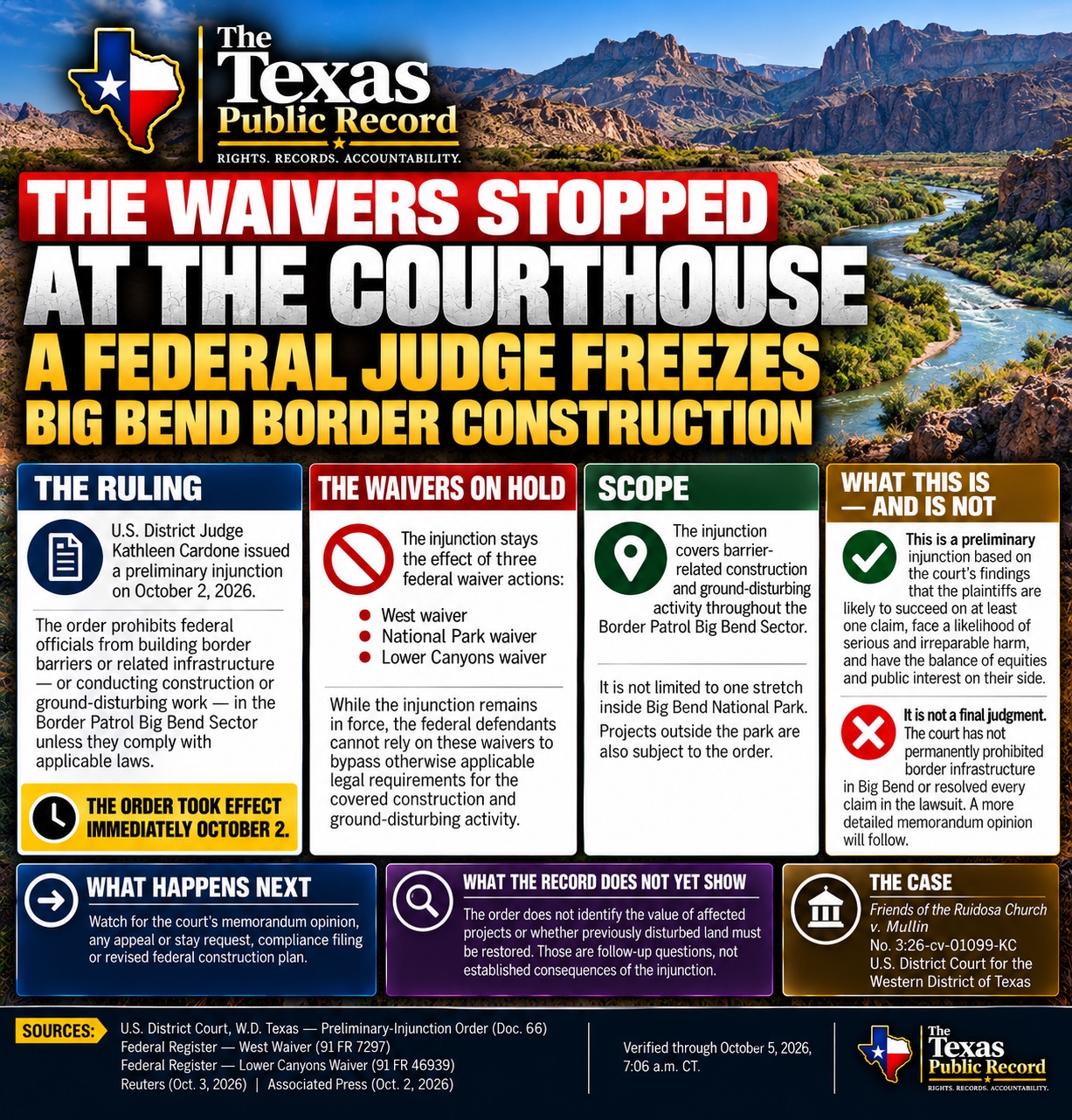
Supplied TPR editorial illustration and summary of the October 2 preliminary injunction. Select to view the complete graphic.
A federal waiver can remove an extraordinary number of legal barriers.
On Friday, a federal judge put the Big Bend waivers themselves on hold.
U.S. District Judge Kathleen Cardone issued a preliminary injunction prohibiting federal officials from building border barriers or related infrastructure — or conducting construction or ground-disturbing work — in the Border Patrol Big Bend Sector unless they comply with applicable laws.
The order took effect October 2.
Its language matters.
This is not merely an order protecting one scenic stretch inside Big Bend National Park. The injunction is written to cover construction and ground-disturbing activity throughout the Big Bend Sector.
It also stays the effect of three federal waiver actions identified as the West, National Park and Lower Canyons waivers.
Those waivers had been issued under federal authority allowing the homeland security secretary to waive legal requirements considered obstacles to expedited border-barrier and road construction.
The February West waiver, for example, waived environmental, historic-preservation and other legal requirements for work that could include roads, staging areas, excavation, lighting, cameras, sensors and physical barriers.
The preliminary injunction temporarily changes that legal terrain.
While it remains in force, the federal defendants cannot rely on the identified waivers to bypass otherwise applicable legal requirements for the construction and ground-disturbing activity covered by the injunction.
WHAT THE COURT DECIDED
Cardone held an evidentiary hearing before granting the injunction.
Her two-page order says the plaintiffs are likely to succeed on at least one claim, face a likelihood of serious and irreparable harm without an injunction, and have the balance of equities and public interest on their side.
Those are findings supporting preliminary relief.
They are not a final judgment.
The court has not permanently prohibited border infrastructure in Big Bend, finally declared every waiver unlawful or resolved every claim in the lawsuit.
Cardone said a memorandum opinion explaining the court's reasoning in greater detail will follow.
Until then, the operative order controls: the federal defendants may not proceed with covered barrier-related construction or ground disturbance in the Big Bend Sector without complying with applicable laws.
THE DISPUTE IS BIGGER THAN A WALL INSIDE THE PARK
The case was brought by Friends of the Ruidosa Church, the Center for Biological Diversity and Big Bend-area landowner and river guide Danny William Miller Jr.
Their challenge reaches the federal government's use of waiver authority for border construction and the consequences of using that authority across a region containing national-park resources, private property, historic sites and environmentally sensitive land.
Some public descriptions have compressed the dispute into a fight over a "wall" inside Big Bend National Park.
The federal plans have been more varied.
Federal records and reporting describe combinations of roads, vehicle barriers, surveillance equipment, lighting, cameras, sensors and supporting construction. Some projects concern federal land. Others may affect privately held land elsewhere in the region.
The injunction's scope reflects that broader dispute.
A project is not outside the injunction simply because it lies outside Big Bend National Park. The operative language reaches covered construction and ground-disturbing activity in the Big Bend Sector.
WHAT THE GOVERNMENT SAYS
U.S. Customs and Border Protection has defended the federal government's authority.
Following the ruling, CBP said it remained confident in its legal authority to secure the border while preserving the region's landscape and was working with the Justice Department on its next steps.
The litigation is not over.
The federal defendants can seek further relief in the district court or pursue appellate review.
As of Monday morning, The Texas Public Record had not located a later order or appellate ruling suspending the October 2 injunction.
THE RECORD DOES NOT YET SHOW THE PRICE
The injunction could affect federal contracts, construction schedules and project spending.
But the court's order does not identify the value of each affected project.
Broader figures associated with national border programs cannot safely be assigned to this injunction without contract-level records showing which money belongs to which Big Bend project and which work falls within the order.
The same caution applies to restoration.
Construction and land clearing had begun in parts of the region before the order. The current record does not establish whether the government will be required to restore disturbed land, what such work would cost or which agency or contractor would be responsible.
Those are follow-up questions, not established consequences of the injunction.
WHAT HAPPENS NEXT
The first major checkpoint is Cardone's promised memorandum opinion.
That document should explain which claim the court believes is likely to succeed and why the judge concluded that the plaintiffs face irreparable harm.
The next records to watch are any notice of appeal, stay request, compliance filing or revised construction plan from DHS or CBP.
The ruling did not end the Big Bend border fight.
It changed what federal officials may do while the litigation continues.
For now, the identified waivers cannot be used to bypass otherwise applicable legal requirements for the construction and ground-disturbing activity covered by the injunction.
Unless the district court modifies its order or an appellate court intervenes, federal officials must comply with those applicable laws before proceeding with covered work in the Big Bend Sector.
Verified through October 5, 2026, 7:06 a.m. CT.
EDITORIAL NOTICE: This report reflects records and information available at publication. Allegations, charges, and disputed claims are not findings of wrongdoing. Submit documented correction or clarification requests by messaging The Texas Public Record on the platform where this article appears. Material errors will be corrected transparently.
A Collin County default judgment finds 27 consumer-protection violations, orders an initial $500,626.64 restitution deposit and restricts specified roofing practices. Whether affected homeowners have received money remains unknown.
Texas issued civil investigative demands to Hanes and Fruit of the Loom. No product-specific test results or findings of unlawful conduct have been announced.