The record doesn’t blink. Keep your eyes on Texas.
All coverage areas
TPR Accountability · The Receipts
Federal Court Orders Texas to Air-Condition Every State Prison by End of 2029. Now Comes the Funding Test.
A federal judge has imposed a systemwide deadline on the Texas Department of Criminal Justice. TDCJ estimates permanent air conditioning could cost roughly $1.5 billion, while its existing construction and budget plans show much of the work—and funding decisions—still ahead.
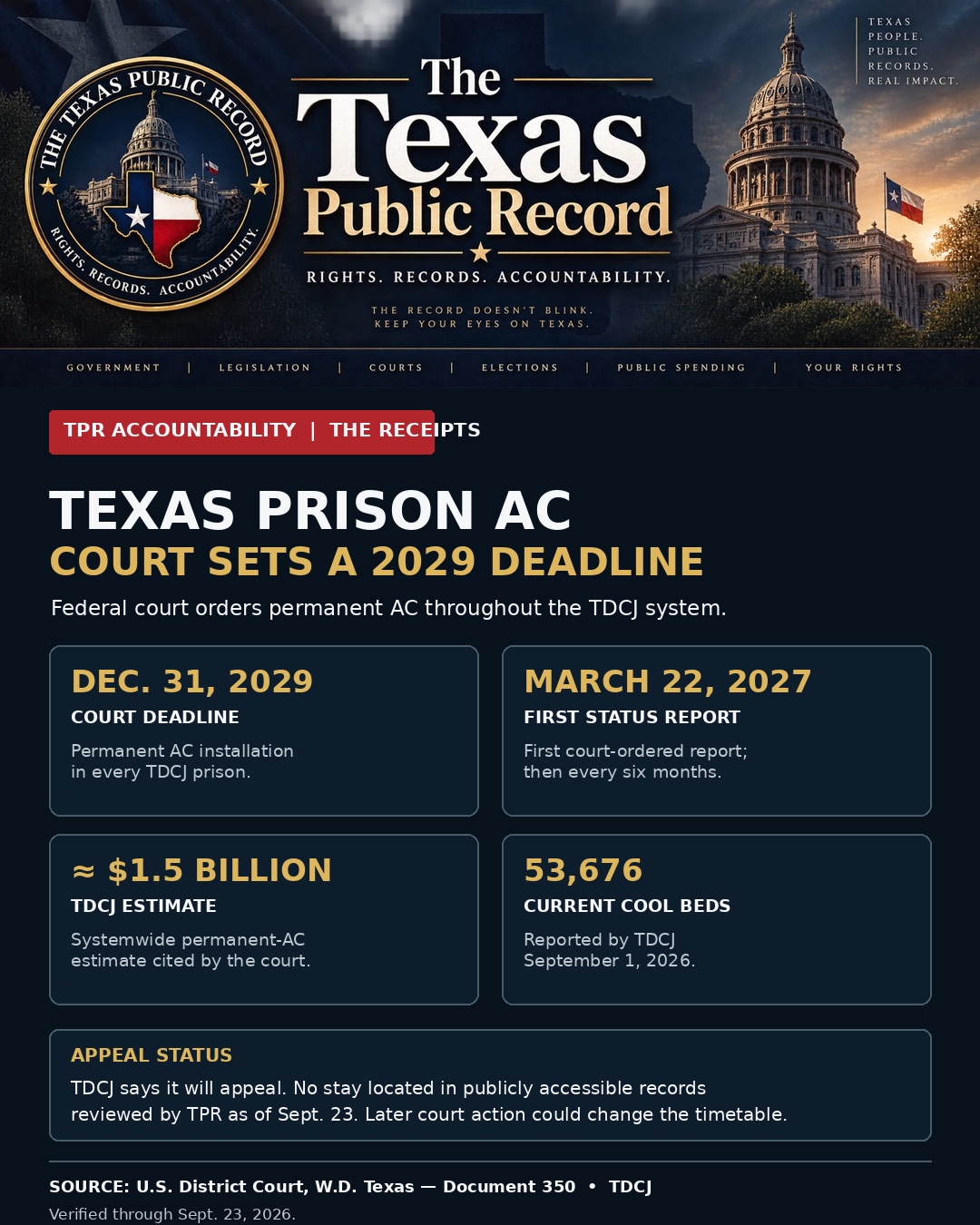
The court’s deadline, TDCJ’s cost estimate and reported cooling capacity. Appeal-status information reflects the September 23, 2026 review described below.
A federal judge has ordered the Texas Department of Criminal Justice to install permanent air conditioning throughout its prison system by December 31, 2029, creating a deadline that now reaches beyond prison conditions and directly into the state budget.
U.S. District Judge Robert Pitman entered the order September 22 in Texas Citizens United for Rehabilitation of Errants, Inc., et al. v. Bobby Lumpkin, a federal lawsuit challenging extreme heat in Texas prisons.
The court found that conditions in TDCJ’s un-air-conditioned prisons violate the Eighth Amendment and that the agency’s existing response to the heat is insufficient. Pitman ordered TDCJ Director Bobby Lumpkin to immediately develop and implement a systemwide installation plan and complete permanent air conditioning in every prison by the end of 2029.
But the ruling does not tell Texas exactly how to build it.
The court did not appoint a special master at this stage, nor did it prescribe particular procurement or construction-management methods. Instead, it imposed a deadline and a recurring reporting system designed to show how TDCJ intends to meet it.
That shifts the next phase of the story toward a basic accountability question:
How will Texas fund, procure and complete a statewide prison air-conditioning program by December 31, 2029—and how will the public know whether the work is on schedule?
TDCJ must submit progress reports to the federal court every six months beginning March 22, 2027.
Those reports are expected to provide more than a general status update. The September 22 order requires the first report to describe the implementation plan, including construction, procurement and design phases, intended project bundling and the amounts TDCJ intends to request from the Legislature for each stage.
The first and subsequent reports must describe progress and next steps. TDCJ must also report whether it remains on schedule for the December 2029 completion deadline. If it falls behind, it must explain why and identify the actions it intends to take to meet the deadline.
That creates identifiable checkpoints between the court order and the finished construction.
For taxpayers, lawmakers, correctional employees, incarcerated people and their families, those reports can become a way to compare what TDCJ says it plans to do with what has actually been funded, contracted and built.
Texas isn’t starting from zero
TDCJ already has a substantial air-conditioning construction program underway.
Its air-conditioning dashboard, updated September 1, reports 53,676 cool beds currently available.
The agency lists another:
23,738 beds associated with projects under construction;
7,348 in procurement; and
9,356 in design.
TDCJ reports 38 fully air-conditioned units and 53 partially air-conditioned units.
Those three development categories total 40,442 beds, but they should not simply be added to the existing cool-bed count and treated as guaranteed future capacity.
TDCJ says funding from the most recent legislative session, combined with projects already under construction, is expected to bring the system to approximately 90,000 air-conditioned beds.
That represents substantial expansion.
It would not, by itself, satisfy the new court order.
The mandate is systemwide.
Then comes the money
The financial scale is substantial.
The court record cites a TDCJ estimate of approximately $1.5 billion for permanent systemwide air conditioning.
The agency’s current budget planning, however, illustrates why the December 2029 deadline could force additional decisions by lawmakers.
TDCJ’s FY2028–29 budget request includes roughly $298 million toward prison air-conditioning work. The court also examined longer-range spending projections extending additional HVAC expenditures into the following biennium. Independent reporting on the order similarly notes that the agency’s previous systemwide plan extended completion into 2031.
The distinction between those numbers is important.
An estimate is not an appropriation.
An appropriation request is not an approved appropriation.
And an appropriation is not the same thing as a contract or completed construction.
The federal court has imposed the deadline. The Texas Legislature controls state appropriations.
The order also expressly states that financial considerations will not be accepted as a legitimate reason for failing to comply.
That means the public-money trail now matters as much as the construction schedule.
The timing deserves scrutiny
Before the September 22 ruling, TDCJ had presented a two-phase approach extending systemwide air-conditioning work through 2031.
The court instead set the completion date at December 31, 2029.
That does not establish that TDCJ will miss the deadline.
Budget requests can change. Lawmakers can appropriate additional money. Construction can be accelerated, reorganized or bundled differently.
But the difference between the existing planning horizon and the court’s deadline creates a specific question Texas officials now must address:
How will TDCJ reconcile its current capital and funding plans with a federal mandate requiring completion sooner?
The Legislature becomes part of the accountability chain
TDCJ cannot appropriate money to itself.
The Legislature will therefore play a central role in determining how quickly the agency can convert the court’s mandate into funded construction.
The state has already committed hundreds of millions of dollars to prison cooling projects.
TDCJ says it received $85 million during the 88th Legislature and another $118 million during the 89th Legislature for air-conditioning installation. It also received $110 million for the purchase and operation of the air-conditioned Dalby Unit and $301 million to construct 14 expansion dormitories totaling 5,600 air-conditioned beds.
Those expenditures show that Texas was expanding cooled capacity before the permanent injunction.
The new question is whether the existing funding trajectory is sufficient to satisfy a court-ordered systemwide deadline.
Procurement will matter too
Money alone does not install HVAC systems.
Once funding is available, TDCJ must move projects through design, procurement and construction across a large correctional system containing facilities of different ages, configurations and infrastructure conditions.
TDCJ’s own dashboard demonstrates those stages in real time.
Some projects are already being built. Others remain in procurement. Still others remain in design.
That makes future solicitations, contract awards, amendments, change orders and construction schedules part of the public record worth following.
Among the unanswered questions:
Which prisons will be prioritized?
Will TDCJ bundle multiple facilities into larger contracts?
How quickly will new solicitations reach the market?
Which companies will receive the work?
How much will construction ultimately cost?
And what will permanent cooling add to TDCJ’s recurring electricity, maintenance and operating expenses?
The September 22 order establishes the destination.
Those records will show how Texas attempts to get there.
TDCJ says it will appeal
The litigation is not necessarily finished.
TDCJ told The Texas Tribune that it intends to appeal the ruling and disputes the court’s conclusion that the agency acted with deliberate indifference. The agency has defended its existing heat-mitigation efforts and pointed to the expansion of air-conditioned capacity already underway.
An announced appeal does not, by itself, erase or suspend the district court’s order.
As of The Texas Public Record’s September 23 review of publicly accessible records and reporting, TPR had not located a Fifth Circuit ruling or stay suspending the September 22 mandate. That review was not an exhaustive search of paid court dockets.
That status is inherently time-sensitive. An appellate filing, stay order or subsequent district-court action could change the operative legal position and should be checked as the case develops.
The first major accountability checkpoint arrives in March
The court has already supplied one date Texans can put on the calendar:
March 22, 2027.
That’s when TDCJ’s first six-month implementation report is due.
That report should allow the public to begin comparing four things that are often discussed separately:
The court order. The money. The contracts. The construction.
From there, the reporting cycle continues every six months until the mandate is satisfied or subsequent court action changes it.
The receipts
The record: The September 22 federal findings, conclusions and permanent-injunction order, TDCJ’s air-conditioning construction dashboard and the agency’s budget records.
The deadline: December 31, 2029.
The first court report: March 22, 2027, followed by reports every six months.
Current cool beds: 53,676, according to TDCJ’s September 1 dashboard.
Projects in the pipeline: 23,738 beds under construction, 7,348 in procurement and 9,356 in design.
Estimated systemwide cost: Approximately $1.5 billion, based on the TDCJ estimate discussed in the court record.
What the record establishes: A federal district court has imposed a systemwide permanent-air-conditioning deadline and recurring reporting requirements on TDCJ.
What it does not establish: The final cost, complete funding source, final procurement structure, winning contractors, facility-by-facility sequence, recurring utility costs or ultimate result of an appeal.
What TPR will follow next
This story now has a measurable accountability chain:
COURT ORDER → FUNDING → PROCUREMENT → CONSTRUCTION → SIX-MONTH REPORTS → DECEMBER 31, 2029
The next records should show whether those pieces begin lining up.
TPR will be watching for appellate filings and any request to stay the injunction; legislative funding decisions; updated unit-by-unit construction schedules; solicitations and contract awards; changes to TDCJ’s projected cooling capacity; and the March 22 implementation report.
The court has established what TDCJ must accomplish.
The public records will show how Texas pays for it, who receives the contracts and whether the work remains on schedule.
Editorial notice: This report reflects records and information available at publication. Allegations, charges, and disputed claims are not findings of wrongdoing. Submit documented correction or clarification requests by messaging The Texas Public Record on the platform where this article appears or through our corrections page. Material errors will be corrected transparently.
The Texas Public Record Rights. Records. Accountability.
Railroad Commission records show more drilling permits issued in September 2026, even as the number of oil and gas completion reports processed by state regulators remained substantially below September 2025 levels.
TxDOT says competitive awards will make better use of federal transportation money. Earlier application instructions show projects were already scored and ranked. The significant change is removal of a formula that helped determine how funding was distributed across Texas.
A Collin County default judgment finds 27 consumer-protection violations, orders an initial $500,626.64 restitution deposit and restricts specified roofing practices. Whether affected homeowners have received money remains unknown.