The record doesn’t blink. Keep your eyes on Texas.
All coverage areas
Public Service | Nonprofit Accountability
A Donation Table, a Global Mission, and the Research Behind Heifer International
Independent studies document improvements in livestock production, agricultural practices and household diets in evaluated Heifer International programs. A chance encounter at a Texas retail store prompted a closer examination of the organization’s mission, finances and measurable results.
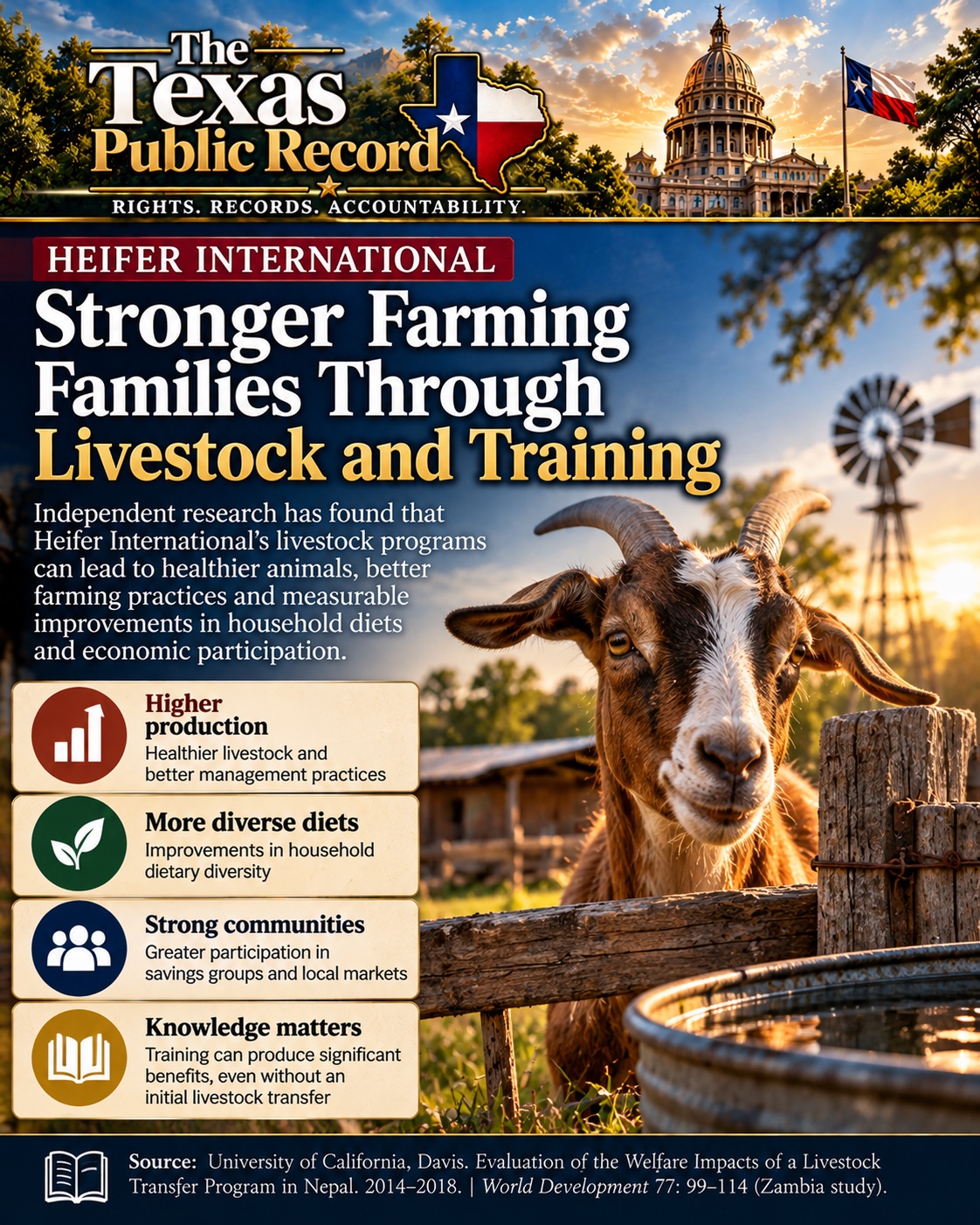
Owner-supplied editorial illustration, not a photograph of a verified Heifer project. Research findings concern the evaluated Nepal and Zambia programs; they do not establish results for every project or lasting poverty reduction.
Sometimes a story worth telling begins in an unexpected place.
Inside a local Texas retail store, a young man stood beside a Heifer International display, enthusiastically explaining how the nonprofit works to help farming families around the world.
He was knowledgeable, courteous and professional. He understood the mission he was presenting and answered questions about how the organization’s programs worked. When questions arose about verifying the solicitation, he was receptive to facilitating that process through the donation arrangement.
His enthusiasm was noticeable. So was his willingness to answer questions.
The encounter raised a larger question: What does Heifer International actually accomplish after someone makes a donation?
The answer reaches far beyond a retail store.
Heifer International works with smallholder farmers and rural communities to improve agricultural production, strengthen livelihoods and expand economic opportunities. Its programs include livestock assistance, agricultural training, animal health, cooperative development and connections to markets.
The organization’s mission is compelling. More importantly, aspects of its approach have been examined by independent researchers.
Those studies offer encouraging findings, including substantial improvements in goat-related earnings in Nepal and better household dietary diversity in Zambia.
They also reveal something important about agricultural development: providing animals is only one part of helping farming families build stronger livelihoods.
From a Gift of Livestock to a Broader Opportunity
Heifer International’s origins reach back to the 1940s, when the organization began pursuing a form of assistance intended to provide families with productive agricultural resources.
The idea was straightforward.
Instead of providing assistance that would be consumed once, a productive animal could offer continuing benefits.
A cow might provide milk. Chickens could produce eggs. Goats could provide food, breeding opportunities and products for sale.
Those resources could help families feed themselves while creating opportunities for agricultural income.
But livestock alone cannot solve the challenges facing rural households.
Animals require feed, veterinary care, suitable living conditions and knowledgeable management. Farmers also need access to markets where they can sell what they produce.
Heifer’s contemporary development model reflects those realities.
The organization works with farming communities on animal husbandry, agricultural practices, cooperative organizations, savings opportunities and market development.
One of its longstanding traditions is known as Passing on the Gift.
Under that approach, participating families share livestock, resources or knowledge with other households, extending the potential benefits of assistance through their communities.
The principle is not simply to give something away. It is to help create resources, skills and relationships that can continue producing value.
Independent research suggests that some of those elements can make a measurable difference.
In Nepal, Better Livestock Practices Produced Real Gains
A randomized controlled evaluation of a Heifer-associated livestock program in Nepal examined the effects of livestock transfers, training and related community activities between 2014 and 2018.
The research used comparison groups to assess changes associated with the program rather than relying solely on participants’ experiences or the organization’s own reporting.
Researchers documented improvements in livestock health, herd management and agricultural practices.
They also found estimated increases of approximately 70% to 100% in goat-production income in the evaluated program.
That is a substantial improvement in a particular agricultural activity.
The study identified additional benefits, including greater participation in savings groups and improvements in women’s involvement in livestock-related decisions.
These findings matter because agricultural development involves more than the number of animals a family owns.
Healthier herds can be more productive. Better management can reduce losses. Savings groups can strengthen financial participation, while greater involvement by women can expand their role in household economic decisions.
One of the evaluation’s particularly useful findings concerned the importance of training.
Researchers found that a program variation providing training without an initial goat transfer achieved outcomes comparable to the more expensive livestock-transfer approach on several measures.
That result suggests the knowledge, practices and community relationships developed through a program can be as consequential as the animals themselves.
It also raises a valuable question for development organizations: whether some benefits can be achieved more efficiently by investing in skills and support rather than relying primarily on livestock transfers.
The evaluation estimated benefit-cost ratios of approximately 2.5 to 3.7 for two program variations involving the livestock-sharing model, including projected benefits extending to additional households.
Those figures are economic estimates based on the researchers’ assumptions, not direct measurements of increased household income.
And the study contained an important qualification.
Although goat-related earnings improved, researchers did not detect a corresponding increase in total household income.
Goat production represented only a small portion of household income in the study setting, approximately 2%. Even sizable gains in that activity were not necessarily sufficient to produce a measurable change in a family’s overall finances.
The finding does not erase the improvements in livestock production, animal health and financial participation.
It shows that meaningful agricultural progress and broad poverty reduction are not identical outcomes.
In Zambia, Researchers Found Benefits at the Dinner Table
A study published in World Development in 2016 examined Heifer International’s livestock distribution program in Zambia.
Researchers used the program’s staggered rollout to compare participating households with similar households that had not yet received animals, finding improvements in dietary diversity and consumption expenditure.
The findings broaden the understanding of how agricultural assistance can affect daily life.
A family may benefit from livestock not only through products sold for income, but also through food produced for its own consumption and the ability to purchase other foods.
Greater dietary diversity can indicate improved access to a wider range of foods, although it does not by itself establish every aspect of nutritional health.
The Zambia findings suggest that livestock-development programs can influence household well-being through pathways beyond direct agricultural earnings.
Together, the Nepal and Zambia studies provide independent evidence of measurable benefits from particular Heifer-associated interventions.
They do not establish that every project produces comparable results or that participating families permanently escape poverty.
But they demonstrate that the organization’s development approach has generated outcomes that researchers could examine and measure.
Research funding and cooperation also warrant disclosure. The Nepal evaluation was funded by USAID and lists Heifer International and IDA Associates as project partners. The Zambia paper acknowledges a grant from Elanco Animal Health, Heifer International’s cooperation and partial support from the U.S. Department of Agriculture. These were outside research evaluations, not studies conducted without organizational involvement.
A Mission Reaching Farming Communities Across the World
Heifer International’s current operations extend well beyond the programs evaluated in Nepal and Zambia.
In its fiscal 2025 annual reporting, the organization said it worked with approximately 1.4 million smallholder farming households in 19 countries.
Heifer also reported that farmer groups it supported generated approximately $51 million in sales.
Those figures describe the scale of its reported activities and the commercial activity associated with supported farmer groups.
They should not be interpreted as independently verified poverty reduction.
The household figure does not mean that every participating family achieved financial independence. The sales figure represents reported economic activity, not net profit or additional household income.
Nevertheless, the numbers illustrate the scale of the agricultural systems Heifer is working to strengthen.
Its approach recognizes that farming livelihoods depend on more than individual production.
Farmers need buyers, transportation, reliable markets, appropriate financing and organizations capable of negotiating and operating effectively.
Helping producers develop those connections can be as important as improving what happens on the farm.
Following the Money
Heifer International makes financial disclosures available to the public, including audited statements and federal nonprofit tax information.
For fiscal 2025, the organization reported approximately $185.8 million in total expenses.
Heifer International reported FY2025 expenses
Expense category
FY2025 expenses
Share
Programs
$137.4 million
73.9%
Fundraising
$38.7 million
20.8%
Management and general
$9.7 million
5.3%
Total
$185.8 million
100%
Nearly three-quarters of reported expenses were allocated to programs.
The financial disclosures give prospective donors a way to examine how the organization classifies its spending.
But expense ratios are not direct measures of charitable effectiveness. Program spending must still be considered alongside evidence of outcomes.
Charity Navigator’s profile for Heifer International, reviewed October 16, 2026, lists a four-star rating and a score of 97%.
The profile indicates that one of four evaluation beacons is completed, limiting the scope of conclusions that can be drawn from the overall rating.
The rating should therefore not be interpreted as a comprehensive assessment across all four evaluation areas or as proof of lasting poverty reduction.
Nor does a 97% rating mean that 97 cents of every donated dollar reaches individual farming families.
Financial disclosures, charity assessments and independent impact research answer different questions. Together, they offer a more useful basis for evaluating the organization.
The Young Man Behind the Table
For all the research findings and financial figures, this story began with one person explaining a mission to shoppers.
The young representative’s enthusiasm was apparent.
He spoke knowledgeably about Heifer International, answered questions professionally and was willing to facilitate verification through the donation process.
His openness was a positive part of the encounter.
Heifer International acknowledges using face-to-face fundraising partners, including representatives who may collect donations electronically through tablets.
Those practices are consistent with the general type of solicitation encountered at the retail store.
The Texas Public Record did not independently complete authentication of the young man’s affiliation, however, and his willingness to facilitate verification should not be mistaken for confirmation that the process was completed.
Anyone considering a contribution can verify the solicitation directly with Heifer International and review the organization’s financial disclosures before providing payment information.
Prospective donors should also understand that a contribution associated with an animal in fundraising materials does not necessarily mean that the exact animal will be purchased and delivered to one designated family. Heifer explains that donations support its broader mission and programs.
Those distinctions are part of informed charitable giving.
The representative’s conduct did not establish whether Heifer’s programs were effective.
But his professionalism and enthusiasm prompted a closer examination of an organization whose work deserves to be understood through more than a fundraising presentation.
What the Research Means for Farming Families
The most compelling aspect of Heifer International’s work is not the image of a donated animal.
It is the possibility that agricultural resources, practical knowledge and community cooperation can help families improve their livelihoods over time.
The independent studies provide evidence of benefits in several areas.
In Nepal, researchers documented healthier livestock, better agricultural practices, increased goat-related earnings and greater participation in financial and livestock-related decisions.
In Zambia, researchers found improvements in household dietary diversity and consumption expenditure.
The Nepal evaluation also showed that training could produce important benefits without an initial livestock transfer, suggesting that agricultural knowledge and community support deserve attention alongside physical resources.
These findings do not establish that every program succeeds or that poverty is permanently eliminated.
They establish something more precise and useful: particular interventions associated with Heifer’s development model have produced measurable improvements in the lives and activities of participating households.
That is a meaningful result.
And it offers a reason to examine the organization’s work seriously rather than accepting or dismissing its mission based solely on fundraising materials.
More Than a Donation
A donation table is an ordinary sight in a retail store.
Most people walk past without learning much about the organization behind it.
On this occasion, a young man’s enthusiasm and willingness to answer questions opened the door to something more.
The examination led from a conversation about helping families to independent research into agricultural production, household diets and economic participation.
It led to financial disclosures showing how a major international nonprofit allocates its resources.
And it revealed that Heifer International’s development approach has produced measurable benefits in evaluated programs, even as broader questions about long-term poverty reduction remain.
The organization’s mission is ambitious. Its work is complex. The evidence is encouraging where specific outcomes have been independently demonstrated.
Perhaps that is the most valuable result of the encounter.
A young man was willing to stand behind a cause, explain it and welcome questions.
Those questions led to a record worth sharing.
Because the strongest reason to take a charitable mission seriously is not simply that it sounds good. It is that there is evidence showing where it makes a difference.
Learn More or Support Heifer International
Readers interested in learning more about Heifer International, examining its agricultural programs or making a voluntary contribution can visit the organization’s official website.
Heifer International provides information about its programs, financial records and donation arrangements through its official website. Readers are encouraged to review those materials before contributing.
The Texas Public Record does not collect donations on behalf of Heifer International and receives no compensation for providing this information.
Editorial disclosure: This reporting originated from an unsolicited encounter with a person presenting Heifer International’s mission at a local retail store. The representative was willing to facilitate verification through the donation process, but The Texas Public Record did not independently authenticate his affiliation. The article is not sponsored content and does not constitute an endorsement or recommendation to donate.
Railroad Commission records show more drilling permits issued in September 2026, even as the number of oil and gas completion reports processed by state regulators remained substantially below September 2025 levels.
The fourth Governor Record installment compares grid reforms, data-center restrictions and electricity-bill proposals from Abbott and Hinojosa, with Dixon’s documented position assessed separately.