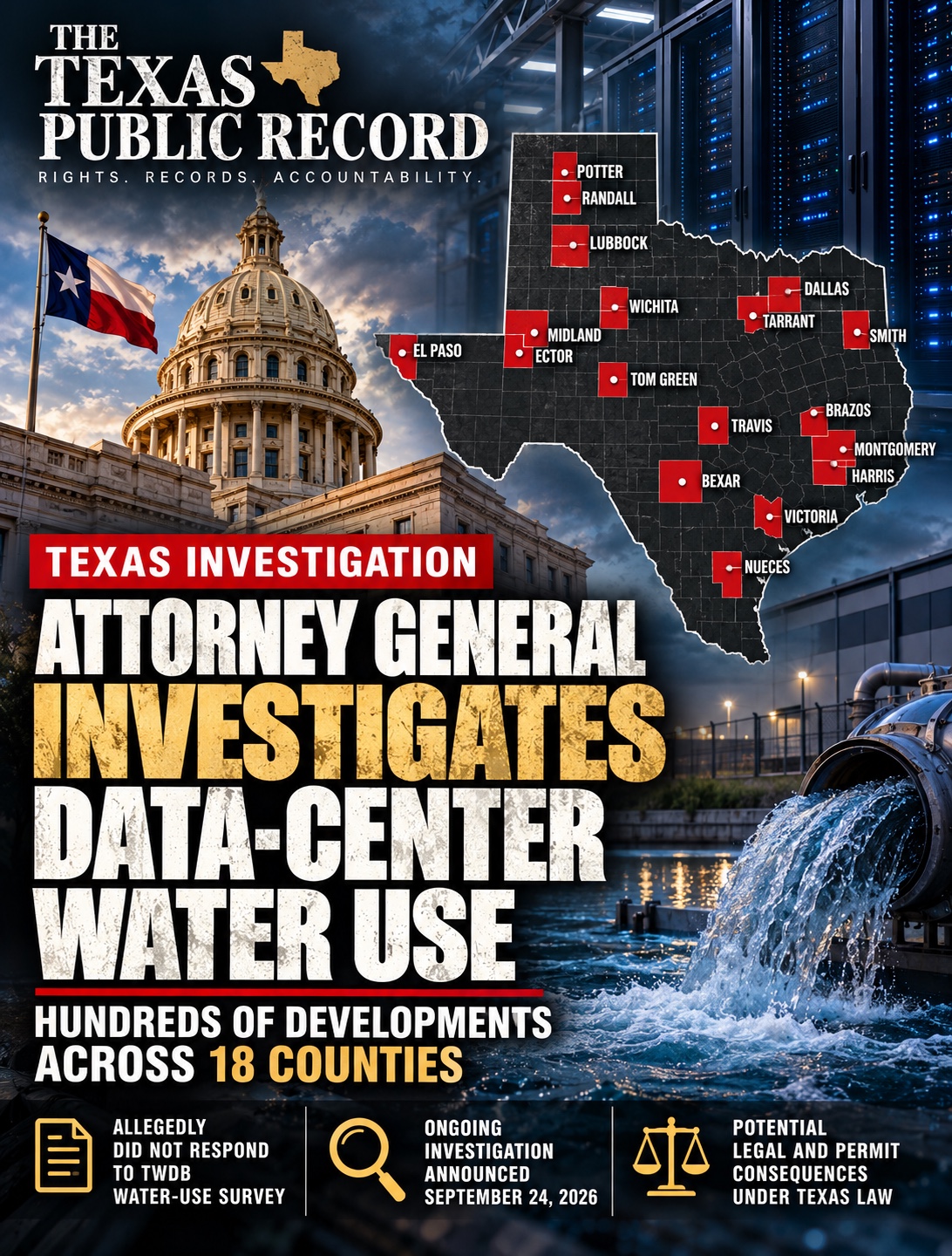
Editorial illustration, not a geographic reference map or a photograph of an investigated facility. County shapes and positions are stylized; use the county list below. Select the graphic to view it full size.
Texas has moved from demanding answers about data-center water use to investigating developments that the state says did not provide them.
The Texas Attorney General’s Office announced Thursday that it has opened an ongoing investigation involving data-center developments that allegedly failed to respond to the Texas Water Development Board’s annual water-use survey.
Attorney General Ken Paxton says his office is investigating “hundreds” of developments.
The state has not released their names.
It has not disclosed an exact number.
And the announcement does not establish that every development under investigation violated Texas law.
What Texas has disclosed is where the initial investigation is reaching.
The Attorney General’s Office identified data-center developments in 18 counties:
Harris, Montgomery, Travis, Dallas, Tarrant, Smith, Bexar, Tom Green, Potter, Randall, Lubbock, Midland, Ector, Wichita, Victoria, Brazos, Nueces and El Paso.
That puts some of Texas’ largest metropolitan areas — and some of its most water-sensitive regions — inside an investigation centered on a basic planning question:
How much water are these facilities actually using?
The answer matters because Texas cannot accurately plan future water supplies without accurate information about existing demand.
And the state says some data-center developments have not supplied that information.
What Texas requires
The Texas Water Development Board conducts an annual Water Use Survey to collect information used for state and regional water planning, modeling and resource management.
The program covers entities using groundwater and surface water for municipal, industrial, power-generation and mining purposes.
Data centers fall within the industrial survey program.
TWDB states plainly that recipients of a Water Use Survey are required by law to complete and return it.
For the current reporting cycle, surveys were due March 1.
The online reporting system closed July 1, although TWDB continues to accept past-due surveys through PDF submissions.
The consequences established in Texas law extend beyond an administrative reminder.
According to TWDB, a person who fails to timely complete and return the survey can become ineligible for financial assistance from the board and ineligible to obtain certain water-right permits, amendments or renewals from the Texas Commission on Environmental Quality until the survey is administratively complete.
Failure to complete and return the survey can also constitute a Class C misdemeanor.
Those are statutory consequences.
They should not, however, be confused with findings against the unnamed developments now being investigated.
The Attorney General has not released records establishing which entity received which survey, when it was received, whether a response was submitted, whether a response was deficient or what enforcement theory is being considered in each case.
Those records will matter.
From reporting problem to enforcement
Thursday’s announcement did not emerge in isolation.
It represents another step in a rapidly escalating state response to data-center development.
On September 14, Gov. Greg Abbott directed TWDB to compel major water users, including data centers, to comply with water-use reporting requirements.
Abbott instructed the agency to impose legal consequences for past and future failures and to coordinate with the Public Utility Commission of Texas and the Electric Reliability Council of Texas.
The governor ordered TWDB to provide his office an update on its enforcement activities by October 14.
Ten days after that directive, the Attorney General’s Office announced its investigation.
The significance is the change in posture.
Texas is no longer merely identifying incomplete data as a planning problem.
State officials are now examining whether developments that allegedly failed to provide required information should face enforcement consequences.
Why the missing data matters
Texas’ Water Use Survey is not simply a statistical exercise.
The state uses the information to understand existing water consumption and help develop long-term water-supply plans.
That becomes increasingly important as large computing facilities expand across Texas.
Data centers can use water directly for cooling and facility operations. Their actual demand varies significantly depending on facility design, cooling technology, climate, water source and other operating characteristics.
TWDB has been working to improve how that demand is measured.
Beginning with the survey covering 2024 water use, the agency said it would attempt to track data-center water consumption more explicitly within the manufacturing category rather than allowing much of it to remain embedded in broader commercial water-use figures.
But better classification cannot compensate for missing reports.
If a surveyed facility does not provide its information, the state has a weaker record from which to estimate current demand and plan future supply.
That gap becomes especially consequential when major facilities are proposed in communities already balancing municipal growth, agriculture, industry and limited water resources.
What the state has not shown
Thursday’s announcement contains strong language.
The evidence publicly available is narrower.
Paxton said his office is investigating “hundreds of data center developments” and accused companies of disregarding their obligations.
But the Attorney General’s announcement does not publish a list of those developments.
It does not provide the underlying TWDB survey records.
It does not disclose investigative demands.
It does not identify how many facilities received surveys versus how many failed to respond.
It does not establish whether every nonresponse satisfies the elements necessary for a criminal referral or another enforcement action.
And it does not establish wrongdoing by any particular data-center operator.
Until those records become public, the investigation itself is established.
Individual violations are not.
The 18-county footprint
The initial geographic reach is substantial.
The Attorney General identified investigations in:
Harris County
Montgomery County
Travis County
Dallas County
Tarrant County
Smith County
Bexar County
Tom Green County
Potter County
Randall County
Lubbock County
Midland County
Ector County
Wichita County
Victoria County
Brazos County
Nueces County
El Paso County
That footprint stretches from Houston and Dallas-Fort Worth to San Antonio and Austin, through West Texas, the Panhandle, the Permian Basin, the Gulf Coast and El Paso.
But inclusion of a county should not be read as an accusation against every data center operating there.
The Attorney General’s Office has not identified the developments involved.
What comes next
The next records could determine whether Thursday’s announcement develops into specific enforcement cases or produces compliance without litigation.
Among the records to watch:
The identities of developments receiving investigative demands.
The exact number of facilities under investigation.
The surveys the state says were not returned.
Any responses subsequently submitted to TWDB.
Criminal referrals, if any.
Administrative consequences affecting TWDB assistance or TCEQ water-right permitting.
And the October 14 report Abbott ordered TWDB to provide on its enforcement activities.
Those records will determine whether Texas can move from saying hundreds of developments are under investigation to showing exactly where reporting failed, which legal consequences apply and whether missing water-use information has finally been supplied.
For communities hosting enormous new computing facilities, that distinction is not academic.
Water planning depends on knowing who is using water, how much they are using and how future demand may change.
Texas is now investigating whether some data-center developments failed to provide part of that record.
EDITORIAL NOTICE: This report reflects records and information available at publication. Allegations, charges, and disputed claims are not findings of wrongdoing. Submit documented correction or clarification requests by messaging The Texas Public Record on the platform where this article appears. Material errors will be corrected transparently.
The Texas Public Record Rights. Records. Accountability.
Railroad Commission records show more drilling permits issued in September 2026, even as the number of oil and gas completion reports processed by state regulators remained substantially below September 2025 levels.
Texas prohibits nearly all abortions but retains defined medical exceptions. Abbott signed legislation clarifying those exceptions while maintaining restrictions on abortion assistance and abortion-inducing drugs. Hinojosa wants reproductive rights restored. Dixon distinguishes his personal opposition to abortion from the use of government power.
Texas reports more than $10 billion in border-security spending. The federal government has approved approximately $7.5 billion in reimbursement, but the Comptroller said the money had not reached the state treasury as of September 21. The governor’s race raises questions about enforcement priorities, public spending and the boundaries of state authority.