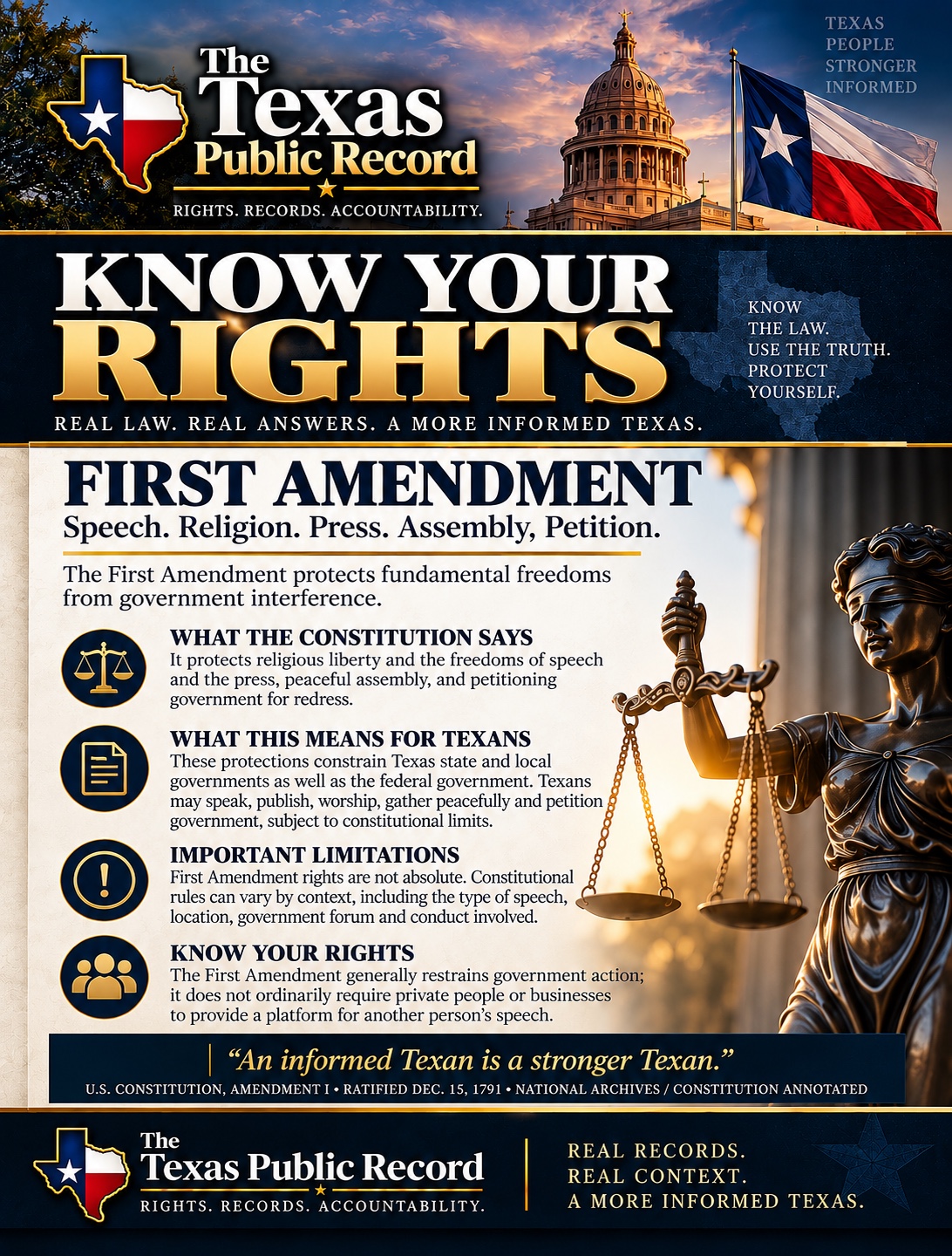
Supplied TPR editorial illustration. Select to view the complete graphic. The article explains the constitutional qualifications behind this summary.
You criticize a public official. You question a government decision. You attend a peaceful demonstration, publish an investigation or practice your faith.
The government may disagree with you. It may face criticism because of you. But disagreement alone does not give it authority to silence you.
That is the foundation of the First Amendment.
Ratified December 15, 1791, as part of the Bill of Rights, the First Amendment protects five closely connected freedoms: religion, speech, press, peaceful assembly and petitioning the government.
These protections apply in Texas. They also have limits that matter when a disagreement becomes a legal dispute.
WHAT THE CONSTITUTION ACTUALLY SAYS
The First Amendment reads:
“Congress shall make no law respecting an establishment of religion, or prohibiting the free exercise thereof; or abridging the freedom of speech, or of the press; or the right of the people peaceably to assemble, and to petition the Government for a redress of grievances.”
Although the text names Congress, Supreme Court doctrine applies its protections to state and local governments through the Fourteenth Amendment.
That means Texas lawmakers, public agencies, school districts, cities and other governmental bodies must operate within applicable First Amendment limits.
The amendment is not a promise that everyone will approve of your expression. It is a constitutional restriction on government power.
FREEDOM OF RELIGION: BELIEF AND GOVERNMENT AUTHORITY
The First Amendment contains two distinct religious protections.
The Establishment Clause restricts government action concerning the establishment of religion. The Free Exercise Clause protects religious belief and practice against unlawful government interference.
Together, they address both government involvement in religion and the freedom to practice religion.
For Texans, these protections matter in public schools, government employment, public institutions and disputes involving religious exercise.
They do not mean that every action described as religious is automatically exempt from otherwise valid law. The applicable constitutional test depends on the government action, the burden on religious exercise and controlling precedent.
Texas also has its own constitutional protections for freedom of worship under Article I, Section 6.
FREEDOM OF SPEECH: GOVERNMENT CANNOT SIMPLY SILENCE DISAGREEMENT
The First Amendment protects expression, including criticism of public officials and government policy.
That protection does not depend on whether an opinion is popular, polite or welcomed by those in authority.
A Texan does not lose constitutional protection merely because a government official finds a statement offensive or embarrassing.
But freedom of speech is not unlimited.
Certain categories of expression, including legally defined true threats, incitement to imminent lawless action and defamation, are governed by distinct constitutional rules. The precise legal standards matter.
Government may also impose constitutionally permissible restrictions on the time, place and manner of expression in appropriate settings. A public sidewalk, a government office, a courtroom and a restricted facility are not interchangeable First Amendment forums.
The question is not simply whether someone was speaking. It is what government did, where the expression occurred, what rule applied and whether that action satisfies constitutional requirements.
FREEDOM OF THE PRESS: THE RIGHT TO EXAMINE GOVERNMENT
The First Amendment protects the freedom of the press, including the ability to report, investigate, publish and scrutinize public affairs.
That protection is not reserved exclusively for large newspapers or established television networks.
Independent journalists and other speakers may invoke applicable First Amendment protections.
For The Texas Public Record, this principle is central to public-interest reporting: government records, official conduct and public decisions are legitimate subjects of examination.
Press freedom does not eliminate laws concerning defamation, unlawful conduct or other applicable legal obligations. Nor does the First Amendment automatically grant a journalist unrestricted access to every government facility, meeting or record.
Access to public records is also governed by specific laws, including the Texas Public Information Act. Press freedom and statutory records access are related but legally distinct.
PEACEFUL ASSEMBLY: THE RIGHT TO GATHER
Texans may gather peacefully to express views, protest government action and pursue shared concerns.
The First Amendment protects peaceful assembly, not only expression by an individual acting alone.
Government may enforce valid, content-neutral time, place and manner rules where constitutional standards permit them. Applicable permitting requirements, traffic restrictions and rules governing particular locations may affect how an event proceeds.
A peaceful demonstration does not become unprotected merely because its message is controversial.
At the same time, the constitutional right to assemble does not authorize violence, trespass or other unlawful conduct.
Texas Constitution Article I, Section 27 separately recognizes the right of citizens to assemble peaceably for their common good.
PETITION: YOU MAY DEMAND ANSWERS FROM GOVERNMENT
The right to petition protects the ability to seek redress from government.
That includes asking officials to address grievances, challenging government action and seeking changes through lawful channels.
A resident may contact elected representatives, submit complaints, organize around public concerns or pursue available governmental processes.
The First Amendment protects the right to petition. It does not guarantee that an official will agree, grant a request or deliver the outcome sought.
The distinction matters: government is constitutionally constrained in how it treats protected petitioning, but the amendment does not require government to adopt the petitioner’s position.
THE LIMIT MOST PEOPLE MISS: PRIVATE ACTION IS DIFFERENT
The First Amendment generally restricts government action.
It does not ordinarily require a private individual, employer, business or social-media platform to host another person’s speech.
A private business declining to display a message is not automatically the same constitutional issue as a government agency suppressing protected expression.
There are circumstances in which private conduct can qualify as government action, and other laws may regulate private conduct. Those questions require separate analysis.
But the starting point remains straightforward: identifying who acted is essential to identifying which constitutional protections apply.
TEXAS HAS ITS OWN BILL OF RIGHTS
Federal constitutional protections are not the only relevant source of law.
Article I of the Texas Constitution contains separate provisions addressing freedom of worship, speech and press, and peaceful assembly and petition.
Section 8 expressly protects the liberty to speak, write and publish opinions while recognizing responsibility for abuse of that privilege.
These state constitutional provisions must be analyzed under their own text and controlling Texas law. They should not be treated as automatically identical to the federal First Amendment.
A dispute may therefore involve federal constitutional law, Texas constitutional law, applicable statutes or a combination of them.
KNOW THE DIFFERENCE BETWEEN A RIGHT AND AN OUTCOME
The First Amendment protects essential freedoms. It does not guarantee freedom from criticism, disagreement or every consequence associated with expression.
Nor does it convert every government building into an unrestricted public forum or every act of protest into constitutionally protected conduct.
When evaluating a possible violation, the material questions include:
Was the challenged action taken by government or someone legally acting on its behalf?
What expression, religious exercise, assembly or petitioning activity occurred?
Where did it occur, and what rules governed that setting?
What specific restriction or adverse action followed?
Which constitutional standard and controlling law apply?
Those details can determine whether a restriction is lawful or unconstitutional.
THE RECORD DOES NOT REQUIRE YOUR AGREEMENT
The First Amendment protects the ability to question power, express belief, publish information, gather peacefully and ask government to answer for its decisions.
Those protections are not conditioned on supporting a particular official, party, religion or viewpoint.
They are constitutional limits on government authority.
An informed Texan should know both the freedom the Constitution protects and the legal boundary that defines it.
EDITORIAL NOTICE: This report reflects records and information available at publication. Allegations, charges, and disputed claims are not findings of wrongdoing. Submit documented correction or clarification requests by messaging The Texas Public Record on the platform where this article appears. Material errors will be corrected transparently.
The Texas Public Record Rights. Accountability. Awareness.
A Collin County default judgment finds 27 consumer-protection violations, orders an initial $500,626.64 restitution deposit and restricts specified roofing practices. Whether affected homeowners have received money remains unknown.
Texas law does not supply a blanket 25-foot recording distance. The interference statute, Fifth Circuit precedent and TCOLE guidance distinguish recording from obstruction.