The record doesn’t blink. Keep your eyes on Texas.
All coverage areas
TPR Accountability / Record Check · Rights & Justice
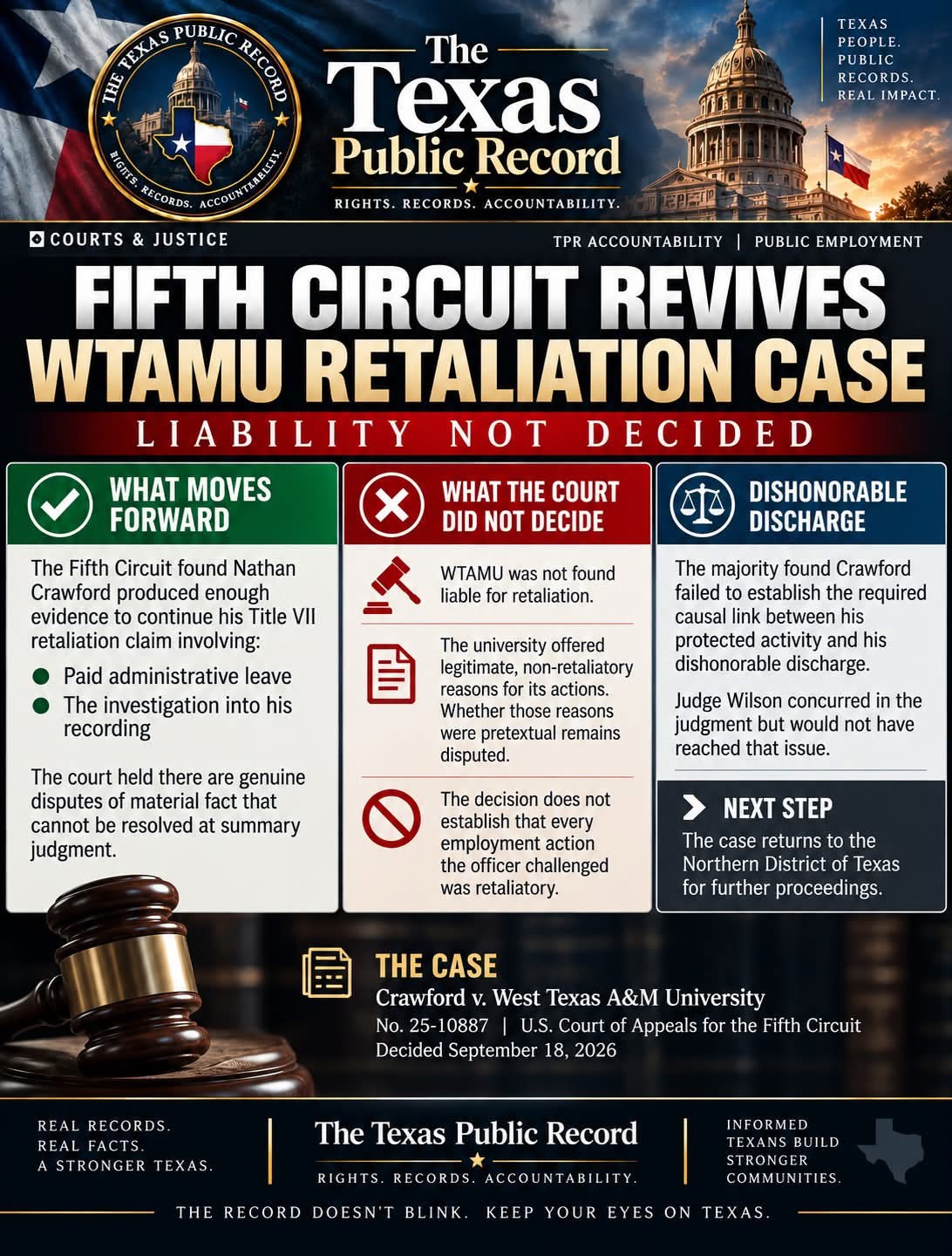
Fifth Circuit revives former WTAMU officer’s retaliation case — but it did not find the university liable
A former West Texas A&M University police officer will get another chance to pursue part of his federal retaliation case after the Fifth Circuit ruled that disputed evidence should not have been resolved against him at summary judgment.
But the September 18 decision does not establish that West Texas A&M unlawfully retaliated against Nathan Crawford. That remains unresolved.
Published: September 21, 2026Desk: TPR-DESK-MON-RJVerified through: September 21, 2026
The Fifth Circuit revived part of Crawford’s retaliation claim while leaving liability unresolved.
Crawford worked for the West Texas A&M University Police Department beginning in 2015.
According to the Fifth Circuit’s opinion, a fellow officer told Crawford in 2021 that another officer had engaged in sexual misconduct. She subsequently initiated a Title IX complaint, and several female officers filed complaints against the officer.
Crawford participated in the investigation and corroborated the allegations.
Both sides agree that his participation in the investigation constituted protected activity for purposes of his Title VII retaliation claim.
What happened next
Crawford alleged that a series of subsequent events amounted to retaliation for his participation in that investigation.
Among them was a dispute over a conversation Crawford recorded involving Police Chief Shawn Burns and Assistant Chief Robert Byrd.
The Fifth Circuit said Burns’ office door was open and the telephone conversation was on speaker. Crawford began recording it because, according to the opinion, he believed the conversation provided evidence of retaliation.
He later reported the recording.
Crawford was placed on paid administrative leave, and an investigation was opened into whether he had unlawfully recorded a private conversation and whether he had misrepresented how the recording was made.
An independent investigative panel ultimately recommended that Crawford be fired and receive a dishonorable discharge designation. Crawford resigned before he could be fired but still received the dishonorable discharge.
The Fifth Circuit noted that a Texas administrative law judge later determined Crawford should have received an honorable discharge.
Crawford subsequently pursued a Title VII retaliation claim against WTAMU. The federal district court granted summary judgment to the university. The Fifth Circuit reversed.
Why the appeals court sent the case back
Title VII prohibits an employer from retaliating against an employee for certain protected activity involving employment discrimination.
At the initial stage of a retaliation case, a plaintiff generally must show protected activity, an adverse employment action and a causal link between the two.
The Fifth Circuit concluded Crawford had produced enough evidence to establish that initial case concerning two actions: his suspension and the investigation into his recording.
The court specifically rejected the idea that paid administrative leave can never qualify as an adverse action. Context matters.
The court explained that paid leave can range from a benign employment measure to something that stigmatizes an employee or affects future opportunities.
The judges also examined evidence concerning Burns’ knowledge of Crawford’s participation in the earlier investigation.
The opinion recounts several statements attributed to Burns that Crawford argued showed retaliatory intent. The university disputed Crawford’s interpretation of those statements.
That dispute is important because the Fifth Circuit did not decide which interpretation is ultimately correct. It concluded that evidence capable of being interpreted in different ways can create a factual question that should not be resolved against the nonmoving party at summary judgment.
WTAMU also provided a non-retaliatory explanation
The decision does not simply accept Crawford’s version of events.
WTAMU argued that its actions resulted from Crawford’s recording and possible misrepresentation about how he made it.
The Fifth Circuit concluded the university satisfied its burden of producing a legitimate, non-retaliatory explanation for its actions.
The court specifically noted that Crawford had said in an email that he recorded the conversation from his desk, while the record showed that he moved toward Burns’ office while recording. The court described that statement as, at minimum, not the whole truth.
But producing a legitimate explanation did not end the case.
The next question was whether Crawford had produced sufficient evidence for a factfinder to determine that WTAMU’s stated explanation was a pretext for retaliation. The Fifth Circuit concluded that he had.
The court pointed to evidence concerning Burns’ knowledge of Crawford’s protected activity, the timing of events, Crawford’s earlier employment record and statements attributed to Burns.
That was enough to create a genuine dispute of material fact. It was not enough to establish liability.
An important limit: the dishonorable discharge
The Fifth Circuit drew an important distinction involving Crawford’s dishonorable discharge.
The court concluded that Crawford could not establish the necessary causal connection between his protected activity and that discharge.
The recommendation came from an independent investigative panel whose members stated under oath that they did not know about Crawford’s participation in the earlier Title IX investigation. The court said Crawford offered no evidence rebutting that point.
The panel therefore concluded that the independent investigation broke the causal chain for the dishonorable-discharge theory.
That distinction matters. The appellate decision revived Crawford’s retaliation case concerning his suspension and the investigation into his recording. It should not be reported as a finding that every employment action Crawford challenged was retaliatory.
What the Fifth Circuit did — and did not — decide
The Fifth Circuit reversed the district court’s summary judgment and sent the case back for further proceedings.
That means Crawford produced sufficient evidence to keep the relevant portions of his retaliation claim alive.
It does not mean a court or jury has determined that WTAMU unlawfully retaliated against him. It does not establish damages. And it does not establish that Crawford will ultimately prevail.
The central factual dispute remains unresolved: whether WTAMU’s actions were actually retaliation for Crawford’s protected participation in the discrimination investigation or resulted from legitimate concerns surrounding his recording and his description of how it was made.
Bottom line
The Fifth Circuit found enough disputed evidence to prevent West Texas A&M University from ending Nathan Crawford’s Title VII retaliation case at summary judgment.
The court concluded that Crawford established the initial requirements of a retaliation claim concerning his suspension and the investigation into his recording, and that evidence created a genuine factual dispute over whether WTAMU’s stated reasons were pretextual.
But the court did not find WTAMU liable for retaliation. It also concluded Crawford failed to establish the necessary causal connection for his dishonorable-discharge theory.
The case now returns to the Northern District of Texas, where those unresolved factual and legal questions remain to be decided.
Records to watch
Northern District of Texas — proceedings following remand.
Any settlement, trial disposition or subsequent dispositive order.
Any further Fifth Circuit activity affecting the September 18 decision.
A Collin County default judgment finds 27 consumer-protection violations, orders an initial $500,626.64 restitution deposit and restricts specified roofing practices. Whether affected homeowners have received money remains unknown.
Texas issued civil investigative demands to Hanes and Fruit of the Loom. No product-specific test results or findings of unlawful conduct have been announced.
Judge Kathleen Cardone’s preliminary injunction stays three federal waivers and requires compliance with applicable laws for covered work throughout the Big Bend Sector.