
Courts & Justice | Federal Government | Border Policy
Supreme Court Sets October 29 Response Deadline in Texas Big Bend Border-Wall Injunction Dispute
The federal government wants the nation’s highest court to lift an injunction restricting border-barrier construction in West Texas. Justice Samuel Alito has requested a response, but the Supreme Court has not yet granted the government’s request.
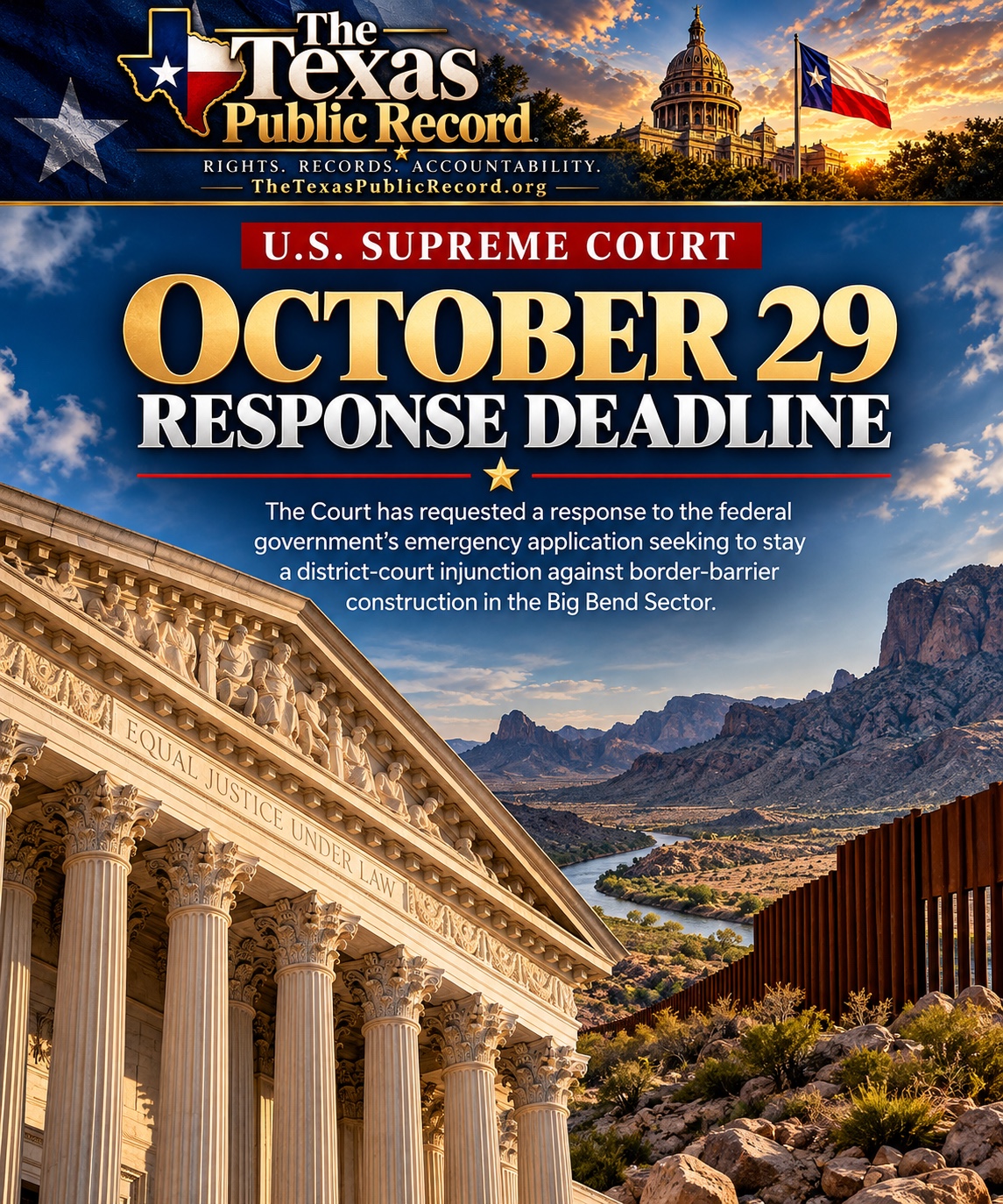
WASHINGTON, D.C. — A federal court order has stopped significant border-wall construction activity in Texas’ Big Bend Sector. Now the federal government is asking the U.S. Supreme Court to intervene, arguing that the injunction interferes with congressional authority granted to the Department of Homeland Security and undermines federal border-security operations.
The Supreme Court has taken an initial procedural step, but it has not decided the dispute.
On October 22, 2026, Justice Samuel Alito requested a response to the government’s emergency application, setting a deadline of October 29 at 4 p.m. Eastern Daylight Time, or 3 p.m. Central Daylight Time.
That deadline is not a scheduled ruling. It is the date by which the opposing parties have been directed to respond to the government’s request for emergency relief.
The distinction matters because the underlying injunction remains the controlling district-court order unless it is modified or stayed.
The dispute reaches beyond the construction of a physical barrier. It concerns how far federal agencies may go in setting aside legal requirements to accelerate border projects, and how much authority federal courts retain to review those decisions.
The case, Mullin v. Friends of the Ruidosa Church, is listed on the Supreme Court’s emergency docket as No. 26A560.
The order that brought construction into question
The controversy began with federal decisions to waive certain legal requirements for border-barrier and road construction in the Big Bend Sector.
Congress, through Section 102 of the Illegal Immigration Reform and Immigrant Responsibility Act of 1996, as subsequently amended, gave the Secretary of Homeland Security authority to waive legal requirements determined necessary to ensure the expeditious construction of qualifying border barriers and roads.
That authority has long been consequential because the waived requirements can include environmental and conservation protections that would otherwise govern federal construction projects.
In 2026, the Department of Homeland Security issued three waiver determinations concerning construction in the Big Bend Sector.
The department maintained that additional barriers and roads were necessary to address illegal crossings and related border-security concerns. The government described the waivers as part of a broader construction effort involving more than 300 miles of proposed barriers and roads.
Opponents challenged the government’s use of that authority.
On October 2, the U.S. District Court for the Western District of Texas issued a preliminary injunction restricting the federal government’s ability to proceed with border-wall construction in the Big Bend Sector without compliance with applicable legal requirements.
The injunction also addressed the effectiveness of the challenged waiver decisions.
A preliminary injunction does not ordinarily constitute a final determination of every issue in a lawsuit. It is an interim judicial order governing the parties while litigation continues or further review occurs.
The district court issued a memorandum opinion explaining its reasoning on October 14.
At the center of that reasoning was whether the government’s interpretation of its statutory waiver authority exceeded what Congress had clearly authorized, including questions about the application of that authority in the Big Bend Sector.
The district court subsequently denied the federal government’s request to stay the injunction in an order signed October 20.
The government took its emergency application to the Supreme Court on October 21.
Washington challenges the court’s authority
The federal government’s Supreme Court application attacks the district court’s decision on both jurisdictional and substantive grounds.
Its principal argument is that Congress sharply limited judicial review of Homeland Security waiver decisions under Section 102.
The government contends that the statute permits certain constitutional challenges but does not authorize the district court to entertain the type of statutory-authority challenge on which the injunction rests.
In the government’s view, the district court improperly used the major-questions doctrine to question a power Congress had expressly granted.
The major-questions doctrine is a principle of statutory interpretation under which courts may require clear congressional authorization when an executive agency claims authority over a matter of vast economic or political significance.
The district court’s reasoning and the government’s response reflect fundamentally different interpretations of how that principle interacts with Congress’ border-construction legislation.
The government also argues that the injunction causes irreparable harm by delaying border-security projects and preventing the department from implementing federal policy.
Those assertions are arguments advanced by the government in litigation, not factual findings adopted by the Supreme Court.
The applicants have requested that the justices stay the preliminary injunction while further review is pursued.
Alternatively, they ask the Supreme Court to treat the emergency application as a petition for a writ of certiorari, grant review and summarily reverse the district court’s decision.
Neither form of relief had been granted in the Supreme Court docket reviewed for this report.
Why the dispute matters to Texas
The Big Bend Sector covers a vast and geographically distinct portion of the Texas-Mexico border, including remote desert and mountain terrain.
Decisions about federal construction there can carry consequences for border enforcement, federal spending, land use and the application of environmental protections.
The legal dispute also raises an institutional question: When Congress gives an executive official broad authority to waive legal requirements, what limits remain on that authority, and which challenges may a federal court hear?
The government’s position emphasizes the breadth of congressional authorization and the statutory limits on judicial review.
The district court’s injunction reflects its preliminary conclusion that the challenged government action could not proceed under the legal reasoning set out in its opinion.
The Supreme Court’s eventual handling of the dispute could affect whether the federal government may resume construction under the challenged waivers while the case moves forward.
But an emergency stay, if granted, would not necessarily resolve every legal issue in the underlying lawsuit. Likewise, a request for a response does not indicate that the justices have accepted either side’s arguments.
What happens October 29
For now, the next documented Supreme Court deadline is October 29.
Justice Alito’s request gives the respondents an opportunity to address the federal government’s emergency application before further action is taken.
The Supreme Court could subsequently issue an order, seek additional submissions or take another procedural step. The October 29 deadline itself does not establish when the Court will decide whether to intervene.
The publicly posted docket reviewed for this article lists the government’s October 21 application and Justice Alito’s October 22 response request. It does not list an order granting a stay.
Until further judicial action changes the situation, the district court’s injunction remains the operative order.
The immediate question is not whether the Supreme Court has approved the federal government’s border-wall plans. It has not done so in this proceeding.
The question is whether the justices will suspend a lower court’s restrictions while the legal fight over federal waiver authority continues.
For Texas, the next consequential development will come not from the passing of the response deadline alone, but from what the Supreme Court decides to do afterward.
Sources
- U.S. Supreme Court — No. 26A560, Mullin v. Friends of the Ruidosa Church. Application filed October 21, 2026; response requested October 22, 2026.
- U.S. Department of Justice — application for a stay of the district-court injunction, filed October 21, 2026
- Supreme Court filing appendix — federal waiver determinations, October 2 preliminary injunction, October 14 memorandum opinion and October 20 order denying a stay
Verification date: October 22, 2026. Supreme Court docket reviewed for procedural status.
EDITORIAL NOTICE: This report reflects records and information available at publication. Allegations, charges, and disputed claims are not findings of wrongdoing. Submit documented correction or clarification requests. Material errors will be corrected transparently.
The Texas Public Record
Rights. Accountability. Awareness.
The record doesn’t blink. Keep your eyes on Texas.