The record doesn’t blink. Keep your eyes on Texas.
All coverage areas
TPR Elections & Public Trust | Governor Record | Public-Record Analysis
Texas Governor Record: Border Security, Operation Lone Star & the Limits of State Power
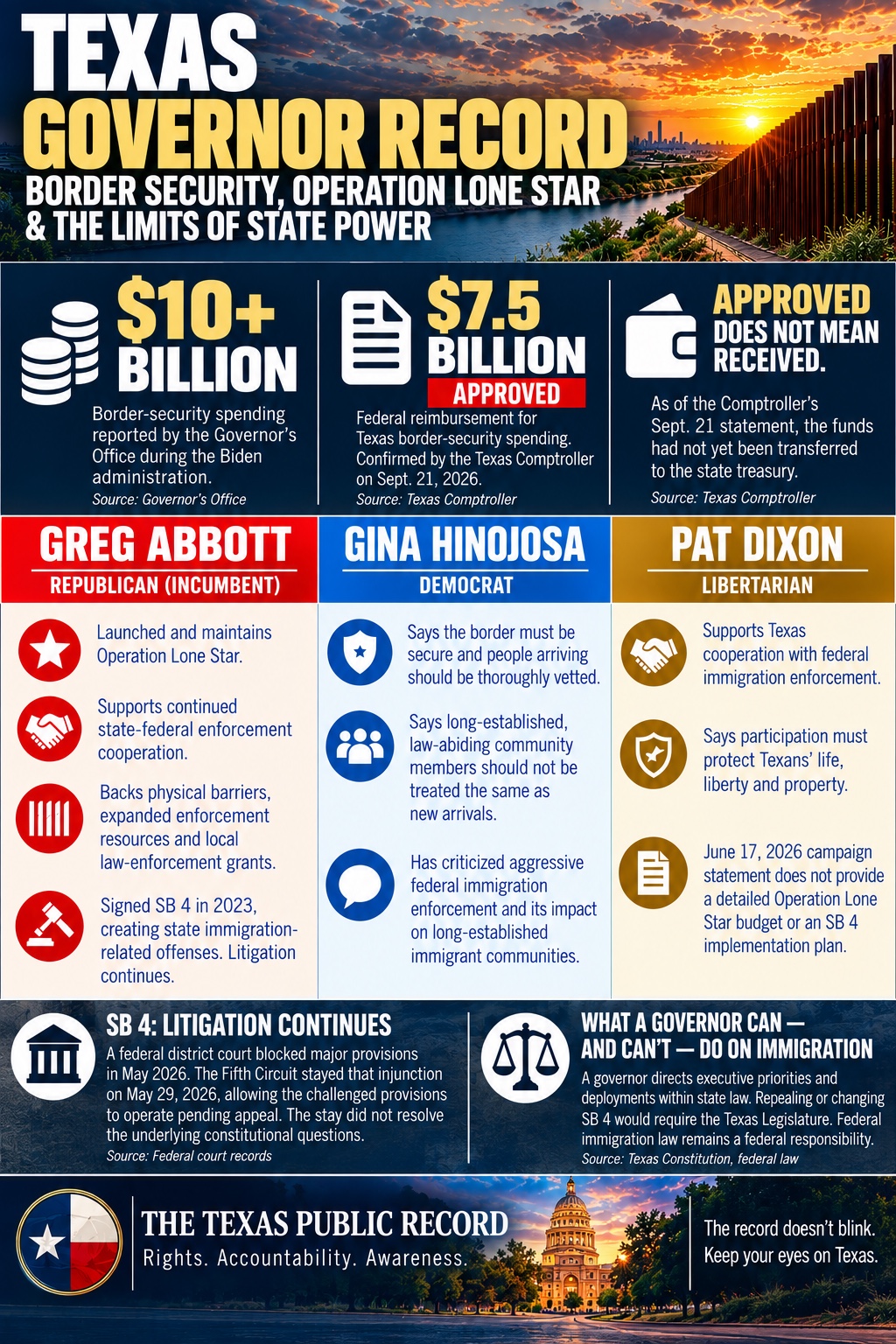
Texas reports more than $10 billion in border-security spending. The federal government has approved approximately $7.5 billion in reimbursement, but the Comptroller said the money had not reached the state treasury as of September 21. The governor’s race raises questions about enforcement priorities, public spending and the boundaries of state authority.
Supplied TPR illustration. Financial transfer status refers to the Comptroller’s September 21 statement. Select to view the complete graphic.
Texas spent years building a state-run border-security operation while challenging federal immigration policy.
Now Washington has approved approximately $7.5 billion to reimburse the state for part of that spending.
The award changes the financial record of Operation Lone Star, the border initiative Gov. Greg Abbott launched in March 2021. It does not settle the operation’s final cost, resolve litigation over Texas immigration law or establish how much of the state’s border spending produced measurable results.
It also arrives during a governor’s race in which the candidates have articulated different positions on enforcement and the proper role of state government.
Abbott, the Republican incumbent, supports continued state-federal enforcement cooperation and maintains Operation Lone Star as a central part of his governing record.
Democratic nominee Gina Hinojosa supports secure borders and vetting new arrivals but challenges aggressive immigration enforcement directed at people who have lived and worked in Texas communities for years.
Libertarian Pat Dixon supports Texas cooperating with federal immigration enforcement, provided that participation protects Texans’ life, liberty and property. His June 17 campaign statement establishes those principles but does not provide a detailed Operation Lone Star budget or SB 4 implementation plan.
The candidates’ positions involve more than whether Texas should participate in immigration enforcement. They concern enforcement priorities, conditions governing state participation and the limits of government authority.
Border security, immigration status, criminal prosecution and deportation are not interchangeable government functions.
Neither are federal reimbursement approval and money actually received.
OPERATION LONE STAR: FIVE YEARS OF STATE ENFORCEMENT
Abbott launched Operation Lone Star in March 2021, deploying the Texas National Guard and Department of Public Safety to the southern border.
The initiative expanded into a substantial state enforcement operation involving personnel, surveillance technology, physical barriers, criminal interdiction, arrests, detention support and coordination with local law enforcement.
The governor’s office reports that Texas spent more than $10 billion on border security during the Biden administration.
That figure establishes the scale of reported state spending. It is not, by itself, a measure of the operation’s effectiveness.
Operation Lone Star also extends beyond personnel stationed directly along the international boundary. State-funded activities include local law-enforcement grants and support for criminal justice operations associated with the initiative.
The spending represents a major commitment of state resources.
Whether those expenditures achieved their stated objectives requires examining actual outcomes, not simply the amount appropriated.
THE FEDERAL GOVERNMENT HAS APPROVED $7.5 BILLION
The reimbursement story has materially changed since Texas submitted its application.
On September 18, Abbott announced that federal authorities had approved approximately $7.5 billion for Texas border-security expenses.
On September 21, Texas Comptroller Don Huffines confirmed the award.
The money comes from the federal State Border Security Reinforcement Fund, created in 2025 to reimburse eligible state border-security expenditures.
According to the Comptroller, the award covers costs Texas previously incurred through Operation Lone Star, including National Guard and DPS deployments, border barriers and related operations.
The Comptroller also established an important limitation:
As of his September 21 announcement, the funds had not yet been transferred to the state.
Once received, the reimbursement is expected to be deposited into the state treasury and become available for appropriation by the 90th Texas Legislature when it convenes in January 2027.
The award is therefore a confirmed federal funding decision, not merely a pending application.
But the September 21 announcement was not confirmation of a completed treasury transfer.
CLAIM VS. RECORD: APPROVED DOES NOT MEAN RECEIVED
Three separate financial events must not be confused.
Texas first incurred the border-security expenses.
The federal government subsequently approved approximately $7.5 billion in reimbursement.
The state must receive and account for the money.
The Comptroller’s September 21 statement confirms the second event and says the third had not yet occurred.
That distinction matters because the award does not establish that Texas had already recovered $7.5 billion in cash as of that announcement.
It also does not establish that every dollar spent on Operation Lone Star has been reimbursed.
The governor’s office reports more than $10 billion in border-security spending during the Biden administration. The approved award covers approximately $7.5 billion.
The final net state cost will depend on the expenses ultimately reimbursed, any additional federal awards and the money actually received.
Huffines has characterized the award as an initial step toward recovering broader costs associated with immigration.
His additional claims about education, incarceration, healthcare and other expenses represent the Comptroller’s position. They are not part of the confirmed $7.5 billion reimbursement award.
The Legislature will also determine how available state funds are appropriated.
Federal reimbursement does not give the governor unilateral authority to spend the money on any purpose he chooses.
ABBOTT’S GOVERNING RECORD GOES BEYOND BORDER DEPLOYMENTS
Operation Lone Star is only one part of Abbott’s immigration record.
He has supported physical barriers, expanded state enforcement resources, National Guard deployments and cooperation between Texas and federal immigration authorities.
He also signed Senate Bill 4 in December 2023.
The law created state immigration-related criminal offenses involving unauthorized entry and reentry and established procedures for certain orders directing people to return to the foreign nation from which they entered.
SB 4 attempted to give Texas a larger role in immigration enforcement, an area extensively regulated by federal law.
That expansion produced years of litigation.
It remains important to distinguish what the Legislature enacted from what courts have allowed to operate and what they have finally decided.
SB 4: THE LAW CAN OPERATE, BUT THE CONSTITUTIONAL DISPUTE IS NOT SETTLED
The litigation surrounding SB 4 has changed repeatedly.
On April 24, 2026, the Fifth U.S. Circuit Court of Appeals vacated an earlier injunction after concluding that the plaintiffs in that case lacked standing.
That decision did not resolve the underlying constitutional merits.
Separate litigation then produced another federal district court injunction on May 14, blocking major reentry and removal provisions.
The district court did not block every provision of the statute.
On May 29, the Fifth Circuit stayed that injunction pending appeal, allowing the challenged provisions to operate while the litigation continued.
The appellate stay was not a final ruling that every challenged provision complies with the Constitution.
The central dispute concerns the division of immigration authority between Texas and the federal government.
Federal law governs admission, immigration status and removal from the United States. Texas possesses authority to enforce state criminal laws within constitutional limits.
SB 4 tests where those powers intersect.
CLAIM VS. RECORD: SIGNING SB 4 DID NOT SETTLE FEDERAL IMMIGRATION AUTHORITY
Abbott signed the law.
The Legislature enacted it.
Federal courts determine whether challenged provisions can operate within constitutional limits.
Those are different institutional responsibilities.
The May 29 appellate stay permitted enforcement of provisions that had been blocked by the district court. It did not permanently resolve the constitutional questions.
A governor cannot eliminate the federal-state division of immigration authority by executive order.
Nor can a governor unilaterally repeal a statute enacted by the Legislature.
Any administration seeking to change SB 4 would have to work within those legal boundaries.
HINOJOSA SUPPORTS A SECURE BORDER, BUT CHALLENGES ENFORCEMENT PRIORITIES
Hinojosa grew up in Brownsville, along the Texas-Mexico border.
In a September 8 CNN interview, she said the United States needs secure borders and that people arriving should be thoroughly vetted.
She also drew a distinction between new arrivals and people who have lived and worked in Texas communities for many years.
Hinojosa argued that targeting established, law-abiding community members does not necessarily improve public safety.
She criticized aggressive federal immigration enforcement and expressed concern about its effects on immigrant communities.
She also acknowledged shortcomings in the Biden administration’s border policy, saying his administration had not provided sufficiently strong leadership during periods of disorder at the border.
Those statements establish a position more specific than either unrestricted immigration or blanket opposition to enforcement.
Hinojosa supports border security while advocating different enforcement priorities and treatment of long-established immigrant communities.
Her comments do not, by themselves, establish a complete replacement budget for Operation Lone Star or a detailed legislative plan for every provision of SB 4.
PAT DIXON: FEDERAL COOPERATION WITH LIMITS
Libertarian Pat Dixon supports Texas cooperating with federal immigration enforcement but says that participation must protect Texans’ life, liberty and property.
His June 17 campaign statement establishes those principles. It does not provide a detailed Operation Lone Star budget or an SB 4 implementation plan.
The distinction matters. Dixon has articulated a position on state-federal cooperation and individual protections, but the statement does not establish how he would fund, restructure or implement the specific programs examined in this report.
TPR does not substitute the Libertarian Party’s general platform for Dixon’s own documented commitments.
WHAT COULD A NEW GOVERNOR ACTUALLY CHANGE?
The governor has substantial influence over state executive operations.
A new administration could review National Guard deployments, DPS priorities, executive directives, coordination arrangements and proposed border-security spending.
It could also recommend changes to state immigration legislation and request different appropriations.
Those powers are consequential.
But they are not unlimited.
The governor cannot independently repeal SB 4.
The governor cannot rewrite federal immigration law.
And the governor cannot direct federal Immigration and Customs Enforcement to adopt a different national enforcement policy.
Repealing or substantially changing state law requires legislative action.
Federal immigration enforcement remains principally a federal responsibility.
The distinction applies regardless of which candidate occupies the governor’s office.
BORDER SECURITY AND INTERIOR ENFORCEMENT ARE DIFFERENT QUESTIONS
Political discussions frequently treat immigration as one policy decision.
It is not.
Border security includes surveillance, interdiction, ports of entry, personnel and infrastructure near the international boundary.
Interior enforcement concerns people already living in the United States.
Criminal prosecution, civil immigration detention and removal proceedings are also legally distinct.
Abbott’s approach emphasizes state enforcement resources and continued cooperation with federal authorities.
Hinojosa’s documented position emphasizes secure borders and vetting while questioning aggressive enforcement against long-established immigrant communities.
Dixon supports cooperation with federal immigration authorities subject to protections for Texans’ life, liberty and property.
These are distinct positions. They should not be reduced to a binary choice between supporting and opposing border security.
DOES THE SPENDING ESTABLISH THAT OPERATION LONE STAR WORKED?
No single spending or enforcement statistic can establish the overall effectiveness of Operation Lone Star.
The governor’s office reports arrests, apprehensions, drug seizures and other enforcement activity.
Those measurements describe different events.
An arrest is not a conviction.
A drug seizure does not independently establish how much trafficking was prevented.
An apprehension count is not the same as the number of people ultimately removed from the United States.
Changes in border encounters also occur alongside changes in federal policy, migration patterns, enforcement practices and conditions outside Texas.
Attributing every increase or decrease to one state initiative would exceed what those figures alone establish.
The same evidentiary standard applies to criticism of the operation.
The reported $10 billion-plus expenditure does not independently establish that every dollar was necessary or that the initiative produced no benefit.
A complete assessment requires examining outcomes, costs, alternative explanations and the actual federal reimbursement received.
The new $7.5 billion award changes the financial picture.
It does not retroactively answer every question about operational effectiveness.
BOTTOM LINE: WHAT THE RECORD ACTUALLY SHOWS
Abbott launched Operation Lone Star in March 2021 and maintained it as a major state enforcement initiative.
His administration reports more than $10 billion in border-security spending during the Biden administration.
The federal government has approved approximately $7.5 billion to reimburse Texas for eligible expenses.
That is a material financial development.
But the Comptroller said on September 21 that the money had not yet been transferred to the state treasury.
The distinction is no longer between a reimbursement request and an approved award. It is between an approved award and funds actually received.
Abbott also signed SB 4, expanding Texas’ immigration-related criminal enforcement authority. The law has been subject to repeated federal court challenges, and the May 29 appellate stay did not resolve its underlying constitutional questions.
Hinojosa supports secure borders and vetting new arrivals but challenges aggressive enforcement directed at people who have lived and worked in Texas communities for years.
Dixon supports Texas cooperating with federal immigration enforcement, subject to protecting Texans’ life, liberty and property. His June 17 statement does not establish a detailed Operation Lone Star budget or SB 4 implementation plan.
The next governor will influence deployments, executive priorities, appointments and budget recommendations.
The Legislature controls statutory changes and appropriations.
Federal law continues to govern core immigration functions.
The award does not resolve several financial questions: how much Texas will ultimately receive, when the money will reach the state treasury, which expenses will qualify for reimbursement and how the Legislature may appropriate the funds. Separate legal and policy questions also remain unresolved, including the limits of state immigration enforcement and the extent to which a governor can alter Operation Lone Star without legislative or federal action.
More than $10 billion reported spent. Approximately $7.5 billion approved for reimbursement. No confirmed transfer as of the Comptroller’s September 21 statement.
Those are the financial facts.
The remaining questions concern what the spending accomplished, how much Texas ultimately recovers and which enforcement decisions fall within the lawful authority of the next governor.
Source review completed September 26, 2026. Treasury-transfer status is stated as of the Comptroller’s September 21 announcement. The SB 4 account describes the April 24 opinion, May 14 injunction and May 29 stay, supplemented by TMCEC’s litigation summary; this review does not constitute a complete current federal docket audit. The official Constitution PDF link did not expose its text during this review; the cited provisions were checked against official indexed text and the Governor’s description of the office’s powers.
EDITORIAL NOTICE: This report reflects records and information available at publication. Allegations, charges, and disputed claims are not findings of wrongdoing. Submit documented correction or clarification requests by messaging The Texas Public Record on the platform where this article appears. Material errors will be corrected transparently.
The Texas Public Record Rights. Accountability. Awareness. The record doesn’t blink. Keep your eyes on Texas.
Railroad Commission records show more drilling permits issued in September 2026, even as the number of oil and gas completion reports processed by state regulators remained substantially below September 2025 levels.
TxDOT says competitive awards will make better use of federal transportation money. Earlier application instructions show projects were already scored and ranked. The significant change is removal of a formula that helped determine how funding was distributed across Texas.