Rural Texas
Waco Has an Ice Age Nursery, Preserved in Fossils
Waco Mammoth National Monument preserves evidence of a Columbian mammoth nursery herd, while ongoing research revises the story of how fossils were deposited.

Rights. Accountability. Awareness.
The record doesn’t blink.
Keep your eyes on Texas.
TPR Rural Texas | Public-Record Explainer
A livestock owner’s responsibilities can depend on an election held generations ago, the animal involved and the road beside the property. Texans may need to examine their own county’s records to determine which restrictions apply.
A cow wanders across a fence line in rural Texas. Who was responsible for keeping it on the other side?
The answer may depend on a local election held decades before either property owner arrived.
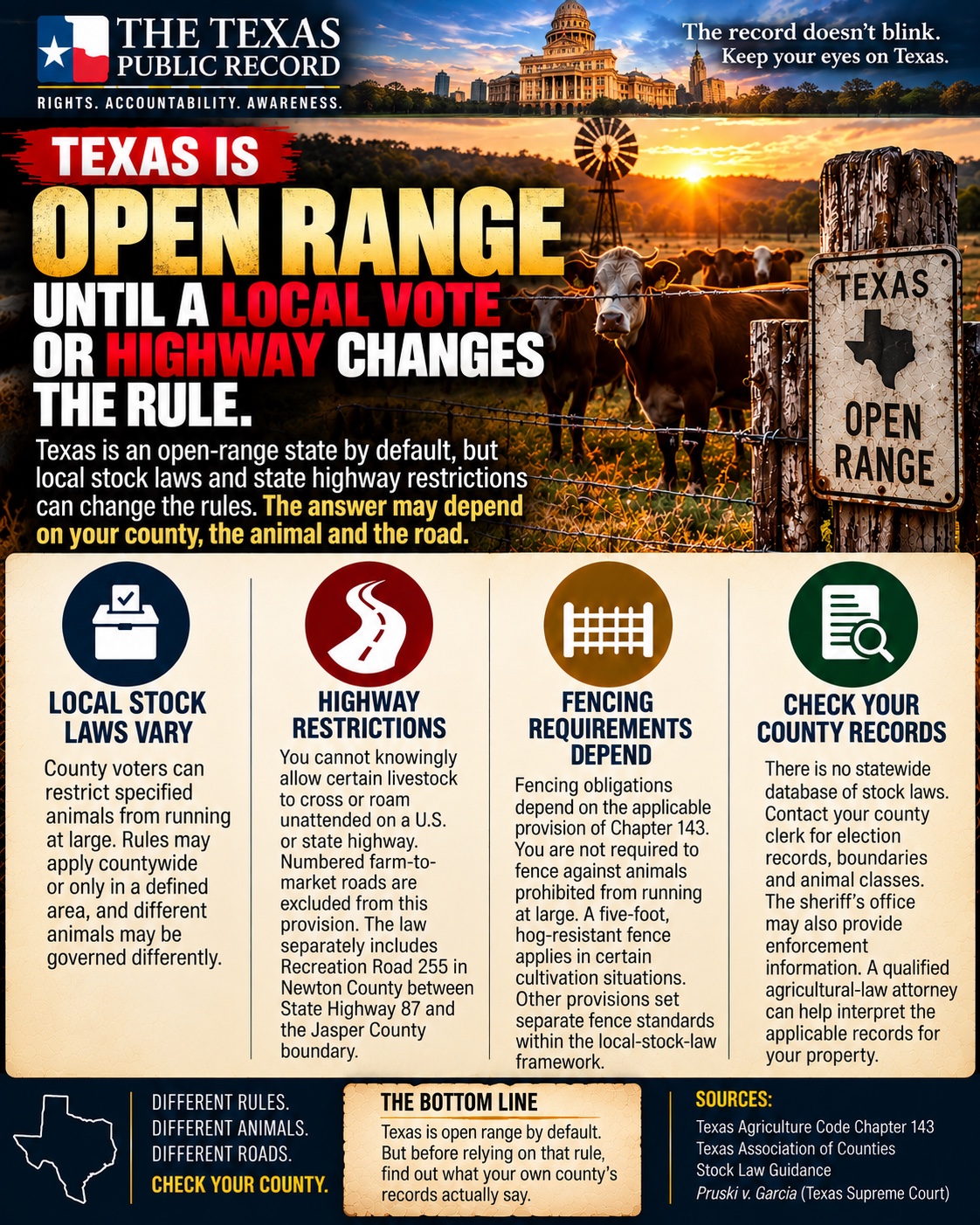
Texas is an open-range state by default. Livestock generally may run at large unless a local stock law or another statutory restriction provides otherwise.
But that familiar description comes with exceptions that can change from one county to another, or even within the same county.
The animal matters. The location matters. And when a public road is involved, an additional state law may control.
For Texans buying rural property, raising livestock or living beside agricultural land, understanding those distinctions can prevent costly assumptions.
Texas Agriculture Code Chapter 143 authorizes local-option elections restricting specified animals from running at large.
Depending on the applicable statutory provisions and election, restrictions may cover cattle, horses, hogs, sheep, goats or other designated animals.
A stock law may apply throughout a county or within a smaller defined area.
That means a property owner cannot necessarily determine the applicable rule by asking whether the county is generally considered open range.
The controlling restriction may apply only to a particular precinct or historical subdivision. Different animal classes may also be subject to different restrictions.
Some of these decisions are surprisingly old.
The Texas Association of Counties reports that many stock-law elections occurred before 1950. Those historical decisions can remain legally significant today.
A livestock dispute in 2026 may therefore depend on an election held generations earlier.
This is where the issue becomes especially important for rural landowners.
According to the Texas Association of Counties, no centralized statewide database identifies every local stock law.
There is no single authoritative statewide map that reliably tells every property owner which livestock restrictions apply to a particular tract.
The relevant information may be preserved in historical election records, commissioners court minutes, election orders or subsequent county actions.
A countywide description found online may not account for older precinct boundaries, animal-specific restrictions or later changes.
For that reason, Texans should research the records governing their specific property rather than rely on a general statement that their county is open or closed range.
Even where livestock are otherwise permitted to run at large, Texas law imposes separate restrictions involving certain highways.
Agriculture Code §143.102 prohibits a person who owns or controls specified livestock from knowingly permitting those animals to cross or roam unattended on a covered highway right-of-way.
The provision covers horses, mules, donkeys, cows, bulls, steers, hogs, sheep and goats.
A violation is a Class C misdemeanor.
But the statutory definition of highway matters.
Under §143.101, the restriction applies to U.S. and state highways. Numbered farm-to-market roads are excluded from this provision.
The law separately includes Recreation Road 255 in Newton County between State Highway 87 and the Jasper County boundary.
That specific inclusion is written into the law.
The exclusion of numbered farm-to-market roads does not mean livestock may automatically roam unattended on every such road. An applicable local stock law or another legal requirement may still govern.
The road’s classification and the property’s location must be examined together.
Open range is not a blanket exemption from roadway restrictions.
The distinction between an animal escaping and an owner knowingly allowing it to roam can determine the outcome of a legal dispute.
In Pruski v. Garcia, decided in 2020, the Texas Supreme Court considered a collision involving a bull that escaped through a broken gate and wandered onto State Highway 123 in Wilson County.
The county had adopted a local stock law.
The court held that, for the highway collision at issue, the liability standard under Agriculture Code §143.102 controlled over the conflicting local stock-law standard.
That highway provision requires knowing permission.
The court therefore rejected the attempt to impose liability under the less demanding local stock-law standard when the collision occurred on a covered state highway.
The decision illustrates why the mere presence of livestock on a roadway does not automatically establish that its owner violated the highway statute.
It also demonstrates that a local stock law and a statewide highway restriction can produce different legal consequences.
The specific circumstances, applicable statutes and evidence remain essential.
Texas law distinguishes between fencing against livestock that may lawfully run at large and an owner’s responsibility to keep animals contained where running at large is prohibited.
Agriculture Code §143.001 addresses fencing around cleared land in cultivation. Within its statutory framework, it specifies a fence at least five feet high and sufficiently close to prevent hogs from passing through.
Section 143.028 establishes separate fencing provisions within the local-stock-law framework. It expressly provides that a person is not required to fence against animals prohibited from running at large.
That section also contains requirements for a sufficient fence, including a four-foot minimum and construction specifications for particular fence types.
These provisions serve different purposes. The four-foot standard in §143.028 should not be presented as the statewide default for all agricultural fencing.
Which requirements apply depends on the property, the animals involved, the applicable local stock laws and the relevant statutory provisions.
Before building or replacing a livestock fence, landowners should verify the operative stock-law records for their location and identify which part of Chapter 143 governs their circumstances.
Before purchasing rural property, installing livestock fencing or relying on an area’s open-range status, research the rules applicable to the exact location.
Start with your county clerk’s office.
Ask whether the county has adopted local-option stock laws under Texas Agriculture Code Chapter 143 and whether any restrictions apply to your property.
Request the existing records that establish the answer:
The county sheriff’s office may also provide information about current local livestock and estray enforcement procedures.
If the issue involves a particular property, request records identifying the applicable historical precinct or district boundaries.
Do not assume modern precinct boundaries are identical to those used when an older stock-law election occurred.
If the county cannot provide a definitive answer from existing records, a qualified Texas agricultural-law attorney can help interpret the controlling documents.
A verbal description of the county’s general status is useful as a starting point. The operative records establish the legal foundation.
Texas retains an open-range default, subject to local stock laws and other statutory restrictions.
Local voters may adopt restrictions covering particular animals and geographic areas.
Historical elections can remain relevant.
Separate state restrictions govern specified livestock on U.S. and state highway rights-of-way, as well as the specifically designated portion of Recreation Road 255.
The applicable fencing provisions depend on whether the animals are legally permitted to run at large and which statutory requirements govern.
The statewide framework does not establish whether a particular property is subject to an operative stock law.
It does not establish that every livestock owner must fence every animal in.
It does not establish that livestock may roam anywhere without restriction.
It does not establish a universal four-foot fencing standard.
And it does not establish that every escaped animal creates civil liability for its owner.
Those questions require the applicable local records and, where necessary, fact-specific legal review.
A rural property purchase may carry livestock-related responsibilities that are not obvious from the fence line.
An owner planning to raise cattle may discover that a historical election governs the property.
A neighboring landowner may need to understand whether the applicable rule requires livestock to be contained or whether fencing against lawfully roaming animals is relevant.
A driver encountering livestock on a state highway may face a different legal situation from one involving a farm-to-market road.
And a broken gate does not, by itself, establish the knowing permission required under the state highway statute.
The answer is not always found in the county’s general reputation.
It may be recorded in an election held decades ago.
Texas is open range by default. But before relying on that rule, find out what your own county’s records actually say.
Source review: September 27, 2026. The court opinion and TAC guide were inspected directly. The Legislature’s links redirected to its homepage during review; the relevant statutory text was checked in indexed official Legislature documents and against the cited guidance. No property-specific stock-law determination is made here. This explainer is general information, not legal advice.
EDITORIAL NOTICE: This report reflects records and information available at publication. Allegations, charges, and disputed claims are not findings of wrongdoing. Submit documented correction or clarification requests by messaging The Texas Public Record on the platform where this article appears. Material errors will be corrected transparently.
The Texas Public Record
Rights. Accountability. Awareness.
Rural Texas
Waco Mammoth National Monument preserves evidence of a Columbian mammoth nursery herd, while ongoing research revises the story of how fossils were deposited.
Rural Texas
A Texas town named for a revolutionary, a nineteenth-century concrete legacy, the workers who built it and a giant pecan that became a local landmark.
Rights & Justice
A Collin County default judgment finds 27 consumer-protection violations, orders an initial $500,626.64 restitution deposit and restricts specified roofing practices. Whether affected homeowners have received money remains unknown.