Rural Texas
Waco Has an Ice Age Nursery, Preserved in Fossils
Waco Mammoth National Monument preserves evidence of a Columbian mammoth nursery herd, while ongoing research revises the story of how fossils were deposited.

Rights. Accountability. Awareness.
The record doesn’t blink.
Keep your eyes on Texas.
TPR Rural Texas | The Receipts
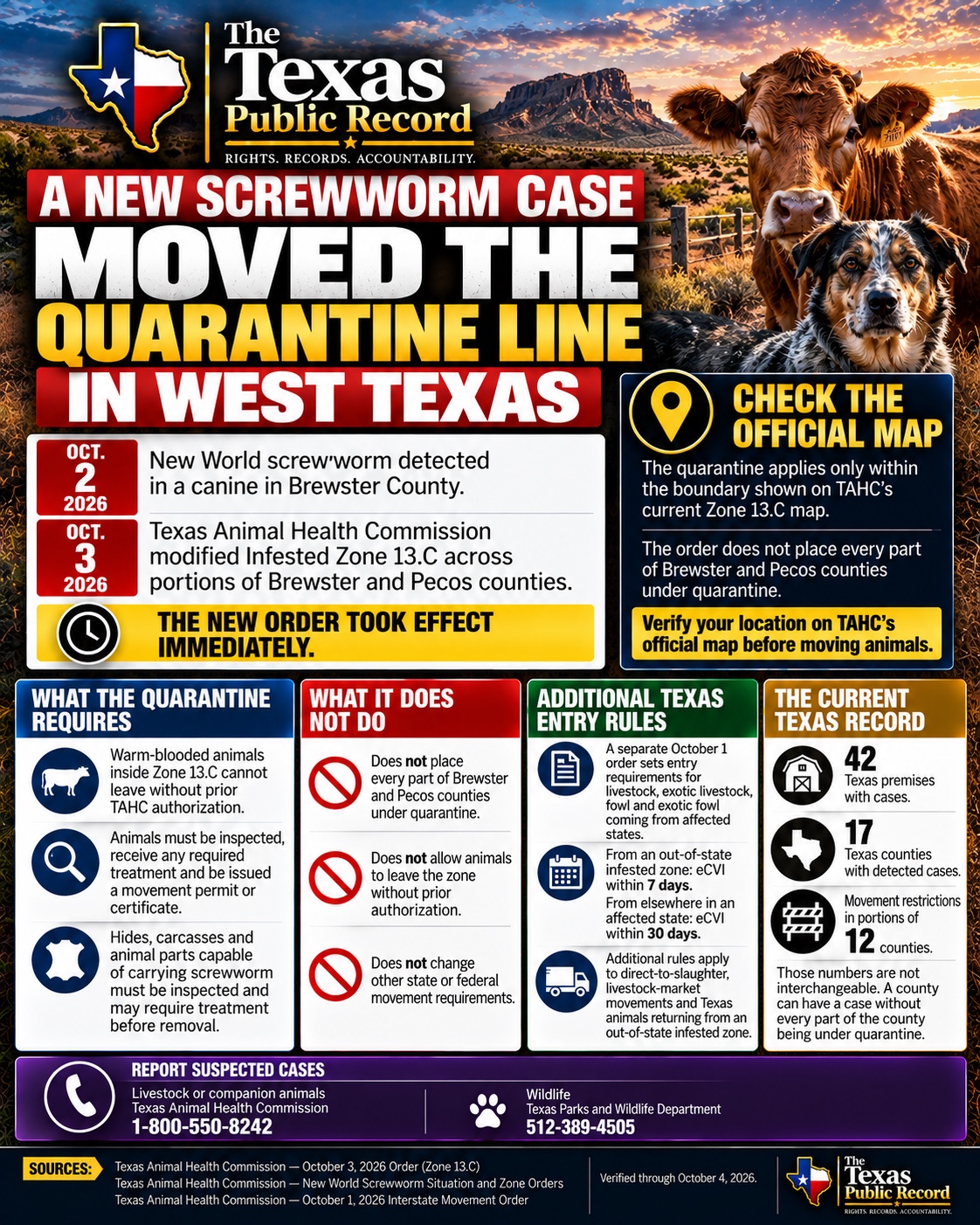
A single confirmed animal case can move a line on the map.
In West Texas, that line now determines when livestock, pets and other warm-blooded animals can legally leave part of Brewster and Pecos counties.
The Texas Animal Health Commission revised New World screwworm Infested Zone 13.C on October 3 after the parasite was detected in a canine in Brewster County one day earlier.
The new order replaces a September 28 order and redraws the quarantine boundary across portions of Brewster and Pecos counties.
It took effect immediately.
Warm-blooded animals inside Zone 13.C cannot be moved beyond the quarantine boundary without prior authorization from TAHC.
Before an animal can leave, it must be inspected, receive any treatment required by the agency and be issued a movement permit or certificate by an authorized commission representative.
The order also reaches hides, carcasses and animal parts capable of serving as a host for New World screwworm. Those materials must be inspected and undergo any treatment TAHC considers necessary before removal.
Unauthorized movement can result in administrative penalties or criminal prosecution.
The order does not place every part of Brewster and Pecos counties under quarantine.
It applies inside the boundary shown on TAHC's official Zone 13.C map. Owners should verify an animal's location through the current agency map rather than relying on a county name alone.
New World screwworm is not an ordinary parasite.
Its larvae enter wounds or other soft tissue and feed on living flesh. An untreated infestation can cause severe injury, secondary infection and death.
That makes animal movement part of the state's containment strategy.
TAHC says moving infested animals can spread screwworm flies and larvae, cause new infestations and increase the overall screwworm population.
The October 3 order says the latest boundary change followed detection in a canine in Brewster County on October 2.
The public order does not identify the animal's owner, disclose its precise location or establish its present condition. Those facts should not be inferred.
The West Texas quarantine governs warm-blooded animals moving out of a defined infested zone.
A separate TAHC order signed October 1 establishes additional Texas entry requirements for livestock, exotic livestock, fowl and exotic fowl coming from states affected by New World screwworm.
Under that order, an "affected state" is one where New World screwworm has been detected and an infested zone, quarantine area or control area remains active.
Animals covered by the order that originate inside an active out-of-state infested zone generally need an electronic certificate of veterinary inspection issued within seven days before entering Texas. The certificate must document the NWS inspection and any treatment performed and certify that the animal is free of NWS infestation and wounds.
Covered animals originating outside an infested zone but still within an affected state generally need an electronic certificate issued within 30 days. It must certify their origin and that they were inspected and found free of NWS infestation and wounds.
Separate procedures apply to certain direct-to-slaughter movements, livestock-market movements and Texas animals returning from an out-of-state infested zone.
These requirements supplement other Texas animal-entry rules.
They are not a blanket prohibition on interstate livestock commerce.
TAHC's current screwworm page reports cases connected to 42 Texas premises.
It also reports active movement restrictions in portions of 12 counties: Brewster, Crockett, Edwards, Jeff Davis, Pecos, Presidio, Schleicher, Starr, Sutton, Terrell, Val Verde and Zapata.
TAHC separately reports that New World screwworm cases have been detected in 17 Texas counties.
Those numbers are not interchangeable.
A county can have a documented case without every part of that county remaining inside an active quarantine. Zones may be expanded, modified or released as surveillance and eradication work continues.
That is why the governing record is not simply a statewide case count.
It is the current map, the active executive orders and the movement documents required for each animal.
Anyone moving an animal near an active zone should check the current TAHC map before transport.
TAHC says warm-blooded animals moving outside an infested zone must be coordinated with the agency or a New World screwworm certified inspector for inspection and the required movement documentation.
Suspected infestations involving livestock or companion animals should be reported immediately to TAHC at 1-800-550-8242.
Suspected wildlife cases can be reported to the Texas Parks and Wildlife Department at 512-389-4505.
The boundaries can change.
The paperwork can change.
And the October 3 order demonstrates how quickly one confirmed case can alter the legal route out.
Verified through October 4, 2026.
EDITORIAL NOTICE: This report reflects records and information available at publication. Allegations, charges, and disputed claims are not findings of wrongdoing. Submit documented correction or clarification requests by messaging The Texas Public Record on the platform where this article appears. Material errors will be corrected transparently.
The Texas Public Record
Rights. Records. Accountability.
Rural Texas
Waco Mammoth National Monument preserves evidence of a Columbian mammoth nursery herd, while ongoing research revises the story of how fossils were deposited.
Rural Texas
A Texas town named for a revolutionary, a nineteenth-century concrete legacy, the workers who built it and a giant pecan that became a local landmark.
Rural Texas
The Guadalupe Mountains preserve the Capitan Reef, built in an ancient Permian sea and later exposed by uplift and erosion.