Texas Law & Rights Education
Texas Has Its Own Bill of Rights. Here Is What Article I Protects.
The Texas Constitution protects expression, religious liberty, criminal-procedure rights and property while placing limits on government power.

Rights. Accountability. Awareness.
The record doesn’t blink.
Keep your eyes on Texas.
Texas Law & Rights Education
Texas county jails have operated under state administrative temperature standards that did not apply to TDCJ prisons. The distinction helps explain why the new federal prison-heat order rests on a different legal foundation.
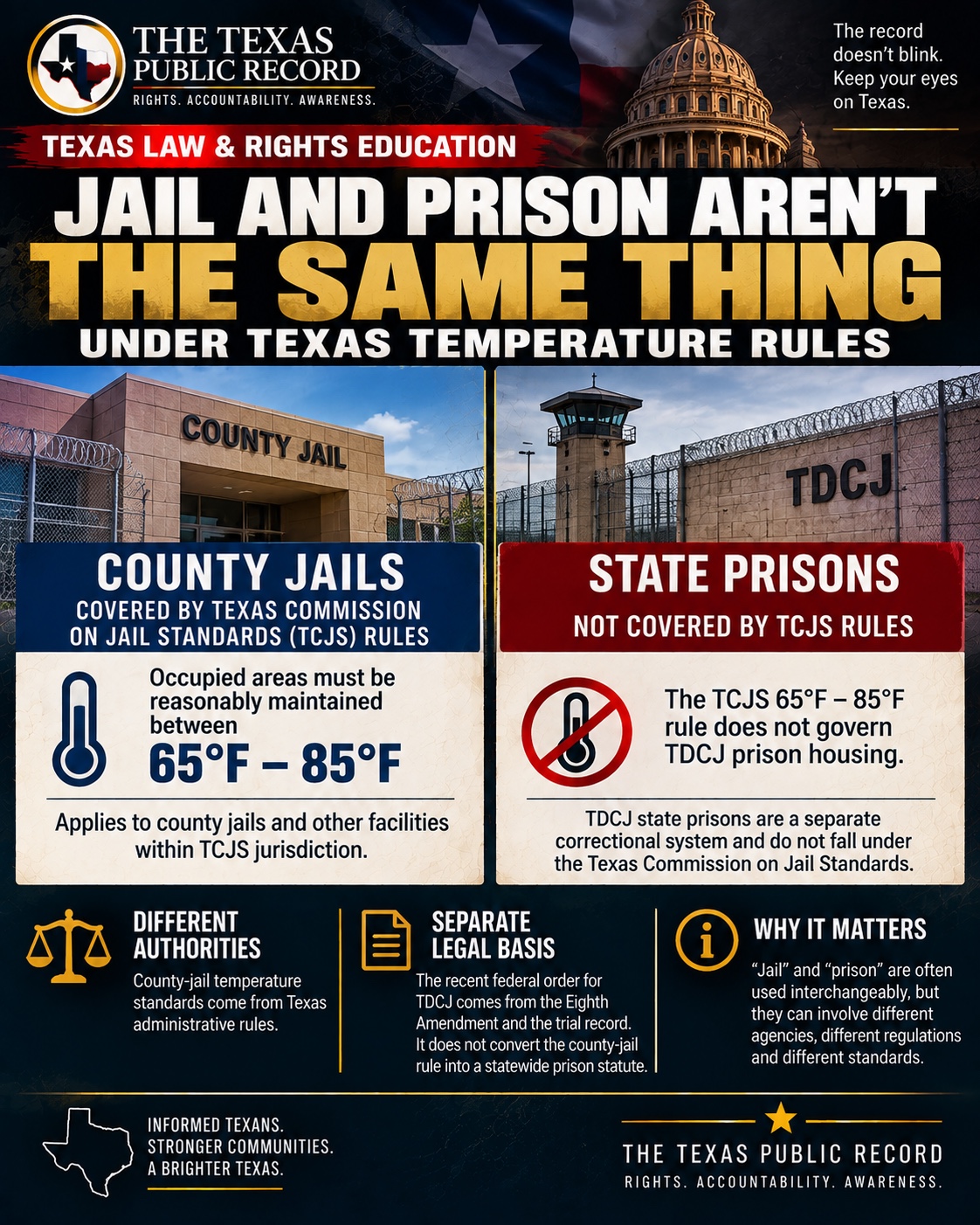
A person confined in a Texas county jail and a person incarcerated in a Texas state prison may both be behind bars, but the facilities holding them operate under different regulatory systems.
That distinction extends to temperature standards.
Texas Commission on Jail Standards rules require occupied areas in covered county-jail facilities to be reasonably maintained between 65 and 85 degrees Fahrenheit.
The same Texas Commission on Jail Standards requirement has not governed housing inside prisons operated by the Texas Department of Criminal Justice.
That difference has taken on new relevance after a federal judge ordered TDCJ to install permanent air conditioning throughout its prison system by the end of 2029.
The federal order did not simply extend Texas’ county-jail temperature rule to state prisons.
It arose under a different source of law: the U.S. Constitution.
The Texas Commission on Jail Standards establishes minimum standards for county jails and other facilities within its jurisdiction.
Those standards contain temperature-control requirements providing that temperatures in occupied areas be reasonably maintained between 65°F and 85°F.
The commission regulates county jails, not TDCJ’s state-prison system.
That jurisdictional divide is central to understanding why the existence of a county-jail temperature rule did not automatically impose the same requirement on state prisons.
A Texas county jail is generally a local correctional facility subject to TCJS oversight. TDCJ, meanwhile, operates the state’s prison system under a separate legal and administrative structure.
The difference is more than terminology. It determines which agency has regulatory authority and which rules govern the facility.
The 65-to-85-degree standard applicable to covered county-jail facilities should not be described as a preexisting statewide requirement for every correctional facility in Texas.
TDCJ facilities do not fall under the Texas Commission on Jail Standards’ jurisdiction, and the commission’s county-jail temperature provisions therefore did not establish the same temperature range for TDCJ prison housing.
That left the conditions inside state prisons to be evaluated under other applicable laws and constitutional requirements.
The distinction became consequential in litigation over extreme heat inside Texas prisons.
On September 22, U.S. District Judge Robert Pitman ordered TDCJ to install permanent air conditioning throughout its prison system by December 31, 2029.
The order came in Texas Citizens United for Rehabilitation of Errants, Inc., et al. v. Bobby Lumpkin, litigation challenging extreme heat inside Texas prisons.
The court found that conditions in TDCJ’s un-air-conditioned prisons violated the Eighth Amendment’s prohibition against cruel and unusual punishment and that the state’s existing response was insufficient.
That is fundamentally different from the Texas Commission on Jail Standards establishing an administrative temperature range for facilities within its jurisdiction.
The county-jail requirement comes from Texas administrative regulation. The prison mandate comes from a federal court applying the Eighth Amendment to the conditions and evidence presented in the litigation.
The federal ruling therefore does not transform the TCJS county-jail standard into a Texas statute governing state prisons.
Texas county-jail facilities covered by Texas Commission on Jail Standards rules have been subject to administrative temperature-control requirements, including the requirement that occupied areas be reasonably maintained between 65°F and 85°F.
TDCJ prisons have not been governed by that same TCJS requirement.
The September 22 federal order establishes a separate requirement for TDCJ arising from federal constitutional litigation.
The federal ruling does not establish that Texas enacted a statewide statute requiring every jail and prison to maintain exactly the same temperature range.
It also does not mean the federal court simply applied the existing county-jail rule to TDCJ.
The 65-to-85-degree TCJS standard and the federal prison-air-conditioning order should not be treated as interchangeable. Their legal sources, jurisdictions and requirements differ.
“Jail” and “prison” are frequently used interchangeably in ordinary conversation. Government records require more precision.
A county jail and a TDCJ prison can be subject to different agencies, regulations and legal standards even when both facilities perform a correctional function.
That distinction becomes particularly important when evaluating claims that Texas already had a temperature requirement for incarcerated people.
For county jails under TCJS jurisdiction, Texas administrative rules provided a specific temperature standard.
For TDCJ prisons, that same rule did not apply.
The new federal order addresses the prison system through a separate constitutional remedy.
County jails: TCJS rules require occupied areas in covered facilities to be reasonably maintained between 65°F and 85°F.
TDCJ state prisons: The same TCJS temperature rule does not govern TDCJ prison housing.
Federal order: A federal court separately ordered permanent air conditioning throughout TDCJ by the end of 2029 based on the Eighth Amendment and the record developed in the prison-heat litigation.
The Texas Public Record
Rights. Accountability. Awareness.
Texas Law & Rights Education
The Texas Constitution protects expression, religious liberty, criminal-procedure rights and property while placing limits on government power.
Texas Law & Rights Education
Texas law does not supply a blanket 25-foot recording distance. The interference statute, Fifth Circuit precedent and TCOLE guidance distinguish recording from obstruction.
Texas Law & Rights Education
In 2009, Texas replaced Pleurocoelus with Paluxysaurus jonesi after research changed the identification.