The record doesn’t blink. Keep your eyes on Texas.
All coverage areas
TPR Constitution Education | Texas Constitution | Article I
Texas Has Its Own Bill of Rights. Here Is What Article I Protects.
By Michael L. Hamilton II · The Texas Public RecordOctober 7, 2026
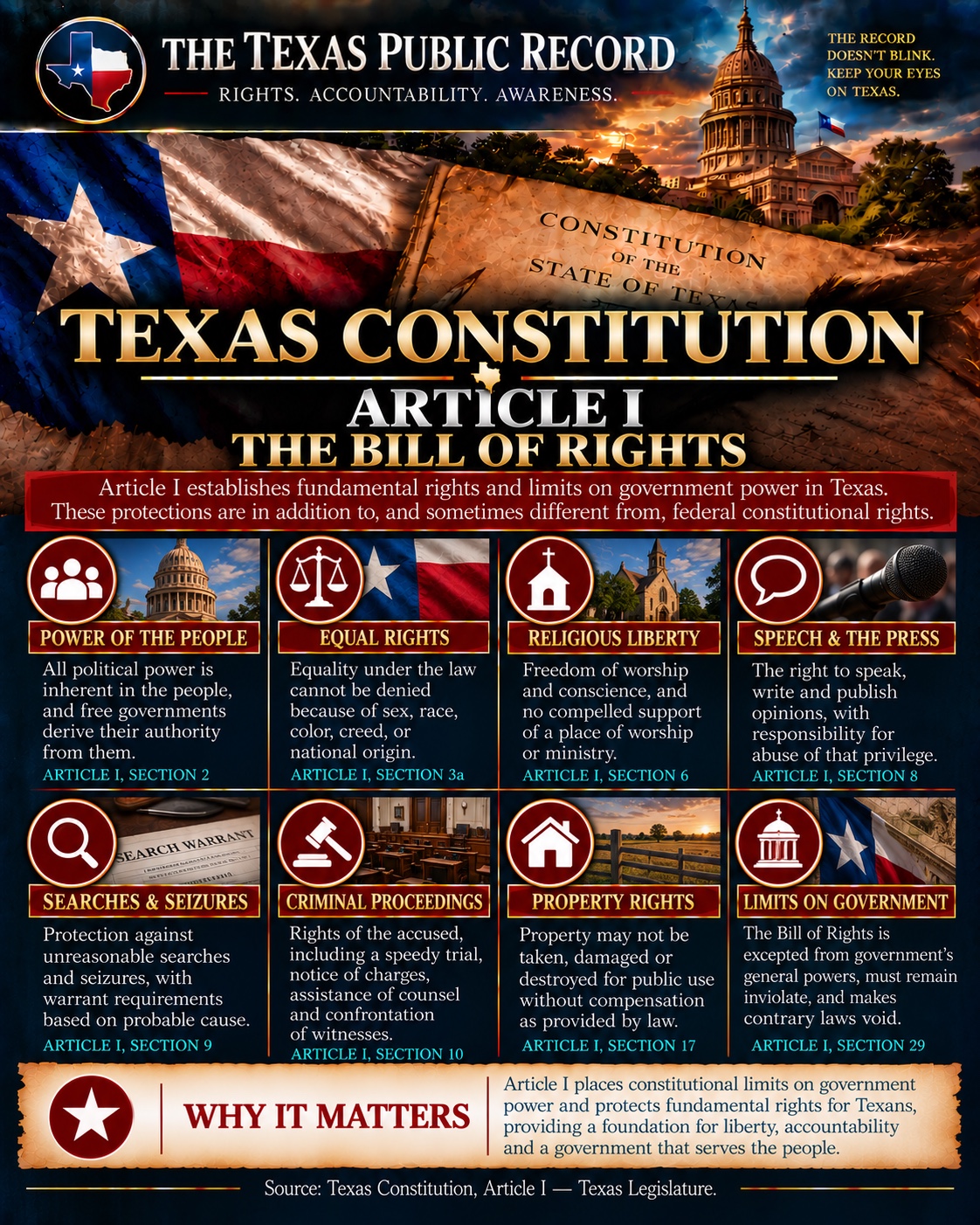
Supplied editorial illustration. Selected protections summarized; the article and official text provide qualifications. Select to view the complete graphic.
The United States Constitution is not the only document that limits government power in Texas.
The Texas Constitution contains its own Bill of Rights, and it begins with a declaration about where political authority originates: the people.
Article I establishes protections involving religious liberty, freedom of expression, criminal proceedings, property, and the relationship between Texans and their government. Some resemble protections in the federal Constitution. Others use different language or address matters more explicitly.
Those differences can matter when a court determines whether a government action is lawful.
Government power begins with the people
Section 2 declares that all political power is inherent in the people and that free governments are established by their authority and for their benefit.
It also recognizes the people’s right to alter, reform, or abolish their government in the manner they consider expedient, expressly subject to preserving a republican form of government.
This principle is known as popular sovereignty. It establishes the people, rather than elected officials or government agencies, as the ultimate source of governmental authority.
Equality and religious liberty
Section 3 declares that all free men have equal rights and that no man or set of men is entitled to exclusive public privileges except in consideration of public services. Section 3a separately prohibits denying or abridging equality under the law because of sex, race, color, creed, or national origin.
These provisions must be understood alongside federal constitutional protections and judicial interpretations.
Religious liberty receives substantial attention.
Section 6 protects freedom of worship according to the dictates of conscience and prohibits compelling someone to attend, erect, or support a place of worship or maintain a ministry against that person’s consent.
Section 7 prohibits appropriating money from the treasury for the benefit of a sect, religious society, or theological or religious seminary.
The provisions establish constitutional limits on government involvement in religious matters. Their application in particular circumstances depends on controlling state and federal law.
Speech, the press, and peaceful assembly
Section 8 protects the liberty to speak, write, or publish opinions on any subject while recognizing responsibility for abuse of that privilege. It also prohibits laws curtailing or restraining freedom of speech or the press.
The provision does not mean every form of expression is immune from legal consequences. Courts determine the scope of constitutional protection in specific disputes.
Section 27 protects the right of citizens to assemble peaceably for their common good and to apply to those invested with government power for redress of grievances or other purposes through petition, address, or remonstrance.
These provisions matter to journalism, public criticism, civic participation, and efforts to hold officials accountable.
Searches, seizures, and criminal proceedings
Section 9 protects people, houses, papers, and possessions against unreasonable searches and seizures. It also sets constitutional requirements for search warrants, including probable cause supported by oath or affirmation and particular descriptions.
Other sections address the treatment of people accused of crimes.
Section 10 establishes rights of the accused in criminal prosecutions, including notice of the accusation, the assistance of counsel, confrontation of witnesses, and protections involving compulsory self-incrimination.
Section 11 addresses bail, while additional provisions establish circumstances under which bail may be denied.
Section 13 prohibits excessive bail, excessive fines, and cruel or unusual punishment. It also declares that courts shall be open and recognizes a remedy by due course of law for injuries to lands, goods, person, or reputation.
These are constitutional protections, not guarantees that every arrest, prosecution, search, or judicial ruling is unlawful whenever someone disputes it. Their application requires examining the facts, governing law, and relevant court decisions.
Property rights and due course of law
Section 17 addresses the taking, damaging, or destruction of property for public use and requires compensation under its terms.
Section 19 provides that no citizen of Texas shall be deprived of life, liberty, property, privileges, or immunities, or otherwise disfranchised, except by the due course of the law of the land.
Due course of law is a fundamental constraint on governmental action. It requires government to operate within constitutional legal standards rather than exercising unrestricted authority.
The precise procedural or substantive protections available depend on the circumstances and judicial precedent.
The provision that reinforces every other protection
Near the end of Article I, Section 29 delivers one of the Texas Constitution’s clearest statements about governmental limits.
It declares that the provisions of the Bill of Rights are excepted from the general powers of government, must remain inviolate, and that laws contrary to those provisions are void.
That language is consequential.
It expressly places the rights recognized in Article I beyond the government’s ordinary legislative authority. A law cannot escape constitutional scrutiny merely because lawmakers enacted it or an official is enforcing it.
But Section 29 does not independently resolve every constitutional dispute. Courts still must interpret the relevant provisions, determine whether they apply, and decide whether the challenged governmental action violates them.
Why Texans should know Article I
Constitutional rights are not limited to disputes that reach the United States Supreme Court.
The Texas Constitution provides an additional body of law governing state and local officials, law enforcement, courts, and legislative action.
In some circumstances, a person may raise claims under both the federal and Texas constitutions. Those claims must be evaluated under the applicable constitutional text, precedent, and available remedies. A state constitutional violation also does not automatically create a right to monetary damages.
Understanding Article I begins with reading what it actually says, recognizing what courts have determined it means, and distinguishing a protected constitutional right from a broader political or personal expectation.
The Texas Bill of Rights is not simply a historical introduction to the state’s governing document.
It remains a constitutional measure of governmental authority.
This article provides public legal education, not individualized legal advice.
Verified through October 7, 2026. The Legislature’s published Article I incorporates amendments approved in November 2025.
EDITORIAL NOTICE: This report reflects records and information available at publication. Allegations, charges, and disputed claims are not findings of wrongdoing. Submit documented correction or clarification requests by messaging The Texas Public Record on the platform where this article appears. Material errors will be corrected transparently.
The Texas Public Record Rights. Accountability. Awareness.
Texas law does not supply a blanket 25-foot recording distance. The interference statute, Fifth Circuit precedent and TCOLE guidance distinguish recording from obstruction.
Texas Government Code §551.023 protects recording by people attending open meetings, subject to reasonable rules that cannot prevent or unreasonably impair that right.