Texas Law & Rights Education
Texas Has Its Own Bill of Rights. Here Is What Article I Protects.
The Texas Constitution protects expression, religious liberty, criminal-procedure rights and property while placing limits on government power.

Rights. Accountability. Awareness.
The record doesn’t blink.
Keep your eyes on Texas.
TPR | Texas Law & Rights Education
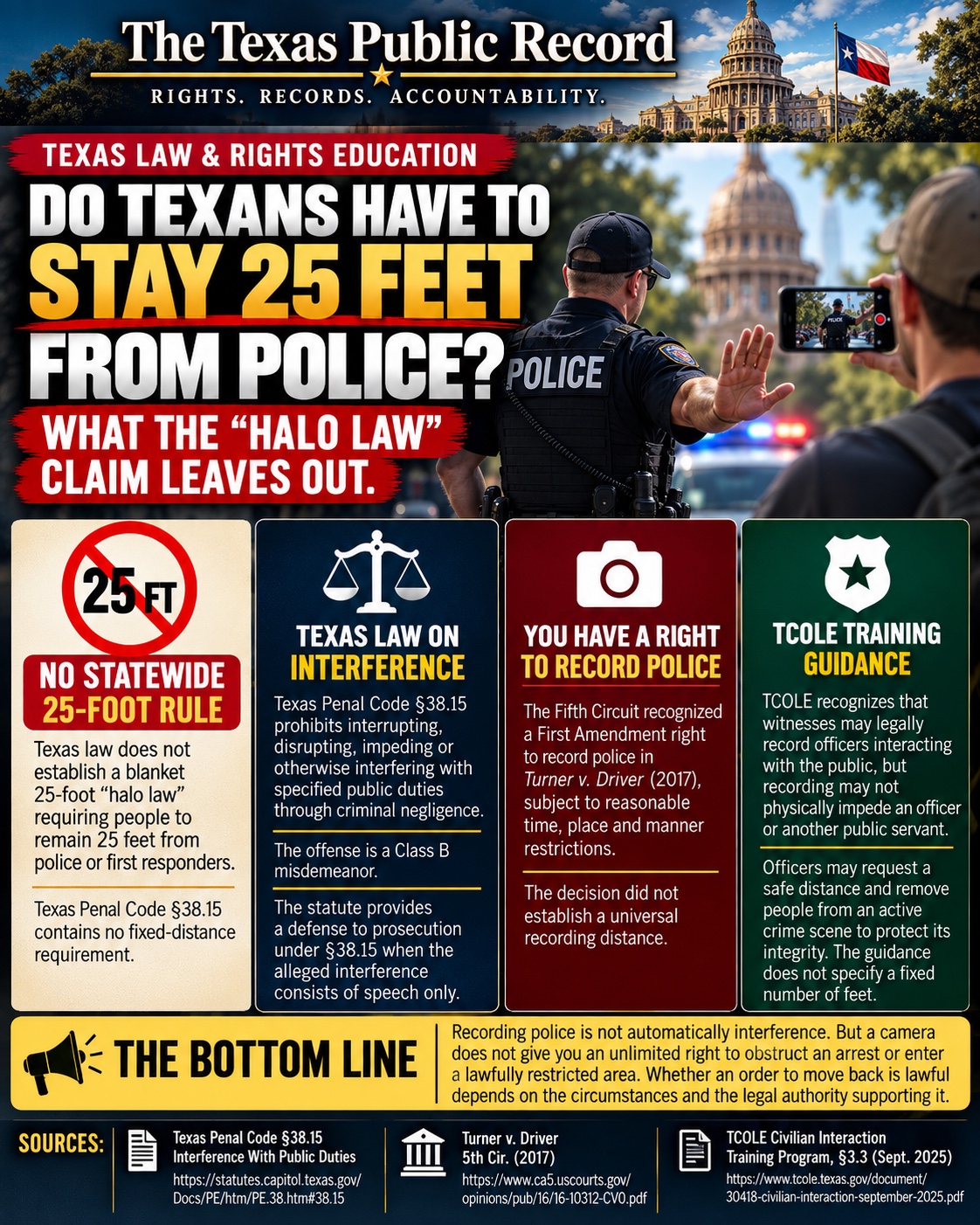
A person raises a phone to record police. An officer tells them to move back.
How far?
Texas law does not supply a blanket 25-foot answer.
The Texas Public Record’s review of the current Texas interference statute, controlling Fifth Circuit precedent and Texas law-enforcement training material found no general statewide “halo law” requiring people to remain 25 feet from police or first responders.
Texas Penal Code §38.15 contains no fixed-distance requirement.
That does not mean someone holding a camera may stand anywhere at an active police scene. It also does not mean every order to move back is automatically lawful.
The distinction is between a universal distance rule—which these authorities do not establish—and restrictions justified by the circumstances.
Texas Penal Code §38.15 makes it an offense to interrupt, disrupt, impede or otherwise interfere with specified public duties through criminal negligence. Those duties include those performed by a peace officer.
The offense is a Class B misdemeanor.
The statute also provides a defense to prosecution under §38.15 when the alleged interference consists of speech only.
Nothing in §38.15 establishes a general 25-foot boundary around an officer.
The U.S. Court of Appeals for the Fifth Circuit addressed the right to record police in Turner v. Driver in 2017.
The court held that a First Amendment right to record police exists, subject to reasonable time, place and manner restrictions.
Because Texas is within the Fifth Circuit, that precedent applies here.
But Turner did not establish a universal recording distance.
The Fifth Circuit said restrictions must be narrowly tailored to serve a significant governmental interest. The court did not decide that a person recording police must remain 25 feet away—or prescribe another fixed distance.
There is an additional historical qualification in Turner: the events underlying the case occurred in 2015. The Fifth Circuit concluded that the right to record police had not been clearly established at the time of Turner’s conduct, while recognizing the First Amendment right in its 2017 decision.
The Texas Commission on Law Enforcement’s September 2025 Civilian Interaction Training Program provides another useful distinction.
Section 3.3 addresses visual and audio recording of traffic stops.
The training material recognizes that witnesses may legally record peace officers interacting with the public. It also says a person may not record in a manner that physically impedes an officer or another public servant performing official duties.
TCOLE gives a concrete example: a person cannot physically place themselves between an officer and someone the officer is attempting to search or arrest.
The training also recognizes reasonable requests for people recording to maintain a safe distance and says people may be removed from an active crime scene to protect the scene’s integrity.
But the TCOLE guidance does not prescribe a fixed number of feet.
And TCOLE’s training material is not itself a statute creating a 25-foot exclusion zone.
Recording police and interfering with police are not legally synonymous.
Holding up a phone, by itself, does not establish interference under §38.15. But possessing a camera does not create an unlimited right to obstruct an arrest, physically impede an officer or occupy an area that may lawfully be restricted.
Likewise, an officer’s instruction to “move back” does not, standing alone, establish that Texas has a statutory 25-foot buffer.
Whether a particular restriction is lawful depends on the circumstances, the nature of the restriction and the legal authority supporting it.
The three authorities reviewed here establish several important points.
Texas Penal Code §38.15 addresses interference with public duties but does not prescribe a blanket 25-foot distance.
The Fifth Circuit recognizes a First Amendment right to record police subject to reasonable time, place and manner restrictions, but Turner does not establish a universal recording distance.
TCOLE’s September 2025 training recognizes reasonable requests to maintain a safe distance and protection of active crime scenes, but it does not specify a fixed distance.
These authorities do not establish that someone recording police may stand anywhere they choose.
They do not establish that every police instruction to move back is unlawful.
And they do not establish a general statewide rule requiring Texans to remain 25 feet from police merely because an officer or first responder is performing official duties.
A fixed number sounds simple. The law reviewed here is more contextual.
For Texans recording police activity, the relevant legal questions are not resolved merely by asking whether someone crossed an imaginary 25-foot circle.
The conduct matters. The location matters. The governmental interest behind a restriction matters. And the legal authority for that restriction matters.
Calling something a “halo law” does not create one.
The Texas Public Record
Rights. Accountability. Awareness.
Texas Law & Rights Education
The Texas Constitution protects expression, religious liberty, criminal-procedure rights and property while placing limits on government power.
Texas Law & Rights Education
In 2009, Texas replaced Pleurocoelus with Paluxysaurus jonesi after research changed the identification.
Texas Law & Rights Education
Texas Government Code §551.023 protects recording by people attending open meetings, subject to reasonable rules that cannot prevent or unreasonably impair that right.