Texas Law & Rights Education
Texas Has Its Own Bill of Rights. Here Is What Article I Protects.
The Texas Constitution protects expression, religious liberty, criminal-procedure rights and property while placing limits on government power.

Rights. Accountability. Awareness.
The record doesn’t blink.
Keep your eyes on Texas.
TPR Texas Law & Rights Education
When a Texas state agency wants to adopt an ordinary rule, it generally cannot simply announce the change and call it done.
The Texas Administrative Procedure Act creates a public rulemaking process—and a record Texans can follow.
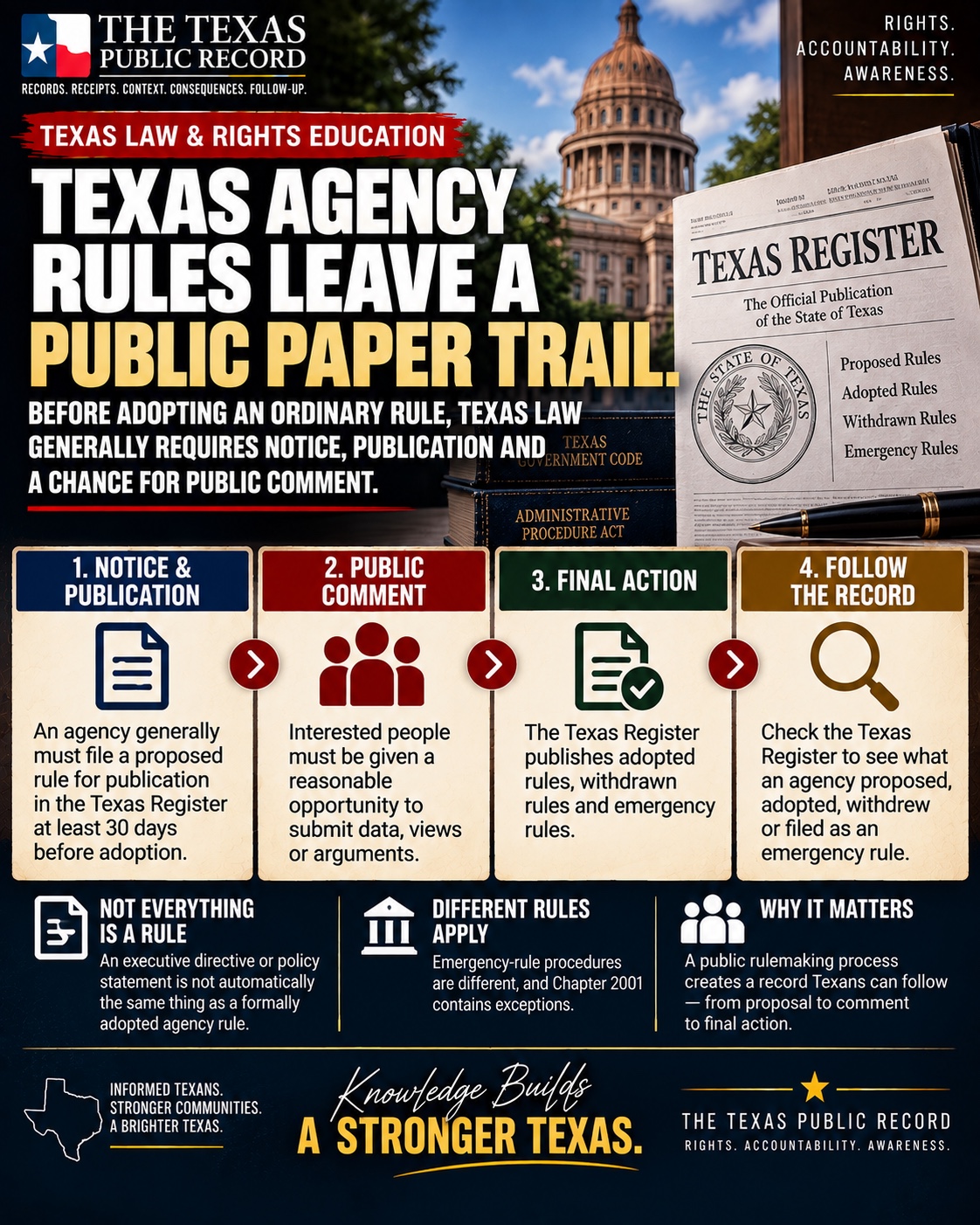
Under Texas Government Code Chapter 2001, an agency generally must file notice of a proposed rule with the Secretary of State for publication in the Texas Register.
The notice must precede adoption by at least 30 days, subject to statutory exceptions. Before adoption, interested people must also receive a reasonable opportunity to submit data, views or arguments.
That creates something valuable for Texans:
A paper trail.
The Texas Register separates agency rulemaking into categories including:
The September 18, 2026 Texas Register, for example, contains separate sections for proposed, withdrawn and adopted rules.
An announcement, directive or policy statement from a government official is not automatically the same thing as a formally adopted agency rule.
When an agency is actually using Chapter 2001 rulemaking, Texans can follow the record from proposal through public comment and eventual adoption, withdrawal or expiration.
That distinction is especially relevant when an executive directive tells an agency to take action. The directive itself may be an important government record, but whether it results in a new agency rule is a separate question that must be established from the agency’s subsequent records.
Texas generally requires notice and an opportunity for public participation before a state agency adopts an ordinary rule.
The Texas Register provides a public record of that process.
Not every government action requires ordinary notice-and-comment rulemaking.
Chapter 2001 contains exceptions and separate procedures, including emergency-rule provisions. Whether a particular agency action legally constitutes a “rule” can also depend on the nature of the action and applicable law.
When you hear that a Texas agency is changing the rules, don’t stop at the announcement.
Check the Texas Register.
The proposal, public-comment opportunity, adoption, withdrawal or emergency filing may tell you considerably more about what legally changed—and what did not.
The Texas Public Record
Rights. Accountability. Awareness.
Texas Law & Rights Education
The Texas Constitution protects expression, religious liberty, criminal-procedure rights and property while placing limits on government power.
Texas Law & Rights Education
Texas law does not supply a blanket 25-foot recording distance. The interference statute, Fifth Circuit precedent and TCOLE guidance distinguish recording from obstruction.
Texas Law & Rights Education
In 2009, Texas replaced Pleurocoelus with Paluxysaurus jonesi after research changed the identification.