Texas Law & Rights Education
Texas Has Its Own Bill of Rights. Here Is What Article I Protects.
The Texas Constitution protects expression, religious liberty, criminal-procedure rights and property while placing limits on government power.

Rights. Accountability. Awareness.
The record doesn’t blink.
Keep your eyes on Texas.
TPR Know Your Rights
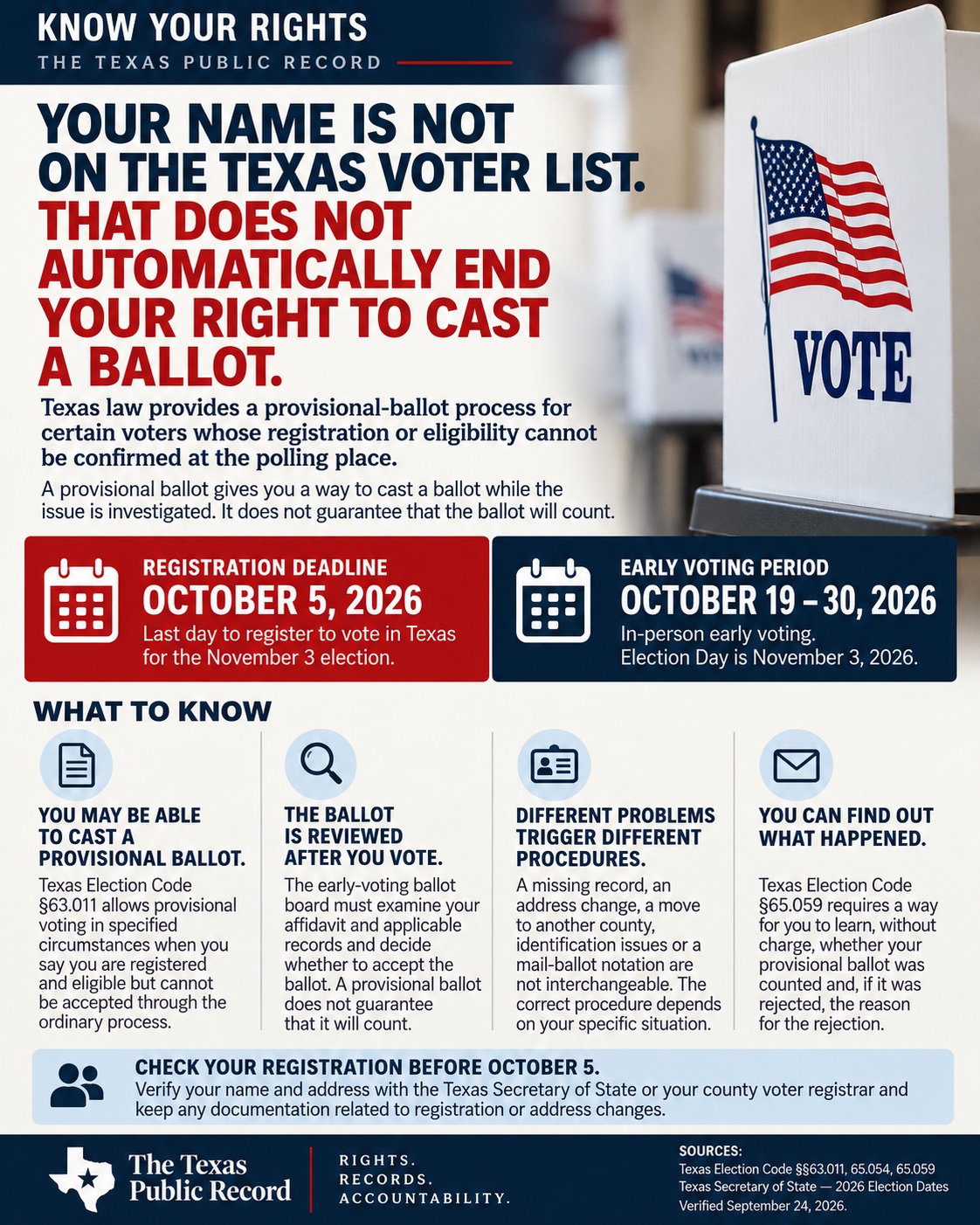
You arrive to vote.
The election worker checks the records.
Your name is not there.
That does not automatically mean the process is over.
Texas law provides a provisional-ballot process for certain voters whose registration or eligibility cannot be confirmed through the ordinary polling-place procedure.
But there is an important distinction:
A provisional ballot gives an eligible voter a way to cast a ballot while the problem is investigated.
It does not guarantee that the ballot will be counted.
Texas Election Code §63.011 allows provisional voting in specified circumstances when a person executes an affidavit stating that the person is registered in the precinct where the person seeks to vote and is eligible to vote in the election.
The voter completes a provisional-ballot affidavit and casts a ballot that is kept separate from regularly accepted ballots until election officials review the person's eligibility.
The early-voting ballot board then determines whether the provisional ballot should be accepted.
That review can include registration records, the provisional-ballot affidavit and other information relevant to the voter's eligibility.
The ballot must be accepted when the board determines that the statutory acceptance requirements are met, including eligibility, no previous vote in that election, and the applicable identification requirements or exceptions.
If the legal requirements are not satisfied, the ballot may be rejected.
That is why the statement “my name is not on the list, so I cannot vote” is too broad.
A missing polling-place record can trigger further verification and, when the statutory conditions are met, the provisional-ballot process.
It does not automatically establish that the voter is ineligible.
A provisional ballot preserves access to a ballot while election officials investigate an unresolved eligibility or registration issue.
It does not create voter eligibility.
It does not erase a missed registration deadline.
And it does not require election officials to count a ballot cast by a person who was not legally eligible to vote in that election.
The distinction matters because several different problems can appear similar at the check-in table.
A voter whose registration record cannot be located may face one procedure.
A voter who recently moved within the same county may face another.
A voter who moved to a different county may have access to a limited ballot under different rules.
An identification problem can trigger additional requirements.
A record indicating that a mail ballot was issued can create another set of procedures.
Those situations should not be treated as interchangeable.
For the November 3, 2026 general election, the last day to register to vote in Texas is Monday, October 5.
The normal 30th-day deadline falls on Sunday, October 4, so state law moves the deadline to the next regular business day.
Early voting begins Monday, October 19, and continues through Friday, October 30.
That makes the safest course simple:
Check your registration before October 5.
Do not wait until you are standing at a polling place to discover that a record is missing, outdated or associated with a previous address.
This is one of the most important limitations.
Texas provisional-voting law does not function as a substitute for timely voter registration.
A person who was not legally registered by the applicable deadline does not become eligible merely by completing a provisional ballot.
The provisional process is designed to allow a disputed or unresolved eligibility issue to be reviewed after the ballot is cast.
It does not eliminate the underlying eligibility requirements.
A provisional ballot is not treated like an ordinary accepted ballot at the moment it is cast.
It is reviewed after voting.
Texas Election Code Chapter 65 governs that review.
The early-voting ballot board determines whether the ballot should be accepted based on the voter's eligibility and the applicable records.
Texas law also requires a system that allows a provisional voter to learn, without charge, what happened to the ballot.
The voter must be able to determine whether the ballot was counted and, if it was rejected, why.
That makes the paperwork you receive important.
If you cast a provisional ballot, keep the notice and instructions given to you.
Do not assume that casting the ballot is the end of the process.
Some provisional voters, particularly those whose issue involves identification, may have additional steps to complete within a post-election deadline.
Follow the instructions you are given.
A change of address does not always produce the same voting problem.
The Texas Secretary of State's 2026 election calendar notes that a voter who changes address after the registration deadline may still qualify for “fail-safe” voting under certain circumstances if the voter remains in the same county and the same applicable political subdivision.
A voter who moved to a different county may instead qualify for a limited ballot.
For the November 3 election, limited-ballot voting is available only during the early-voting period, October 19 through October 30.
A person voting a limited ballot in person must do so at the main early-voting location.
That is why “my name isn't on the list” is not enough information to determine the correct procedure.
The underlying reason matters.
Before the October 5 registration deadline:
Verify your registration with the Texas Secretary of State or your county voter registrar.
Confirm that your name and address are current.
If you recently submitted a registration or address change, retain any documentation showing what you submitted and when.
If you moved to another county, check the limited-ballot rules before early voting begins.
If you have questions about identification, review the current Texas voter-identification requirements before going to vote.
The goal is not to rely on a provisional ballot if a registration problem can be corrected beforehand.
The provisional process is a safeguard for unresolved situations at the polls.
Do not assume the answer is simply “you cannot vote.”
Ask election officials to verify your registration status and determine which procedure applies to your situation.
A provisional ballot is not always necessary. Under §63.0051, election officials can contact the registrar; specified corrected registration errors or an inadvertent omission can allow regular voting when the identification requirements are met. If you are at the wrong precinct, officials must provide the correct precinct location.
If you qualify for provisional voting under Texas law, you may complete the provisional process.
If the problem instead involves a move, identification issue, mail-ballot notation or another circumstance, a different statutory procedure may apply.
The correct question is not merely:
“Is my name on this list?”
It is:
“What does Texas law require for this particular voter and this particular problem?”
THE RECORD: Texas Election Code §§63.0051, 63.011, 65.054 and 65.059.
THE DATE: October 5, 2026.
WHAT IT PROVES: Texas law provides a provisional-ballot process for specified voters whose eligibility or registration cannot be accepted through the ordinary polling-place procedure.
WHAT IT DOESN'T PROVE: That every provisional ballot will be counted.
It also does not mean provisional voting can cure a missed registration deadline.
WHY TEXANS SHOULD CARE: Registration, address, identification and database problems can surface when a voter attempts to vote.
Knowing the applicable procedure before Election Day can prevent an avoidable loss of access to the ballot process.
WHAT HAPPENS NEXT: The registration deadline is October 5. Early voting begins October 19. Election Day is November 3.
If your name is not on the Texas voter list when you attempt to vote, that does not automatically mean you have no available ballot procedure.
Texas law provides provisional voting for specified circumstances.
But the reason your record is missing matters, and different problems can trigger different procedures.
A provisional ballot is a safeguard.
It is not a guarantee.
Verify your registration before October 5, understand your address and identification status, and keep any provisional-ballot paperwork if you need to use the process.
Verified through September 24, 2026.
EDITORIAL NOTICE: This report reflects records and information available at publication. Allegations, charges, and disputed claims are not findings of wrongdoing. Submit documented correction or clarification requests by messaging The Texas Public Record on the platform where this article appears. Material errors will be corrected transparently.
The Texas Public Record
Rights. Records. Accountability.
#Texas #KnowYourRights #Voting #TexasElections
Texas Law & Rights Education
The Texas Constitution protects expression, religious liberty, criminal-procedure rights and property while placing limits on government power.
Texas Law & Rights Education
Texas law does not supply a blanket 25-foot recording distance. The interference statute, Fifth Circuit precedent and TCOLE guidance distinguish recording from obstruction.
Texas Law & Rights Education
In 2009, Texas replaced Pleurocoelus with Paluxysaurus jonesi after research changed the identification.