Texas Law & Rights Education
Texas Has Its Own Bill of Rights. Here Is What Article I Protects.
The Texas Constitution protects expression, religious liberty, criminal-procedure rights and property while placing limits on government power.

Rights. Accountability. Awareness.
The record doesn’t blink.
Keep your eyes on Texas.
TPR Texas Veterans | The Receipts
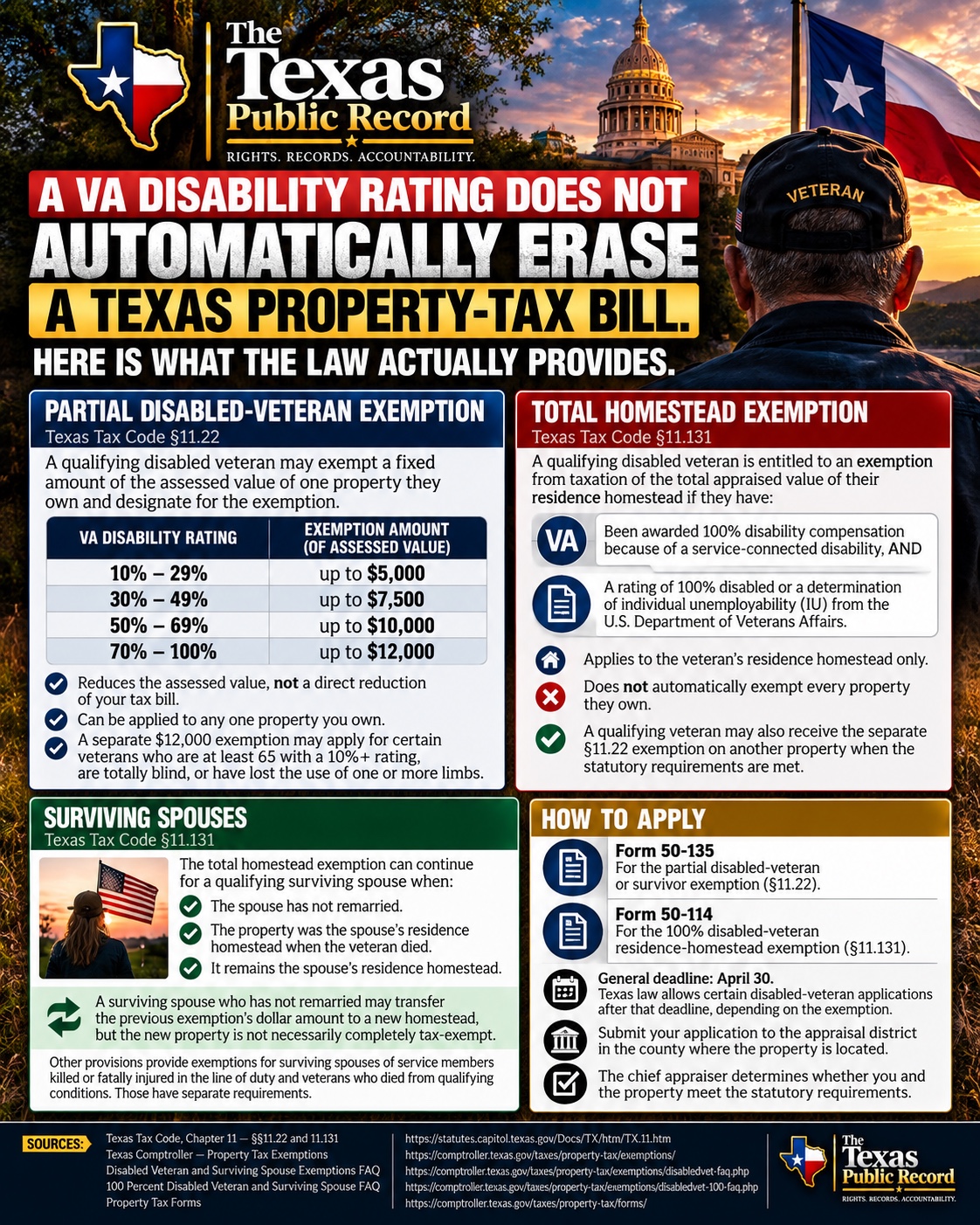
For a disabled Texas veteran, the difference between a partial property-tax exemption and a total residence-homestead exemption can be substantial.
It can also be easy to misunderstand.
Texas does not provide one universal property-tax exemption simply because a veteran has received a disability rating from the U.S. Department of Veterans Affairs. Instead, state law contains several military-related exemptions with different eligibility requirements, different amounts and different rules about which property qualifies.
For disabled veterans, two provisions are particularly important: Texas Tax Code §11.22 and §11.131.
They are not interchangeable.
Tax Code §11.22 provides a partial exemption from the assessed value of one property owned and designated by a qualifying disabled veteran.
The standard exemption amounts are tied to the veteran's disability rating:
10%–29% disability rating: up to $5,000
30%–49% disability rating: up to $7,500
50%–69% disability rating: up to $10,000
70%–100% disability rating: up to $12,000
That is an exemption from property value — not a dollar-for-dollar reduction of the tax bill.
A veteran receiving the $12,000 exemption, for example, does not automatically owe $12,000 less in taxes. Instead, up to $12,000 is removed from the property's assessed value for purposes of the exemption. The actual tax savings depend on the applicable taxable value and local tax rates.
The law also provides a $12,000 exemption for certain qualifying disabled veterans who are at least 65 years old and have a disability rating of at least 10%, are totally blind in one or both eyes, or have lost the use of one or more limbs.
The §11.22 exemption can be applied to any one property the qualifying veteran owns and designates. It is not limited to a residence homestead.
Tax Code §11.131 can provide a total exemption from taxation of the appraised value of a qualifying veteran's residence homestead.
But a veteran does not qualify for that exemption merely because some level of VA disability rating has been awarded.
Under §11.131, the veteran must have been awarded by the U.S. Department of Veterans Affairs:
100% disability compensation because of a service-connected disability; and
either a 100% disability rating or a determination of individual unemployability.
The Texas Comptroller's current guidance confirms those requirements.
When the requirements are satisfied, the exemption covers the total appraised value of the veteran's qualifying residence homestead.
The words "residence homestead" matter.
The total exemption does not automatically eliminate property taxes on every piece of property a qualifying veteran owns.
The Comptroller also explains that an eligible veteran receiving the total §11.131 homestead exemption may qualify for the separate §11.22 disabled-veteran exemption on another property when the statutory requirements are met.
Texas law can continue the §11.131 total exemption for a qualifying surviving spouse.
Among the statutory requirements, the surviving spouse must not have remarried, the property must have been the surviving spouse's residence homestead when the veteran died, and the property must remain the surviving spouse's residence homestead.
There is also protection when a qualifying surviving spouse later moves.
If the surviving spouse has not remarried, Texas law can transfer an exemption to a subsequent residence homestead. But the transferred exemption is based on the dollar amount of the exemption received on the former homestead.
That distinction means the new residence is not necessarily completely exempt from property taxation.
Texas law contains additional exemptions involving surviving spouses of members of the armed services killed or fatally injured in the line of duty and surviving spouses of certain veterans who died from qualifying conditions or diseases.
Those are separate provisions with their own requirements. They should not be treated as extensions of the basic disabled-veteran exemption.
Applications are filed with the appraisal district in the county where the property is located — not with the Texas Comptroller.
For the partial disabled-veteran or survivor exemption under §11.22, the prescribed application is:
Form 50-135 — Application for Disabled Veteran's or Survivor's Exemption.
For the 100% disabled-veteran residence-homestead exemption under §11.131, the prescribed application is:
Form 50-114 — Residence Homestead Exemption Application.
The general deadline is April 30.
Missing April 30, however, does not necessarily end a veteran's ability to claim an exemption.
Texas law allows certain disabled-veteran applications to be filed after the ordinary deadline. Current law allows a disabled veteran applying under §11.22, or a disabled veteran — but not the surviving spouse — applying for the §11.131 residence-homestead exemption, to file as late as five years after the delinquency date for the taxes on the property.
Different late-filing rules can apply to surviving spouses and other exemptions.
That makes contacting the appraisal district particularly important when a veteran believes an exemption should have applied in an earlier tax year.
A veteran should not assume that a missed April deadline automatically means the exemption is lost.
Likewise, a veteran should not assume that receiving a VA disability determination automatically changes the property-tax account.
The application and supporting documentation still matter.
The local appraisal district administers the exemption.
The chief appraiser determines whether the applicant and property meet the statutory requirements.
That means no statewide explainer — including this one — can determine whether a particular veteran or surviving spouse qualifies without the individual's VA documentation, property information, exemption history and other facts required by law.
If you believe you qualify, contact the appraisal district in the county where the property is located and ask which exemption applies, which documentation is required and whether a late application remains available for the tax year involved.
A VA disability rating and a Texas property-tax exemption are related, but they are not the same thing.
Under §11.22, qualifying disabled veterans can receive a fixed exemption from the assessed value of one designated property. Depending on the disability rating, the standard exemption ranges from $5,000 to $12,000.
Under §11.131, a veteran meeting the additional statutory requirements can receive an exemption from taxation of the total appraised value of the veteran's residence homestead.
That distinction is the one veterans and their families need to know before assuming what a VA disability rating will — or will not — do to a Texas property-tax bill.
Verified through October 3, 2026.
EDITORIAL NOTICE: This report reflects records and information available at publication. Allegations, charges, and disputed claims are not findings of wrongdoing. Submit documented correction or clarification requests by messaging The Texas Public Record on the platform where this article appears. Material errors will be corrected transparently.
The Texas Public Record
Rights. Records. Accountability.
Texas Law & Rights Education
The Texas Constitution protects expression, religious liberty, criminal-procedure rights and property while placing limits on government power.
Texas Law & Rights Education
Texas law does not supply a blanket 25-foot recording distance. The interference statute, Fifth Circuit precedent and TCOLE guidance distinguish recording from obstruction.
Texas Law & Rights Education
In 2009, Texas replaced Pleurocoelus with Paluxysaurus jonesi after research changed the identification.