The record doesn’t blink. Keep your eyes on Texas.
All coverage areas
Texas Governor Record · Installment 2 · Elections & Public Trust
Property taxes, state money & the $1,500 question
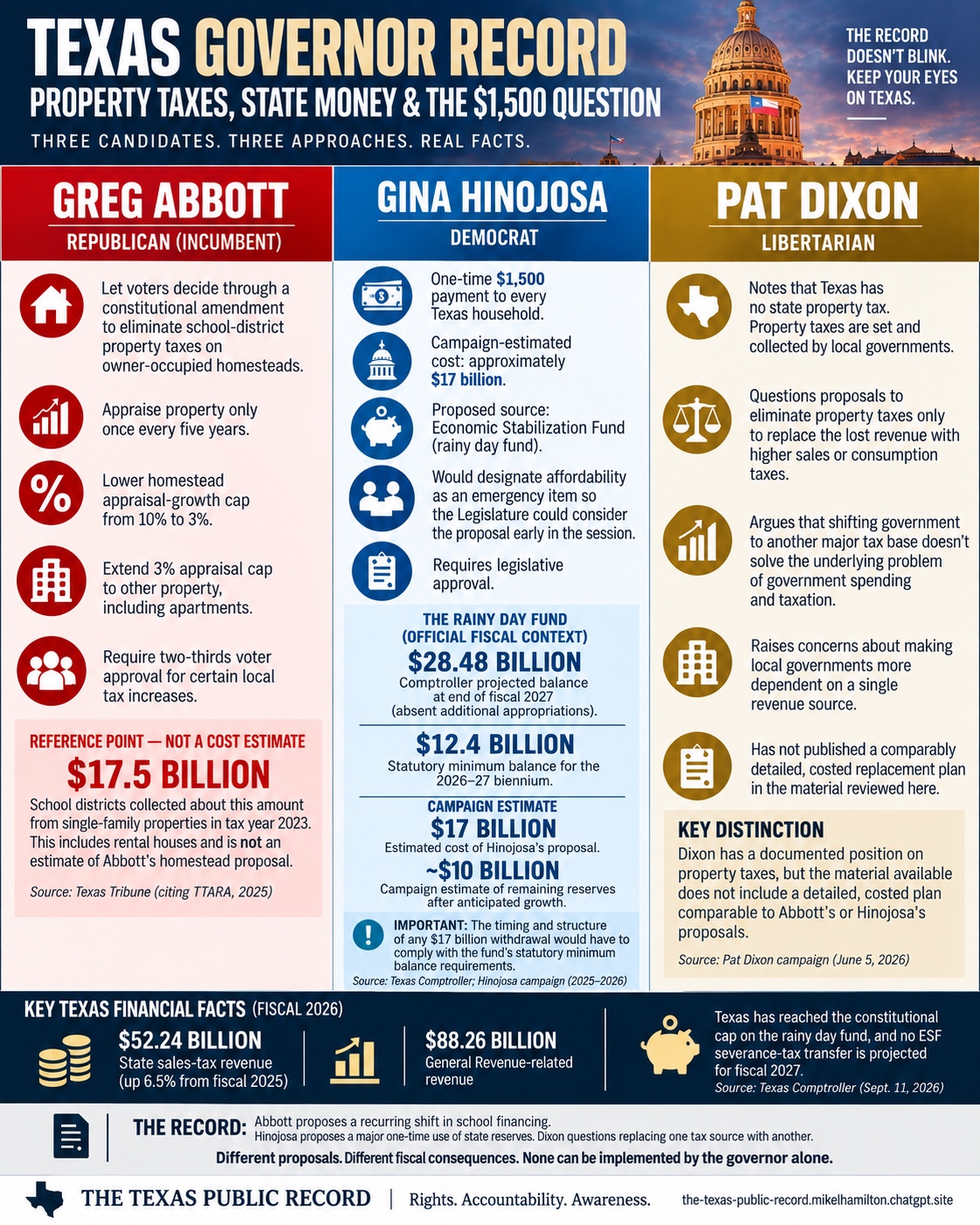
Greg Abbott wants Texas voters to eliminate school-district property taxes on homeowners. Gina Hinojosa wants Texas to send every household a one-time $1,500 payment from the state’s rainy day fund. Pat Dixon questions whether replacing property taxes with higher sales or consumption taxes solves the underlying problem.
All three positions address what Texans pay and how government finances itself—but they would work very differently, and neither Abbott nor Hinojosa could implement the centerpiece alone.
Published: September 22, 2026Series: Texas Governor RecordDesk: Elections & Public Trust
Three candidates. Three approaches. Different fiscal consequences.
This is the second installment of The Texas Public Record’s examination of the 2026 race for Texas governor.
Property taxes are local — but Austin has enormous influence
Start with a distinction that is routinely blurred in Texas politics:
Texas does not have a state property tax.
Property taxes are imposed by local taxing units, including school districts, counties, cities and special-purpose districts.
The Texas Comptroller states that local governments set property-tax rates and collect the money.
But state government determines much of the legal framework governing those taxes and plays a major role in financing public schools.
That is why the governor and Legislature can substantially reduce school property taxes without Texas technically having a state property tax.
Abbott’s proposal: eliminate school property taxes on homesteads
Property-tax reduction is a centerpiece of Republican Gov. Greg Abbott’s campaign for a fourth term.
His proposal goes considerably further than another increase in the homestead exemption.
Abbott wants Texas voters to decide through a constitutional amendment whether to eliminate school-district property taxes on owner-occupied homesteads.
His broader five-point property-tax plan also calls for appraising property only once every five years, reducing the homestead appraisal-growth cap from 10% to 3%, extending a 3% appraisal cap to other property, requiring two-thirds voter approval for certain local property-tax increases and creating mechanisms designed to roll back certain tax increases.
The proposal could significantly change how affected homeowners finance public education.
But eliminating the tax does not eliminate the cost of operating public schools. It changes where the money comes from.
How much money are we talking about?
There is not yet a definitive cost estimate for Abbott’s proposal to eliminate school property taxes on homesteads.
But existing numbers show the scale of the revenue involved.
School districts collected approximately $17.5 billion from owners of single-family properties in tax year 2023, according to an analysis by the Texas Taxpayers and Research Association cited by The Texas Tribune.
That number is important, but it is not a cost estimate for Abbott’s plan.
The $17.5 billion figure includes rental houses, while Abbott’s school-tax elimination proposal applies to owner-occupied homesteads.
For additional perspective, replacing all school property taxes would have cost approximately $39.5 billion in tax year 2023, according to a Legislative Budget Board figure reported by The Texas Tribune.
Abbott’s proposal is narrower than eliminating every school property tax.
The numbers nevertheless illustrate the size of the revenue stream involved.
Texas is already spending billions to reduce property taxes
Texas has already enacted substantial property-tax relief during Abbott’s governorship.
The 2025 Legislature increased the standard school-district homestead exemption from $100,000 to $140,000 and approved additional tax-relief mechanisms.
Abbott’s campaign describes the overall 2025 package as approximately $51 billion in property-tax relief.
The Texas Tribune has similarly reported that Texas plans to spend roughly $51 billion during the current two-year budget period on property-tax reductions, including previous commitments and the latest measures.
One part of that package was Senate Bill 4.
The Legislative Budget Board estimated that SB 4 alone would have a roughly $2.74 billion negative impact on General Revenue-related funds through the 2026–27 biennium, while additional school-aid costs could not be fully determined from the available information.
Key distinction: The $2.74 billion figure is associated with SB 4. It is not the cost of Texas’ entire property-tax relief package.
Claim vs. record: has Abbott actually cut property taxes?
Texas has enacted major property-tax reductions during Abbott’s tenure.
The Legislature approved larger homestead exemptions, school-tax compression and other relief mechanisms, and Abbott signed property-tax legislation.
So the record supports saying substantial property-tax relief has been enacted while Abbott has been governor and that he signed legislation implementing it.
But a governor does not enact those changes alone. The Legislature must pass the laws. And where constitutional amendments are required, Texas voters must approve them.
There is another important distinction.
A larger exemption or lower tax rate does not guarantee that every homeowner’s total property-tax bill will continuously decline.
The final bill depends on taxable value, exemptions, tax rates and the various local taxing units levying taxes on the property.
That is why competing political claims about whether Texans’ property taxes have “gone up” or “gone down” can produce different answers depending on what is actually being measured.
Abbott wants to take the existing model much further
Texas already uses state money to offset reductions in local school property-tax revenue.
Abbott proposes moving much further in that direction for homeowners.
If school-district property taxes on homesteads disappear, the state would have to account for a substantial recurring source of school revenue.
That makes long-term financing central to the proposal.
Texas currently has substantial resources.
For fiscal 2026, the Comptroller reported approximately $52.24 billion in state sales-tax collections—up 6.5% from fiscal 2025.
General Revenue-related revenue totaled approximately $88.26 billion.
Those figures establish a strong current revenue position. They do not establish that equivalent revenue growth will continue indefinitely.
That distinction becomes especially important when discussing a permanent change in how Texas finances public schools.
If state revenues weaken during an economic downturn, the obligation to finance schools does not disappear with them.
The school-funding question cannot be separated from the tax question
Abbott’s proposal can accurately be described as property-tax relief for affected homeowners.
Fiscally, however, it also represents a shift in the source of school funding.
Texas could dedicate more existing state revenue to public education. Lawmakers could reduce spending elsewhere. Future legislatures could identify additional revenue. Or Texas could use some combination of those approaches.
Abbott’s proposal establishes the objective: eliminate school-district property taxes on homesteads.
It does not, by itself, establish every long-term funding decision future legislatures would make to sustain that system.
What about renters?
Abbott’s proposed elimination of school-district property taxes applies to homeowners.
But that is not the only part of his property-tax plan.
His separate appraisal proposal would extend a 3% appraisal cap to other property, including apartments.
Abbott’s campaign argues that this would help renters.
That is a campaign claim about the proposal’s economic effect, not a guaranteed outcome.
The amount—if any—of a landlord’s property-tax savings ultimately reflected in rent would depend on market conditions, operating costs and landlord decisions.
The proposal can therefore be evaluated separately from the campaign’s prediction about what it would do to rents.
Hinojosa’s proposal: send Texas households $1,500
Democratic nominee Gina Hinojosa proposes a very different use of Texas’ current financial position.
She wants the state to make a one-time $1,500 payment to every Texas household.
Her campaign estimates the program would cost approximately $17 billion.
The money would come from the Economic Stabilization Fund—commonly called the rainy day fund.
When Hinojosa announced the proposal, the fund stood at approximately $24.8 billion as of November 2025.
The Comptroller’s current revenue estimate projects that, absent additional legislative appropriations, the Economic Stabilization Fund could reach approximately $28.48 billion by the end of fiscal 2027.
The fund has grown enough to reach its constitutional cap.
So the central premise behind Hinojosa’s proposal is supported: Texas has accumulated a historically large reserve.
But that does not resolve whether withdrawing approximately $17 billion is the appropriate use of it. That is a policy decision.
The rainy day fund also has a minimum balance
There is another number that belongs in this discussion.
The Economic Stabilization Fund is subject to a $12.4 billion statutory minimum balance for the 2026–27 biennium.
Hinojosa’s campaign has estimated that its proposal would leave roughly $10 billion in reserves after accounting for anticipated fund growth.
Those figures cannot simply be subtracted from one another without considering the law.
How a proposed $17 billion withdrawal would interact with the statutory minimum—including the timing and structure of any expenditure—would have to be addressed in the actual legislation.
The fund exists partly to help Texas manage revenue volatility and extraordinary fiscal needs.
Oil and natural-gas severance taxes are important funding sources for the account, meaning deposits can fluctuate with the energy sector.
The fund has also been used for major state needs, including infrastructure, education and disaster-related expenditures.
Spending $17 billion would therefore represent a real fiscal transaction.
Texas households would receive money. Texas would retain substantially less in reserve than it otherwise would.
Both sides of that transaction belong in the analysis.
Could Hinojosa just send the checks?
No.
A governor does not have unilateral authority to withdraw approximately $17 billion from the Economic Stabilization Fund and distribute it to Texas households.
The Legislature would have to approve the expenditure.
Hinojosa has said she would designate affordability as an emergency item.
That would allow lawmakers to consider the proposal early in the legislative session. It would not require them to approve it.
The same basic limitation applies to Abbott.
A governor can advocate for legislation, place certain issues on the legislative agenda, sign legislation and veto legislation.
A governor cannot independently rewrite Texas tax and spending law.
Abbott’s proposed elimination of school property taxes would go one step further: his plan calls for putting a constitutional amendment before Texas voters.
The inflation question
Hinojosa’s proposal also raises a broader economic question.
Rice University economist John Diamond told The Texas Tribune that injecting approximately $17 billion into the Texas economy while employment is high and inflation remains above 2% could increase demand and create additional pressure on prices.
That is economic analysis—not a demonstrated outcome.
The actual effect would depend on factors including how quickly the money was distributed, how households used it and broader economic conditions at the time.
But it is a relevant potential consequence when evaluating a proposal of this size.
The same evidentiary standard applies to Abbott’s proposal.
Its recurring fiscal consequences depend on the eventual legislation, the amount of local school revenue replaced and future state revenues.
Neither campaign can establish those future effects merely by asserting them.
Hinojosa and property taxes
The difference between the candidates should not be reduced to “Abbott wants lower property taxes and Hinojosa doesn’t.”
Hinojosa has also argued for property-tax relief and has criticized Abbott’s record on the issue.
Her campaign points to her previous service on the Austin Independent School District board and says the district lowered its tax rate during her tenure.
That is a campaign claim and should be treated as one unless measured against the district’s complete tax and appraisal record.
A lower tax rate also does not necessarily mean every property owner’s final bill declined. Taxable values, exemptions and other factors matter.
The central quantified fiscal proposal Hinojosa has placed before voters in this race is the approximately $17 billion household-payment plan.
That proposal can be evaluated directly.
Pat Dixon: a different property-tax argument
Libertarian Pat Dixon has published a current position on property taxes.
Dixon notes that Texas has no state property tax and argues that the current system creates problems of its own.
He also questions proposals that would eliminate property taxes only to replace lost revenue through higher sales or consumption taxes.
His argument is that shifting government onto another major tax base does not necessarily solve the underlying issue of government spending and taxation.
Dixon has also raised concerns about making local governments more dependent on a single revenue source.
What Dixon has not provided in the material reviewed here is a comparably detailed, costed replacement plan matching the specificity of Abbott’s property-tax proposal or Hinojosa’s $17 billion household-payment proposal.
That distinction matters.
His documented position belongs in the comparison. Numbers or mechanisms he has not supplied should not be invented for him.
Three approaches — three different fiscal questions
The candidates are not simply proposing different amounts of “tax relief.”
They are describing different approaches to state and local finance.
Abbott proposes moving more of a recurring school-finance obligation away from affected homeowners and toward state financing.
The central fiscal question is what that shift would cost each year and how Texas would sustain it through periods of weaker state revenue.
Hinojosa proposes converting approximately $17 billion of accumulated state savings into immediate, one-time household payments.
The central fiscal questions are what that withdrawal would leave in reserve, how it would interact with statutory restrictions and what economic effects a payment of that scale could have.
Dixon questions whether replacing property taxes with another tax base actually reduces the overall burden rather than simply moving it.
His current published position provides less detail about precisely how Texas would replace existing property-tax revenue.
Those are not interchangeable approaches.
And none can be evaluated solely by asking which candidate promises the largest dollar amount of relief.
Bottom line: what the record actually shows
Abbott and Hinojosa are proposing fundamentally different uses of Texas’ current fiscal capacity.
Abbott wants voters to eliminate school-district property taxes on homeowners through a constitutional amendment while imposing additional restrictions on appraisals and local tax increases.
Texas has already committed tens of billions of dollars to property-tax relief, and Abbott’s proposal would shift still more of the cost of financing public schools from affected homeowners toward state government.
The unresolved question is how much that shift would cost annually and how Texas would sustain it when state revenues weaken.
Abbott’s campaign has not supplied a definitive cost estimate for eliminating homeowners’ school property taxes.
School districts collected approximately $17.5 billion from single-family properties in tax year 2023, but that figure includes rental houses and therefore is not a direct estimate of Abbott’s narrower homestead proposal.
Hinojosa proposes approximately $17 billion from the Economic Stabilization Fund for one-time $1,500 payments to Texas households.
The Comptroller currently projects a $28.48 billion fiscal-2027 balance absent additional appropriations.
The fund is also subject to a $12.4 billion statutory minimum balance for the 2026–27 biennium.
How a $17 billion withdrawal would interact with that requirement would have to be addressed in the actual legislation.
Neither Abbott nor Hinojosa could implement the centerpiece alone. Both would need legislative action.
Abbott’s proposed elimination of school property taxes would additionally require a constitutional amendment submitted to Texas voters.
Dixon has published a property-tax position questioning both the existing system and proposals to replace property taxes with increased sales or consumption taxes, but the material reviewed here does not provide a comparably detailed, costed replacement plan.
The fiscal choice is not simply “tax cuts versus checks.”
Each approach raises a different question about who pays, when they pay and what happens to Texas’ finances afterward.
Texas prohibits nearly all abortions but retains defined medical exceptions. Abbott signed legislation clarifying those exceptions while maintaining restrictions on abortion assistance and abortion-inducing drugs. Hinojosa wants reproductive rights restored. Dixon distinguishes his personal opposition to abortion from the use of government power.
Texas reports more than $10 billion in border-security spending. The federal government has approved approximately $7.5 billion in reimbursement, but the Comptroller said the money had not reached the state treasury as of September 21. The governor’s race raises questions about enforcement priorities, public spending and the boundaries of state authority.
Counties are processing delayed DPS transactions before the October 5 deadline. Record counts are not unique-voter counts, and the statewide total remains unknown.