A Texan renews a driver’s license online and submits a voter-registration transaction through the Department of Public Safety.
The transaction appears complete. But the registration record never reaches the county responsible for processing it.
Months pass.
Now, less than two weeks before Texas’s voter-registration deadline, counties are receiving tens of thousands of records that should have reached them earlier.
Some date to October 2025.
The state says the technical problem has been resolved. What remains unanswered is how many people were affected, whether every valid transaction has been recovered and whether counties can complete the work before voting begins.
THE BACKLOG IS ALREADY SUBSTANTIAL
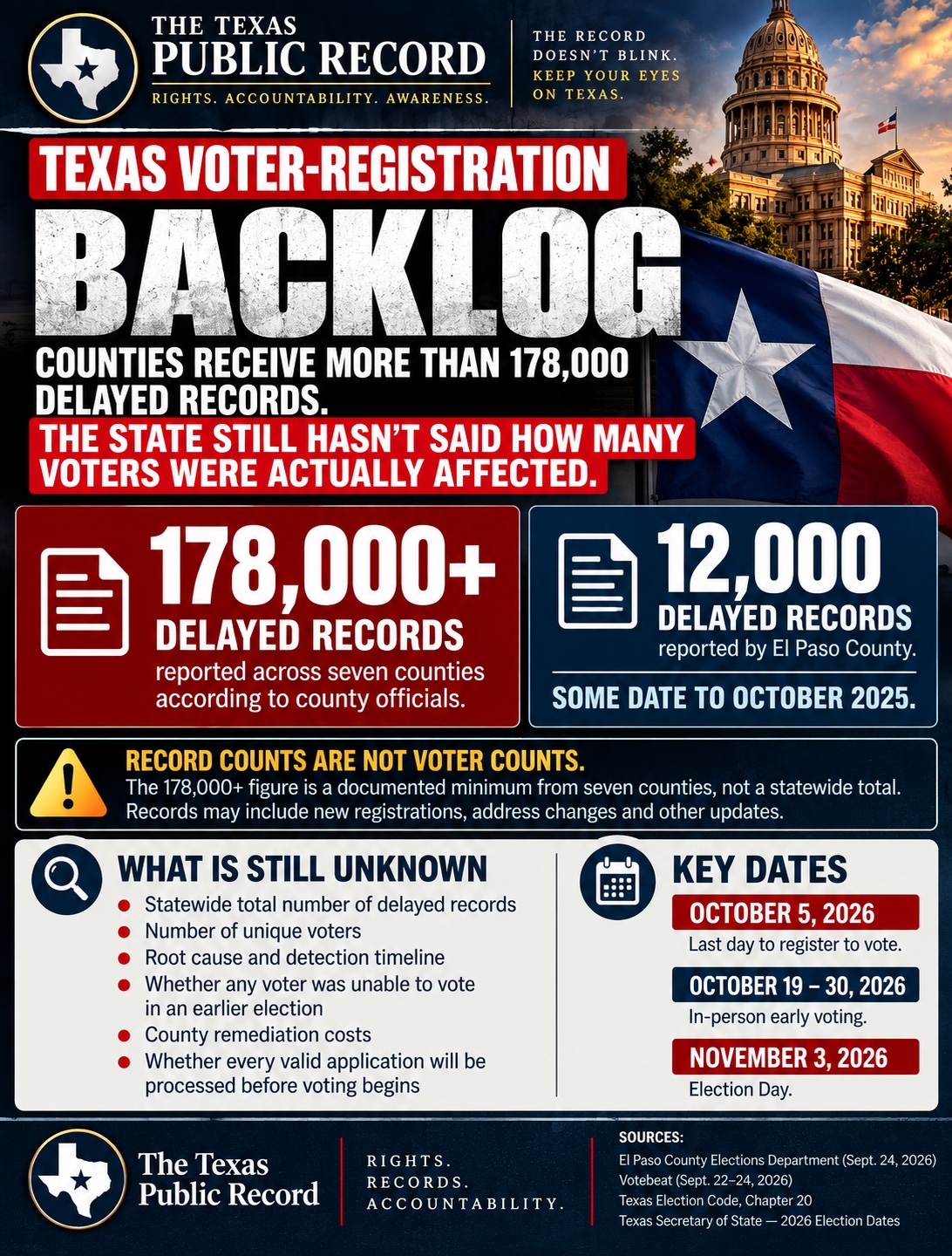
On September 24, the El Paso County Elections Department publicly confirmed receiving approximately 12,000 delayed DPS voter-registration records.
The county attributed the backlog to a state-level technological error and said some submissions dating to October 2025 were not transmitted to county registrars until this week.
El Paso officials said they were working to ensure valid, timely submissions would be processed appropriately despite the additional workload.
The problem extends beyond El Paso.
Votebeat reported that officials in seven other counties had confirmed receiving more than 178,000 delayed records combined.
The reported figures were:
Dallas County: more than 68,000.
Collin County: 40,000.
Travis County: 32,000.
Williamson County: 18,000.
Hays County: 8,200.
Lubbock County: 7,400.
Cameron County: 4,500.
Those figures describe records received by county offices. They do not establish the number of unique voters affected.
A record may represent a new registration, an address change or another update. Some people whose transactions were delayed may have subsequently registered through another method.
El Paso’s approximately 12,000 records were reported separately from the seven-county figure.
Neither figure establishes the statewide total.
WHAT FAILED BETWEEN DPS AND THE COUNTIES?
Texas law designates DPS as a voter-registration agency.
Eligible Texans conducting certain driver’s license or identification-card transactions can submit voter-registration information through DPS.
That information must ultimately reach county voter registrars, who maintain and process registration records.
According to state officials’ explanations reported by Votebeat, affected DPS transactions produced incomplete voter-registration records. Those records were not transmitted to counties.
The Secretary of State’s Office said it became aware of the problem after county officials noticed older DPS records appearing in TEAM, the state’s voter-registration system.
DPS subsequently identified affected records and worked with the Secretary of State’s Office to supply missing information.
DPS says the technical problem has been resolved.
But resolving the transmission problem is not the same as completing the registration work.
Counties must still examine the records, determine whether more recent information exists, process valid transactions and ensure that older records do not replace newer voter information.
The state has not publicly established how many individual voters were affected or how many records remain unresolved.
THE RISK OF AN OLD RECORD REPLACING A NEW ONE
The age of the delayed records creates a separate problem.
Consider a voter who submitted an address change through DPS months ago, then subsequently updated that registration through another channel.
The older DPS transaction may no longer reflect the person’s current information.
According to Votebeat’s reporting on communications from the Secretary of State’s Office, the state identified voters with newer registration information in counties using TEAM directly and withheld older DPS records in those circumstances.
Counties using separate voter-registration software face a different reconciliation task. They must determine whether delayed DPS records conflict with more recent information already in their systems.
This is why the backlog cannot be measured solely by the number of records delivered.
The state must also establish whether those records were correctly reconciled.
A record received is not necessarily a registration completed.
THE COUNTIES NOW CARRY THE WORKLOAD
County election officials are processing the delayed transactions alongside their ordinary registration workload immediately before a major election.
Chris McGinn, executive director of the Texas Association of County Election Officials, told Votebeat that the influx ranges from hundreds of records in smaller counties to tens of thousands in larger counties.
He also warned that the work would create additional staffing and overtime demands.
The financial consequences have not been established.
There is no verified statewide accounting of county overtime, temporary staffing, vendor expenses or other costs associated with resolving this backlog.
Nor has a public reimbursement plan been established in the records reviewed for this report.
The state-level error has become a county-level processing obligation.
That distinction matters when determining who is responsible for the failure and who ultimately pays to correct it.
STATE OFFICIALS FACE QUESTIONS ABOUT DETECTION
The incident also raises questions about monitoring.
If transactions dating to October 2025 remained untransmitted, when did the problem first become detectable?
Did DPS have a mechanism to identify records that failed to reach county registrars?
Did the Secretary of State’s Office reconcile expected DPS transactions against records actually delivered?
Were error reports generated, reviewed or escalated?
The available reporting does not answer those questions.
Republican state Sen. Paul Bettencourt, who has worked extensively on Texas election-administration legislation, told Votebeat that the Secretary of State’s Office should have detected the problem.
His criticism concerns oversight and operational accountability. It is not an established finding that the Secretary of State’s Office caused the underlying DPS error.
Democratic lawmakers have also called for investigation and additional resources to address the backlog.
Those responses underscore the need for a documented incident timeline rather than competing assumptions about responsibility.
A SEPARATE QUESTION: THE STATE’S REGISTRATION SYSTEM
The delayed DPS transactions arrive amid previously reported problems involving TEAM, the state’s voter-registration and election-management system.
County election officials have reported functionality and performance problems since the system’s 2025 overhaul.
Those concerns warrant examination, but they should not be conflated with the DPS transmission failure.
The available evidence identifies incomplete DPS transaction records as the reported reason affected submissions were not transmitted.
It does not establish that TEAM’s broader functionality problems caused those incomplete records.
The relationship between the systems, the detection process and any vendor involvement remains a subject for further reporting.
WHAT THE STATE HAS NOT ACCOUNTED FOR
The available records establish that a substantial backlog existed.
They do not yet establish its complete consequences.
Texas still needs to account publicly for:
The total number of delayed records statewide.
The number representing unique individuals.
The number of new registrations versus address changes and other updates.
The number of duplicate or superseded records.
The number successfully processed.
The number rejected or still requiring correction.
The date the technical failure began.
When the failure first became detectable.
Whether any affected voter encountered a problem in an earlier election.
The cost of county remediation.
Whether every valid, timely application will be processed and correctly reflected before voting begins.
Those are measurable questions. They require records, not assurances alone.
THE OCTOBER 5 DEADLINE
Texas’s registration deadline for the November 3 general election is Monday, October 5.
Early voting begins October 19.
That leaves county officials a narrow period to process the newly delivered records while handling ordinary pre-election registration work.
The Secretary of State’s Office has told Votebeat that an affected voter whose timely DPS registration does not appear on the rolls can use the provisional-ballot process. Election officials can verify the underlying DPS transaction and determine whether the ballot qualifies to be counted.
That safeguard does not eliminate the need to correct the records.
It also does not establish that every delayed transaction represents an eligible voter or that every provisional ballot must be accepted.
THE RECEIPTS
THE RECORD:
El Paso County Elections Department’s September 24 statement; Texas Election Code Chapter 20; and Votebeat’s reporting based on county confirmations and state communications.
THE NUMBER:
Approximately 12,000 delayed records in El Paso County.
Separately, more than 178,000 records reported across seven other counties.
WHAT IT PROVES:
A state technology failure prevented a substantial number of DPS voter-registration transactions from reaching county registrars when originally submitted.
WHAT IT DOESN’T PROVE:
That each record represents a unique voter, that every affected person was denied registration or voting, or that the failure was intentional.
WHAT REMAINS UNKNOWN:
The statewide total, unique-voter count, root cause, earlier-election consequences, final processing status and remediation cost.
NEXT CHECKPOINT:
A statewide reconciliation from DPS and the Secretary of State’s Office, followed by county processing updates before the October 5 registration deadline.
THE ACCOUNTABILITY TEST
The immediate question is whether counties can finish processing valid, timely submissions before the election.
The larger question is how a state voter-registration channel could accumulate records dating back nearly a year without the failure being identified and resolved sooner.
DPS says the technical issue is fixed.
The public still needs a complete accounting of what happened.
That accounting should identify how many transactions failed, how many people were affected, what controls failed, what corrections were made and how the state will prevent a recurrence.
Until those figures are documented, the full scale of the incident remains unknown.
A transmission fix closes one part of the problem.
A verified reconciliation closes another.
And a public incident report is necessary to establish how the failure occurred in the first place.
EDITORIAL NOTICE: This report reflects records and information available at publication. Allegations, charges, and disputed claims are not findings of wrongdoing. Submit documented correction or clarification requests by messaging The Texas Public Record on the platform where this article appears. Material errors will be corrected transparently.
Texas prohibits nearly all abortions but retains defined medical exceptions. Abbott signed legislation clarifying those exceptions while maintaining restrictions on abortion assistance and abortion-inducing drugs. Hinojosa wants reproductive rights restored. Dixon distinguishes his personal opposition to abortion from the use of government power.
Texas reports more than $10 billion in border-security spending. The federal government has approved approximately $7.5 billion in reimbursement, but the Comptroller said the money had not reached the state treasury as of September 21. The governor’s race raises questions about enforcement priorities, public spending and the boundaries of state authority.
The fourth Governor Record installment compares grid reforms, data-center restrictions and electricity-bill proposals from Abbott and Hinojosa, with Dixon’s documented position assessed separately.