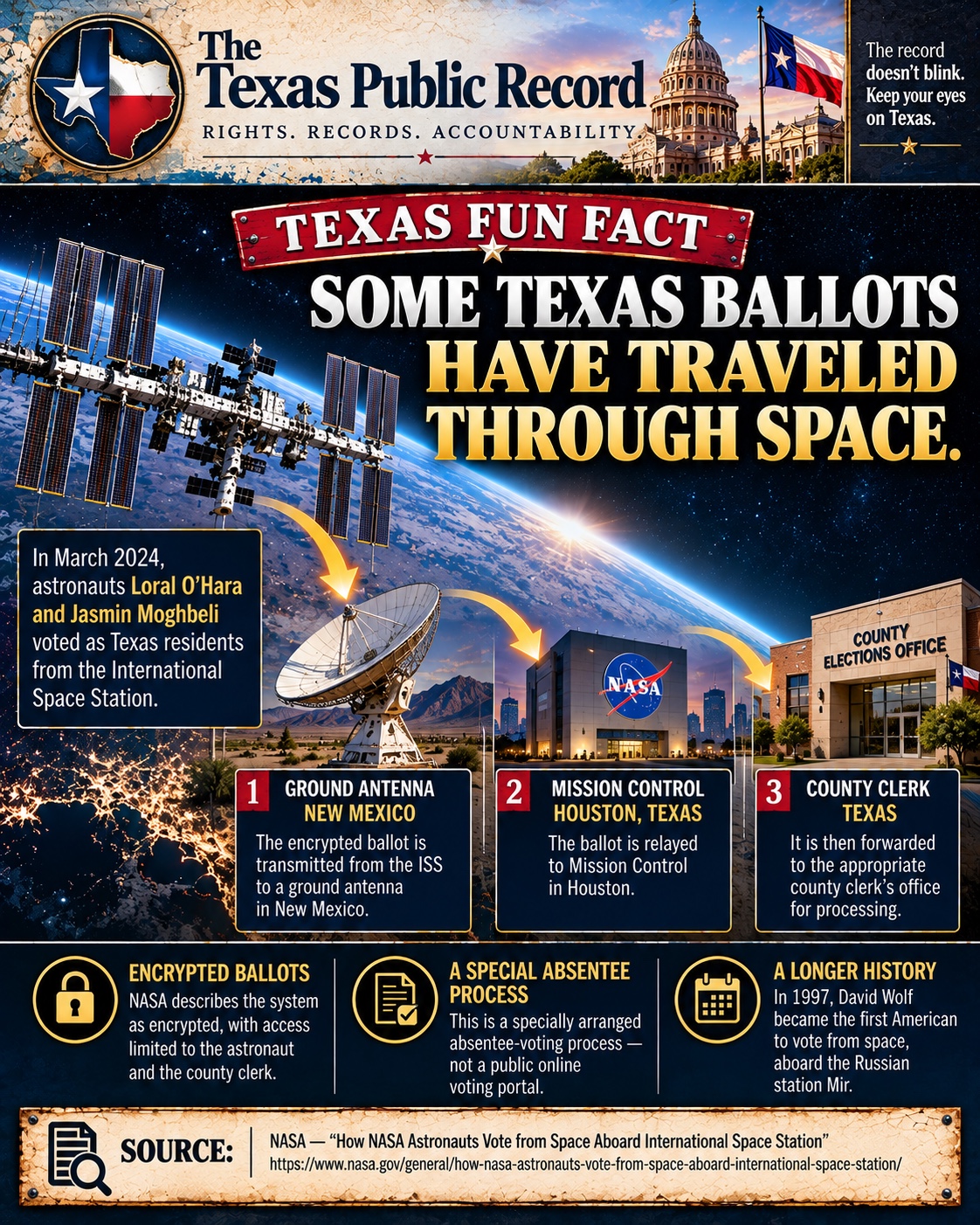
Supplied explanatory illustration, reproduced unchanged. Buildings and the space scene are illustrative; this is not a documentary photograph or a complete communications-network diagram.
Most Texans cast their ballots at a polling place or through an authorized mail-in process. But for some Texas residents, voting has involved a journey hundreds of miles above Earth.
In March 2024, NASA astronauts Loral O’Hara and Jasmin Moghbeli voted as Texas residents while aboard the International Space Station.
Their ballots followed a remarkable route home.
According to NASA, the electronic absentee ballots were transmitted from the space station through a ground antenna in New Mexico to Mission Control in Houston. From there, the ballots were forwarded to the appropriate county clerk’s office for processing.
NASA describes the process as encrypted, with access to the completed ballot restricted to the astronaut and the county clerk.
This is not a public online voting system. It is a specially arranged absentee-voting process that allows eligible astronauts to participate in elections while working in orbit.
And Texas’s connection to voting from space goes back even further.
In 1997, astronaut David Wolf became the first American to vote from space while aboard the Russian space station Mir.
It’s a fascinating intersection of Texas election administration, American space exploration and the right to participate in government.
Even hundreds of miles above Earth, a Texas ballot can still find its way home.
Texas voters have until October 30 to cast an early ballot in person. Polling locations and hours depend on the county, while a separate mail-ballot application deadline arrives Friday.
Texas prohibits nearly all abortions but retains defined medical exceptions. Abbott signed legislation clarifying those exceptions while maintaining restrictions on abortion assistance and abortion-inducing drugs. Hinojosa wants reproductive rights restored. Dixon distinguishes his personal opposition to abortion from the use of government power.
Texas reports more than $10 billion in border-security spending. The federal government has approved approximately $7.5 billion in reimbursement, but the Comptroller said the money had not reached the state treasury as of September 21. The governor’s race raises questions about enforcement priorities, public spending and the boundaries of state authority.