Elections & Public Trust
Texas Fun Fact: Some Texas Ballots Have Traveled Through Space
NASA astronauts have voted as Texas residents from orbit, sending encrypted electronic absentee ballots back to Earth for county processing.

Rights. Accountability. Awareness.
The record doesn’t blink.
Keep your eyes on Texas.
Elections & Public Trust | Texas Voter Information · Explainer
Texas voters have until October 30 to cast an early ballot in person. Polling locations and hours depend on the county, while a separate mail-ballot application deadline arrives Friday.
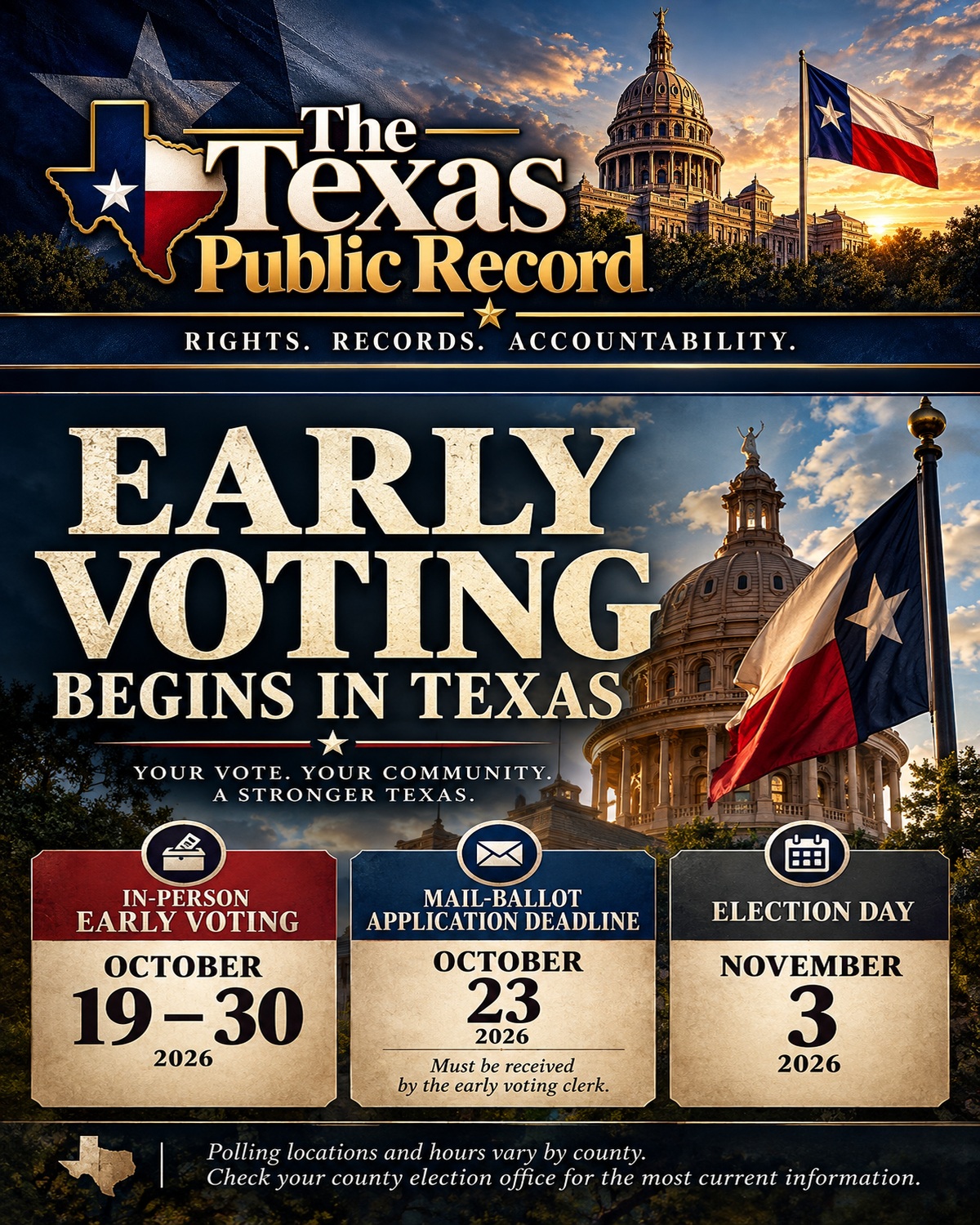
AUSTIN, Texas — Early voting begins across Texas on Monday, October 19, opening a two-week period in which eligible voters can cast their ballots ahead of the November 3 general election.
The statewide dates are straightforward. Finding the correct polling place, understanding identification requirements and meeting the deadline for a ballot by mail require a closer look.
Texas voters can generally cast an early ballot at any designated early-voting polling place in the county where they are registered. They are not limited to a single assigned precinct location during early voting.
For most voters, that flexibility stops at the county line.
Certain eligible voters who recently moved between Texas counties may qualify for a limited ballot under separate procedures. Those voters should contact their county election office to determine whether the limited-ballot process applies to them.
Each county administers its own early-voting locations and schedules, making local election information essential.
In-person early voting begins October 19 and ends Friday, October 30. Election Day is Tuesday, November 3.
There is also a more immediate deadline for voters seeking to vote by mail.
Applications for a ballot by mail generally must reach the early voting clerk by Friday, October 23. Mailing an application by that date is not enough if it arrives after the deadline.
Faxed or emailed applications generally carry an additional requirement that the signed original reach the clerk within the period established by law. Special rules and exceptions may apply, including for certain military and overseas voters.
Texas also limits eligibility to vote by mail. It is not an unrestricted alternative available to every registered voter.
The Texas Secretary of State provides statewide election information, but individual counties determine the locations and operating hours of their early-voting sites within applicable state law.
That means two voters living in different counties may encounter different polling schedules even though they are participating in the same statewide election.
Voters should consult their county election office for the current list of early-voting sites, hours, accessibility information and any last-minute changes.
An address or schedule found in an older social-media post may no longer be reliable.
Texas generally requires voters who possess an acceptable form of photo identification to present it when voting in person.
State law also provides alternatives.
A voter who does not possess an acceptable photo ID and cannot reasonably obtain one may qualify to present an approved supporting form of identification and complete a Reasonable Impediment Declaration.
Other exemptions and procedures may apply in particular circumstances.
The distinction matters. Lacking one of the standard photo IDs does not automatically mean an otherwise eligible voter cannot cast a ballot.
Voters uncertain about their documentation should review the Secretary of State’s official identification guidance before visiting a polling place.
Texas elections operate through a combination of statewide law and county-level administration.
The Secretary of State establishes and publishes statewide election guidance. County election officials handle the practical work of conducting voting, including the locations and schedules voters use.
That division makes county-specific information especially important during the opening days of early voting.
It also means a statewide election calendar cannot, by itself, establish whether a particular polling place is operating at a particular moment.
Early voting continues through October 30, followed by Election Day on November 3.
For Texans planning to vote, the immediate questions are practical: Is their registration current? Which early-voting locations are available in their county? What identification or qualifying alternative will they need? And, if eligible to vote by mail, can their application reach the clerk before the deadline?
Those answers should come from current official election records, not assumptions about how voting worked in a previous election.
The Texas Public Record will distinguish confirmed election procedures from reports of problems or changes that have not been independently verified.
Verified through October 19, 2026.
EDITORIAL NOTICE: This report reflects records and information available at publication. Submit documented correction or clarification requests through The Texas Public Record’s corrections page. Material errors will be corrected transparently.
The Texas Public Record
Rights. Accountability. Awareness.
The record doesn’t blink. Keep your eyes on Texas.
Elections & Public Trust
NASA astronauts have voted as Texas residents from orbit, sending encrypted electronic absentee ballots back to Earth for county processing.
Elections & Public Trust
Texas prohibits nearly all abortions but retains defined medical exceptions. Abbott signed legislation clarifying those exceptions while maintaining restrictions on abortion assistance and abortion-inducing drugs. Hinojosa wants reproductive rights restored. Dixon distinguishes his personal opposition to abortion from the use of government power.
Elections & Public Trust
Texas reports more than $10 billion in border-security spending. The federal government has approved approximately $7.5 billion in reimbursement, but the Comptroller said the money had not reached the state treasury as of September 21. The governor’s race raises questions about enforcement priorities, public spending and the boundaries of state authority.