The record doesn’t blink. Keep your eyes on Texas.
All coverage areas
Texas Governor Record · Installment 3
Texas Governor Record: Public Schools, Education Savings Accounts & Who Controls the Classroom
Abbott signed Texas’ new education savings account program into law. Hinojosa wants it repealed. Their differences extend to teacher pay, school accountability, state takeovers and who should lead the Texas Education Agency.
The candidates’ documented positions and the education policies already enacted in Texas.
Texas has already made one of its biggest education-policy changes in decades.
For the first time, families are using state-funded Texas Education Freedom Accounts to pay approved private-school, homeschool and other education expenses.
Republican Gov. Greg Abbott fought for the program and signed it into law. Democratic nominee Gina Hinojosa wants to end it.
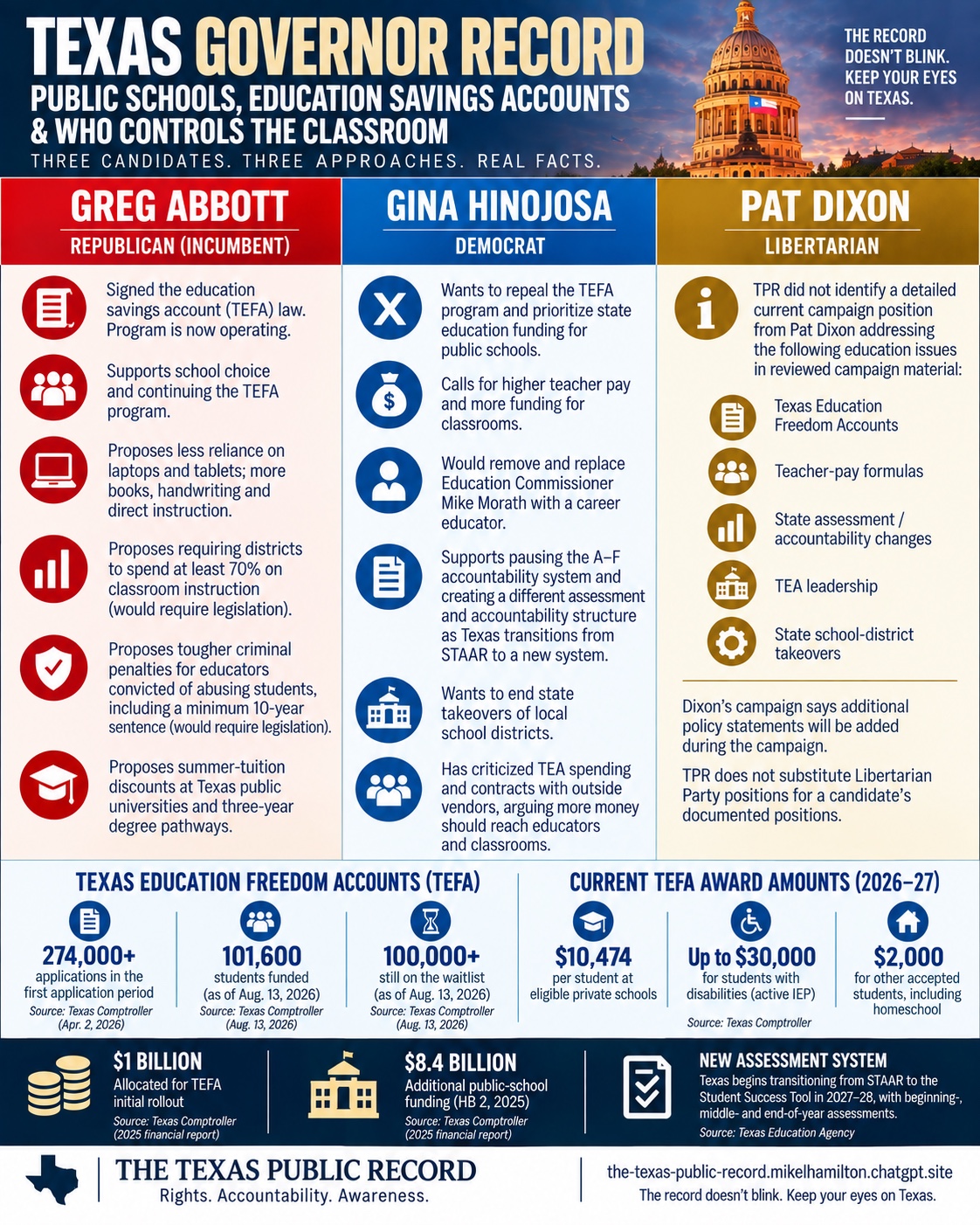
This is no longer a debate about a program that might someday exist. By Aug. 13, the Texas Comptroller reported that 101,600 students had received funding through Texas Education Freedom Accounts, while more than 100,000 remained on the waitlist.
The disagreement also extends well beyond school choice. The candidates offer different approaches to standardized testing, school-district takeovers, teacher pay, classroom technology and leadership of the Texas Education Agency.
This is the third installment of The Texas Public Record’s examination of the 2026 race for Texas governor.
The governor does not run your local school, but the office has real power
Texas public schools are governed locally by elected school boards, but Austin exercises substantial authority over them.
The governor appoints the Texas education commissioner, designates the chair of the State Board of Education and appoints members of the State Board for Educator Certification. The governor can also make education an emergency legislative priority, sign or veto education legislation and appoint university regents.
That makes a governor’s education record about more than campaign speeches. Appointments, legislation and state intervention all matter. In Abbott’s case, there is more than a decade of executive decisions to examine.
The school-choice fight is no longer hypothetical
Texas debated private-school vouchers and related school-choice proposals for years. In 2025, the Legislature enacted a statewide education savings account program.
Senate Bill 2 created what the state calls Texas Education Freedom Accounts, or TEFAs. The program allows eligible families to use state-funded accounts for approved education expenses outside the traditional public-school system. The Legislature allocated $1 billion in General Revenue for the initial rollout.
The Comptroller reported more than 274,000 applications during the first application period. By Aug. 13, 2026, 101,600 students had received funding and more than 100,000 remained on the waitlist.
When candidates talk about education savings accounts in this election, Texans are no longer comparing theories about a program that might someday exist. There is now a law, state funding and actual participation data.
How much can a student receive?
Current award amounts for the 2026–27 school year differ from some figures discussed when SB 2 was enacted.
Participating students attending eligible private schools can receive $10,474.
Students with disabilities who have an active individualized education program, or IEP, may receive up to $30,000.
Other accepted participants, including eligible homeschool students, may receive $2,000.
Those are the current administered amounts. That distinction matters because the original statutory framework included different headline figures. The amounts families can actually receive during the current school year provide a clearer picture of the program as it operates now.
Abbott: School choice is part of his governing record
Creating a statewide education savings account program was one of Abbott’s major legislative priorities. He spent years pushing lawmakers to enact it, including through special legislative sessions after previous proposals failed.
The breakthrough came in 2025. SB 2 passed the Legislature. Abbott signed it. The program became law. The Texas Comptroller administers the program, and participating families can use their accounts for approved education expenses.
Demand has exceeded available first-year funding, as demonstrated by the waitlist. That makes the program a concrete part of Abbott’s governing record rather than simply a campaign promise.
The state does not physically remove a particular student’s existing public-school appropriation and transfer those identical dollars into a private-school account. The Legislature separately allocated $1 billion in General Revenue for the TEFA program.
That does not make the program financially irrelevant to public education. It means claims that the law literally takes an individual student’s existing public-school dollars and hands those same dollars to a private school oversimplify how the state budget works.
The cost does not necessarily stop at $1 billion
The Legislature provided $1 billion for the initial rollout. That does not establish its permanent cost.
Before final passage, the Legislative Budget Board analyzed earlier versions of the legislation and projected substantially higher General Revenue costs in later years under its assumptions. Those projections were not guaranteed future expenditures under the final law.
Participation, eligibility, statutory changes and future appropriations all matter. Future legislatures will determine how much money future programs receive. The first-year experience already provides one important piece of evidence: demand exceeded the funding available for the initial rollout.
Hinojosa: End the education savings accounts
Hinojosa’s position is direct. She wants to eliminate the program. Her campaign describes it as a voucher system and argues that state education money should instead be prioritized for traditional public schools, teachers and classrooms.
A Governor Hinojosa could not simply erase SB 2 with an executive order. The program exists in state law. Repealing it would require the Legislature to pass legislation changing or eliminating the program and the governor to sign it.
A governor could make repeal a legislative priority and influence future budget decisions. The office does not possess unilateral authority to repeal an enacted statute.
Claim versus record: Did Texas fund vouchers instead of public schools?
That framing is incomplete.
Texas created the $1 billion education savings account program in 2025. Texas also enacted a major public-school finance package during the same legislative session.
House Bill 2 provided approximately $8.4 billion in additional public-school funding and made changes involving teacher compensation, support staff, school safety and other education expenses. The law created a teacher retention allotment beginning with the 2025–26 school year.
For districts with 5,000 or fewer students, the allotment provides $4,000 for classroom teachers with at least three but fewer than five years of experience and $8,000 for teachers with five or more years. For larger districts, the amounts are $2,500 and $5,000, respectively.
The law requires districts to use those funds for specified salary increases and maintain those increases subject to the statute.
The record therefore does not support reducing the 2025 session to “Texas funded vouchers but did not fund public schools.” It funded both the new education savings account program and a multibillion-dollar public-school package.
Hinojosa’s teacher-pay argument
Hinojosa says Texas should put more money directly into classrooms and increase teacher salaries. Her campaign has criticized spending at the Texas Education Agency and contracts with outside vendors, arguing that more resources should reach educators and classrooms. She has also said she wants Texas teachers to become among the highest paid in the country.
That is a campaign objective. It is not, by itself, a complete financing plan establishing precisely how much additional money would be required, which expenditures would be eliminated or what statewide salary structure would replace the current system.
Texas already increased teacher compensation through HB 2. The election question is whether those increases are sufficient and what the state should do next.
Abbott’s next education agenda goes beyond school choice
Abbott has proposed reducing reliance on laptops and tablets during instruction while emphasizing books, handwriting and direct teacher instruction. That follows legislation Texas enacted in 2025 restricting student cellphone use during the school day.
He has also proposed requiring school districts to direct at least 70% of their spending toward classroom instruction. Under his proposal, districts with weaker academic performance could face additional scrutiny of their spending. That is a proposal, not current statewide law, and would require legislative action.
Abbott has also proposed tougher criminal penalties for educators convicted of abusing students, including a minimum 10-year sentence. That likewise would require lawmakers to change state law.
Hinojosa wants new leadership at TEA
One of Hinojosa’s clearest promises involves Texas Education Commissioner Mike Morath. She says she would remove and replace him with a career educator.
Morath has led the Texas Education Agency since 2016 and previously served as a Dallas ISD trustee.
This promise is different from Hinojosa’s pledge to eliminate the education savings account program. The TEFA program exists in statute and would require legislative action to repeal. The education commissioner, by contrast, is appointed by the governor subject to Senate confirmation. That makes TEA leadership an area where the governor possesses more direct authority.
The STAAR debate has already changed
Texas lawmakers approved House Bill 8 during the 89th Legislature’s second called session in 2025. The legislation replaces the existing STAAR structure with a new Student Success Tool beginning with the 2027–28 school year.
According to the Texas Education Agency, the new system will use beginning-of-year, middle-of-year and end-of-year assessments. The beginning- and middle-of-year assessments are designed to be shorter and adaptive.
The 2026 governor’s race is therefore no longer simply about whether Texas should keep or eliminate STAAR. Texas has already enacted a replacement. The question is what the new assessment and accountability system should look like and how heavily standardized testing should continue to influence school accountability.
Hinojosa’s position goes beyond the STAAR name
Hinojosa has opposed the state’s existing high-stakes testing and accountability structure. Her current position includes pausing the A–F school-accountability system and creating a different assessment and accountability system.
Simply promising to eliminate STAAR no longer describes the full policy question. The Legislature has already acted to replace it. The remaining disagreement concerns what succeeds it and how Texas should measure school performance.
Hinojosa would end state school-district takeovers
Another major difference involves state intervention in local school districts.
Texas law gives the education commissioner significant intervention authority when districts or campuses repeatedly fail state standards or encounter specified governance problems. During Morath’s tenure, TEA has used state intervention authority in multiple districts.
Houston ISD is the most prominent recent example. The state replaced Houston’s elected board with an appointed board of managers as part of the intervention.
Abbott’s administration has defended state accountability and intervention authority. Hinojosa argues that locally elected leadership should not be displaced in this way.
That presents a fundamental governance question: when a school system repeatedly fails state standards or meets statutory conditions for intervention, how much authority should remain local and how much should Austin exercise?
Higher education is also part of Abbott’s plan
Abbott has proposed requiring four-year Texas public universities to provide summer-tuition discounts. Under his proposal, undergraduates taking up to five summer credit hours would receive a $500 reduction in tuition and fees. Students taking six or more hours would receive $1,000 off.
The proposal would require legislative approval. Abbott has also directed the Texas Higher Education Coordinating Board to develop pathways allowing students to complete bachelor’s degrees in three years.
Whether those proposals ultimately reduce students’ total costs would depend on implementation, participation and legislative action where required.
Pat Dixon
Libertarian Pat Dixon is also on the certified general-election ballot.
For this report, TPR reviewed Dixon’s current campaign material but did not identify a detailed education agenda addressing the specific issues examined here: Texas Education Freedom Accounts, teacher-pay formulas, the Student Success Tool, TEA leadership and state district takeovers.
That does not establish that Dixon has no views on education. His campaign site indicates additional policy statements will be added during the campaign. It means the material currently available does not support assigning him detailed positions on these specific questions.
TPR does not substitute general Libertarian Party positions for Dixon’s own documented positions.
What the record shows
The 2026 governor’s race begins with a functioning statewide education savings account program. Abbott pushed for it, the Legislature enacted it, he signed it, and Texans are using it.
Hinojosa wants the program eliminated, but repeal would require legislation. A governor could not cancel SB 2 alone.
The Legislature also enacted an approximately $8.4 billion public-school finance package in 2025 that included additional funding and mandatory teacher-pay increases for qualifying educators.
The candidates disagree over whether those investments were sufficient and where future education dollars should go. Their differences extend to appointments, classroom technology, district spending, testing, accountability and state intervention.
Some campaign promises could be pursued substantially through gubernatorial appointments. Others would require legislation. Some concern programs already operating. Others remain proposals.
That is the distinction voters need when evaluating education claims in this race: What has already happened? What can a governor actually change? What would still require the Texas Legislature? And what does the record show instead of the campaign slogan?
Texas prohibits nearly all abortions but retains defined medical exceptions. Abbott signed legislation clarifying those exceptions while maintaining restrictions on abortion assistance and abortion-inducing drugs. Hinojosa wants reproductive rights restored. Dixon distinguishes his personal opposition to abortion from the use of government power.
Texas reports more than $10 billion in border-security spending. The federal government has approved approximately $7.5 billion in reimbursement, but the Comptroller said the money had not reached the state treasury as of September 21. The governor’s race raises questions about enforcement priorities, public spending and the boundaries of state authority.
Counties are processing delayed DPS transactions before the October 5 deadline. Record counts are not unique-voter counts, and the statewide total remains unknown.