The record doesn’t blink. Keep your eyes on Texas.
All coverage areas
What Changed · Texas Government & Lawmaking
Texas orders data-center permit pause as state reviews grid and water demands
Texas has ordered a pause on environmental permits related to data-center projects while state officials examine the industry’s growing demands on the electric grid and water supplies.
The directive is clear. Its project-by-project effect is not.
By The Texas Public RecordPublished: September 22, 2026Desk: Government & LegislationVerified through: September 22, 2026
The directive orders a permit pause while state reviews continue. TCEQ must update the Governor’s Office by October 19, 2026.
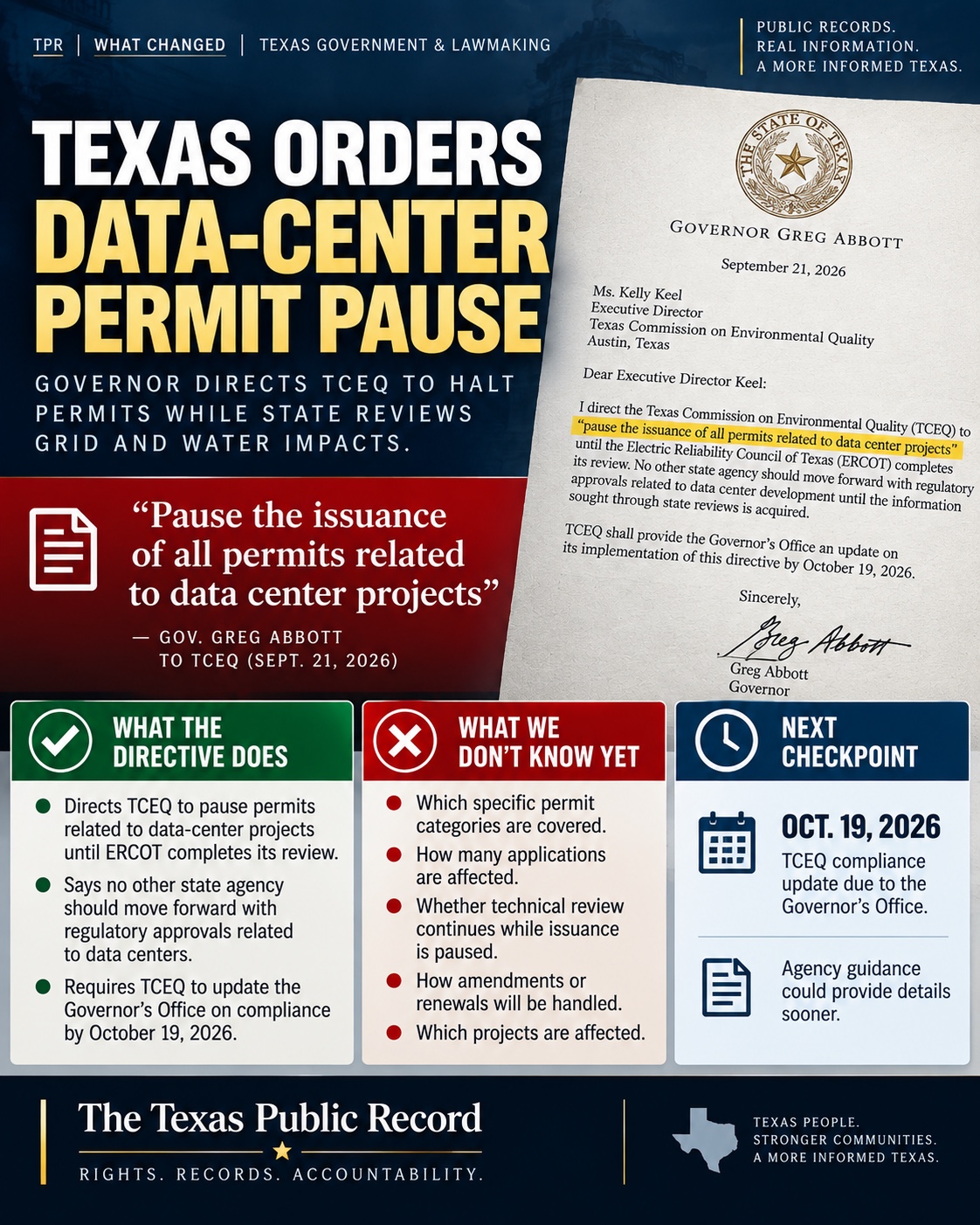
Gov. Greg Abbott issued a written directive September 21 instructing the Texas Commission on Environmental Quality to “pause the issuance of all permits related to data center projects” until the Electric Reliability Council of Texas completes its review.
The public record reviewed by The Texas Public Record does not yet identify how many pending applications are affected, which specific TCEQ permit programs fall within the order or which individual data-center projects have had permits formally paused.
That makes implementation the next major checkpoint.
What changed
Abbott’s directive adds environmental permitting to a broader state review of data-center development and its demands on Texas infrastructure.
The governor has directed the Public Utility Commission of Texas and ERCOT to examine data centers going through ERCOT’s interconnection process. The Texas Water Development Board has also been directed to gather additional information about water use and coordinate with ERCOT.
Now TCEQ has been instructed to pause permits related to data-center projects while that work continues.
The September 21 letter also says no other state agency should move forward with regulatory approvals related to data-center development until information sought through the state reviews is acquired.
TCEQ must provide the Governor’s Office with an update on its implementation of the directive by October 19, 2026.
What Texas has not identified yet
The directive establishes the state’s policy, but several practical questions remain unanswered.
The available public record does not identify the specific air, water, waste or other TCEQ permit programs covered by the pause. It also does not establish how many applications are affected or whether agency staff will continue technical reviews while withholding final permit issuance.
It is similarly unclear how TCEQ will treat amendments or renewals involving existing facilities.
Most importantly for communities where data centers are proposed or under development, the directive itself does not provide an inventory of affected projects.
Key distinction: An individual project should not be described as paused merely because the statewide directive exists. Connecting a specific development to the order requires evidence that a relevant permit or regulatory approval is actually affected.
The directive reaches beyond TCEQ
Abbott’s letter says other state agencies should not advance regulatory approvals related to data centers while the requested information is being gathered.
That potentially gives the directive consequences beyond environmental permitting.
But the record does not yet contain an agency-by-agency inventory explaining which approvals are affected or how individual regulators will implement the instruction.
The Governor’s Office also outlined broader policy expectations for data-center development, including that projects cover electrical-infrastructure costs, protect grid reliability and community water supplies, report electricity and water consumption, and comply with setback requirements.
Those are policy positions contained in the governor’s directive. They are not findings that any particular data-center operator has violated those standards.
Why Texans should watch the implementation
Data-center development can intersect with local decisions involving electricity infrastructure, water supplies, economic-development agreements and anticipated tax bases.
A statewide permitting pause therefore has potential consequences beyond the companies developing the facilities.
But those consequences cannot yet be reliably assigned to individual communities or projects without additional records.
TCEQ implementation guidance could provide that information.
An affected-application inventory, changes in state permit databases or agency instructions identifying the permit programs covered by the directive would provide a clearer picture of the pause’s practical reach.
What happens next
TCEQ must report to the Governor’s Office on its compliance by October 19.
Agency guidance could arrive before that deadline.
The Texas Public Record will be watching for TCEQ implementation instructions, identification of affected applications, ERCOT and PUCT review activity, Texas Water Development Board findings and any modification of the governor’s directive.
Bottom line
Texas has ordered TCEQ to pause permits related to data-center projects while the state reviews the industry’s effects on electricity and water resources.
What the public record does not yet establish is equally important: which specific permits are covered, how many applications are affected, whether technical processing continues or which individual projects have actually been paused.
The directive is established. Its project-level impact remains to be documented.
Texas prohibits nearly all abortions but retains defined medical exceptions. Abbott signed legislation clarifying those exceptions while maintaining restrictions on abortion assistance and abortion-inducing drugs. Hinojosa wants reproductive rights restored. Dixon distinguishes his personal opposition to abortion from the use of government power.
Texas reports more than $10 billion in border-security spending. The federal government has approved approximately $7.5 billion in reimbursement, but the Comptroller said the money had not reached the state treasury as of September 21. The governor’s race raises questions about enforcement priorities, public spending and the boundaries of state authority.