The record doesn’t blink. Keep your eyes on Texas.
All coverage areas
TPR What Changed / Record Check · Texas Government & Legislation
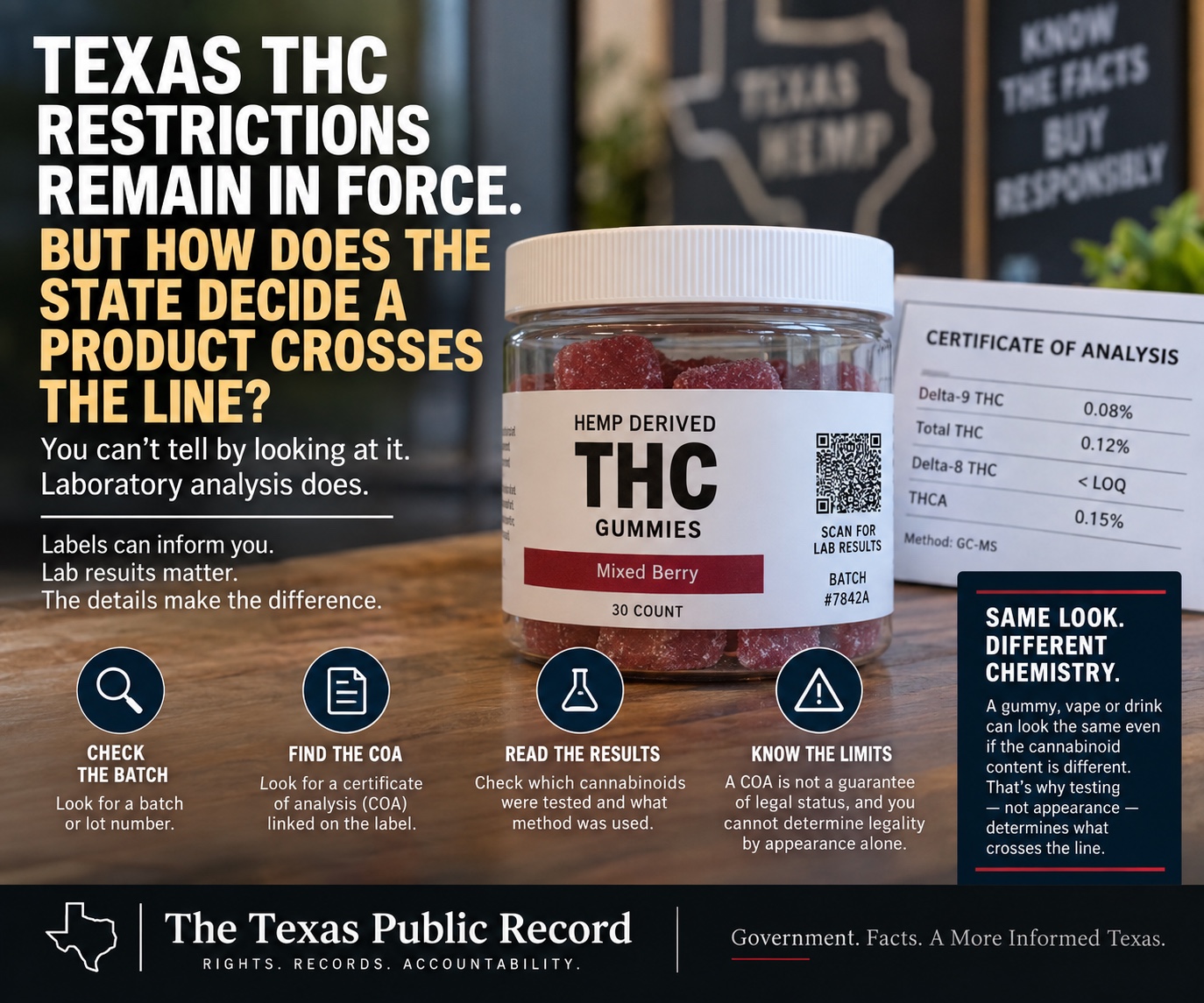
Texas THC restrictions remain in force. But how does the state decide a product crosses the line?
Texas did not enact the sweeping THC prohibition lawmakers approved in 2025. But the state’s hemp market is not operating under the rules consumers and retailers may remember from a year ago.
Since July 31, DSHS has been operating under reinstated controlled-substance definitions affecting delta-8 THC. The unresolved public-record question is what test—and what result—turns “trace” into prohibited.
By The Texas Public RecordUpdated: September 23, 2026Desk: Government & LegislationVerified through: September 23, 2026
A product’s appearance cannot establish cannabinoid content. The sample, method, uncertainty and reported result all matter.
The Texas Department of State Health Services says only naturally occurring trace amounts of delta-8 THC in the hemp plant from which a consumable hemp product was manufactured are permissible.
The agency also warns that products labeled as containing delta-8—or shown to contain more than trace amounts of tetrahydrocannabinols, including delta-8—may be detained and referred to law enforcement.
Cannabinoid content is not something a consumer, retailer or officer can reliably determine simply by looking at a product. Laboratory analysis supplies the chemical evidence. But the sample, analytical method, measurement uncertainty and way the result is reported all matter.
What can Texans still buy?
Texas law retains a statutory framework allowing qualifying consumable hemp products within its THC limits.
Before a consumable hemp product is sold, distributed or otherwise introduced into commerce in Texas, a representative sample must be tested by an accredited laboratory.
Current rules require testing for cannabinoid identity and concentration, delta-9 THC, total delta-9 THC, total THC, residual solvents, heavy metals, pesticides and harmful pathogens.
For the applicable THC determination, the representative sample must have a total delta-9 THC concentration of 0.3% or less on a dry-weight basis, taking the accredited laboratory’s measurement uncertainty into account.
Key distinction: Texas has a detailed regulatory testing framework for consumable hemp. The unresolved question examined here is narrower: how the state applies its separate rule that only naturally occurring “trace amounts” of delta-8 THC are permissible.
What does a certificate of analysis actually prove?
A certificate of analysis, or COA, is one of the most useful documents attached to a hemp product.
Current Texas rules require COAs to contain substantial analytical information, including laboratory and sample information, testing dates, analytical methods, instrumentation, limits of detection and quantitation, measurement-uncertainty information and test results.
Texas labeling rules also require a consumable hemp product to provide a URL linking to a COA for the product or its hemp-derived ingredients, along with identifying information such as a batch number.
But a COA is not a blanket government declaration that every item bearing the same brand name is lawful. It documents laboratory testing of a particular sample. That is why the connection between the retail product, its batch and the COA matters.
Questions a consumer can ask
Does the product have a batch number?
Does the COA correspond to that product or batch?
What cannabinoids were reported?
What analytical method was used?
What were the laboratory’s limits of detection and quantitation?
What measurement uncertainty was reported?
Regulatory testing and criminal forensic testing are not the same thing
DSHS regulates consumable hemp products and can inspect regulated businesses, obtain representative product samples and conduct random testing.
That regulatory process should not be confused with forensic analysis of evidence in a criminal investigation.
Texas Department of Public Safety crime laboratories analyze seized-drug evidence and have issued laboratory notifications concerning THC methodology, oils and vape cartridges, and THCA/THC analysis. DPS issued updated THCA/THC guidance in January 2026 and updated vape-cartridge guidance in April.
The analytical question can therefore depend on what is being tested, why it is being tested and which laboratory system is performing the analysis. One laboratory procedure should not automatically be assumed to govern every cannabinoid product in every Texas regulatory or criminal context.
Why the testing method matters
Texas has already confronted a concrete example of why analytical method and reporting language matter.
In 2025, the Texas Forensic Science Commission examined DPS testing involving non-plant cannabinoid material, including liquids and oils. The issue involved gas chromatography-mass spectrometry, or GC-MS.
THCA and delta-9 THC are chemically distinct. But heat can cause THCA to decarboxylate into THC, and the Commission found that the GC-MS method at issue could produce a total THC result incorporating THC and THCA.
That did not mean the analytical data were invalid. The Commission’s concern centered on reporting and interpretation: a court, law-enforcement agency or other customer could misunderstand a result if the laboratory did not clearly disclose what its method could and could not distinguish.
The Commission’s observations were expressly limited to non-plant cannabinoid products. It separately noted that GC-MS is appropriate for plant material under the federal total-THC framework used to distinguish hemp from marijuana.
For methods unable to distinguish THC from THCA in non-plant material, the Commission supported reporting the result as “total THC” with language explaining the analytical limitation.
Important qualification: The finding does not establish that Texas forensic THC testing is generally unreliable. It demonstrates why the method and the language accompanying a laboratory result matter.
Texas has also changed its regulatory testing rules
Rules effective March 31, 2026 require testing for delta-9 THC, total delta-9 THC and total THC, along with cannabinoid identity and concentration and specified contaminants.
They also require COAs to disclose analytical methods, instrumentation, detection and quantitation limits and measurement-uncertainty information.
So the public-record question is not whether Texas has cannabinoid testing standards. It does. The narrower issue is what analytical standard government agencies use when applying the July 31 delta-8 restriction.
What does “trace” delta-8 actually mean?
DSHS currently says: “Only trace amounts of delta-8 THC naturally produced by the hemp plant from which the consumable hemp product was manufactured are permissible.”
The agency also says products shown to contain more than trace amounts of tetrahydrocannabinols, including delta-8 THC, may be detained and referred to law enforcement.
But unlike the numerical THC standard used elsewhere in the consumable-hemp framework, the public-facing DSHS material reviewed by TPR does not provide a simple numerical percentage defining exactly when delta-8 stops being “trace.”
That creates a legitimate accountability question: If a laboratory reports delta-8 THC in a product, what analytical result causes the state to determine that the amount exceeds the naturally occurring trace exception?
When the consequences can include product detention and referral to law enforcement, what written method, threshold or decision rule governs that determination?
Can an officer tell by looking at a product?
Not reliably.
A package, gummy, vape cartridge, beverage or other product can provide clues through its labeling, branding or accompanying documentation, but appearance does not quantify cannabinoid concentration. A seized product may require laboratory analysis.
That makes the chain from product to sample to analytical method to laboratory result to enforcement decision especially important. It also means a retailer’s COA and a government laboratory result should not automatically be treated as interchangeable evidence without examining what each laboratory tested and how.
What the Texas Supreme Court actually decided
In Texas Department of State Health Services v. Sky Marketing Corp., the Texas Supreme Court affirmed in part and reversed in part the lower appellate court and rendered judgment on May 1.
The Court held, among other things, that sovereign immunity barred the hemp vendors’ ultra vires claims challenging the commissioner’s controlled-substance scheduling decisions. It also held that DSHS’s website statement was not itself a “rule” subject to the Administrative Procedure Act.
The Court therefore reversed the temporary injunction that had blocked enforcement of the challenged scheduling action.
DSHS subsequently published notice in the July 10 Texas Register reinstating clarifications to the definitions of tetrahydrocannabinols and marihuana extract from the 2021 Schedule of Controlled Substances. DSHS says that scheduling action became effective July 31.
The court fight is not over
Hemp businesses and consumers subsequently challenged the restrictions in federal court and sought emergency relief. A federal judge denied their request for a temporary restraining order in August.
That denial of emergency relief was not a final judgment resolving every legal challenge to the state’s hemp framework.
A separate state-court challenge to portions of DSHS’s 2026 consumable-hemp rules also remains pending on appeal. The temporary injunction against those challenged rules is not currently in effect, so the rules remain enforceable while the appeal proceeds.
Other portions of Texas hemp regulation have their own litigation history. DSHS currently notes, for example, that an injunction involving the state’s smokable-hemp ban continues to allow distribution and retail sale of consumable hemp products for smoking.
Those separate disputes should not be confused with the issue examined here. The narrower point is that the July 31 controlled-substance scheduling action affecting delta-8 remains operative.
What should a consumer look for?
If you’re considering a consumable hemp product in Texas, start with the documentation attached to that specific product.
Look for the batch number. Find the linked COA. Confirm that the COA corresponds to the product or its hemp-derived ingredients. Read the cannabinoid results rather than relying solely on marketing language on the front of the package.
A COA can provide valuable evidence about what an accredited laboratory found in the sample it tested. It should not be treated as an unconditional guarantee of how DSHS, DPS, a prosecutor or a court would classify a particular product under every circumstance.
The public-record question
The next step is not speculation. It’s records.
The most useful records would show how Texas agencies are actually applying the July 31 restriction.
TPR should seek DSHS written criteria, standard operating procedures, guidance, memoranda or instructions defining or operationalizing “trace amounts” of delta-8 THC.
That should include analytical methods, limits of detection and quantitation, measurement-uncertainty policies and any decision thresholds used to determine whether delta-8 exceeds a trace amount.
The records should also identify product detentions since July 31 based wholly or partly on delta-8 or other tetrahydrocannabinol findings, the government laboratory results underlying those actions, associated manufacturer or retailer COAs, referrals to law enforcement and the basis for those referrals.
From DPS, the relevant records include seized-drug procedures for delta-8, delta-9, THCA and other tetrahydrocannabinols, along with reporting policies and analytical-method changes following the Texas Forensic Science Commission’s 2025 review.
Particularly useful would be records showing cases in which a government test and a manufacturer’s COA produced materially different results and what happened afterward.
The complete chain
PRODUCT → COA → GOVERNMENT TEST → ENFORCEMENT DECISION → DISPOSITION
That would show Texans not merely what the state’s rules say, but how those rules are being applied.
Bottom line
Texas now has detailed testing requirements for regulated consumable hemp.
But DSHS’s public-facing guidance uses a different formulation for delta-8: only naturally occurring “trace amounts” are permissible.
The agency warns that products exceeding that line may be detained and referred to law enforcement. Yet the public-facing DSHS material reviewed by TPR does not provide consumers with a simple numerical delta-8 threshold comparable to the numerical standard used elsewhere in the hemp framework.
That does not establish that Texas lacks an analytical standard internally. It establishes the question the records need to answer:
What analytical method, threshold and decision rule does Texas actually use to determine when permissible “trace” delta-8 becomes controlled delta-8?
Editorial notice: This report reflects records and information available at publication. Allegations, charges and disputed claims are not findings of wrongdoing. Submit documented correction or clarification requests by messaging The Texas Public Record on the platform where this article appears. Material errors will be corrected transparently.
The Texas Public Record Rights. Accountability. Awareness.
Texas prohibits nearly all abortions but retains defined medical exceptions. Abbott signed legislation clarifying those exceptions while maintaining restrictions on abortion assistance and abortion-inducing drugs. Hinojosa wants reproductive rights restored. Dixon distinguishes his personal opposition to abortion from the use of government power.
Texas reports more than $10 billion in border-security spending. The federal government has approved approximately $7.5 billion in reimbursement, but the Comptroller said the money had not reached the state treasury as of September 21. The governor’s race raises questions about enforcement priorities, public spending and the boundaries of state authority.