The record doesn’t blink. Keep your eyes on Texas.
All coverage areas
Texas Law & Rights Education | Public Safety
Texas School Bus Stop Laws: When Drivers Must Stop, When They May Proceed, and What Violations Can Cost
Texas law requires motorists to stop for school buses displaying their required warning signals, but the rules for divided highways are more specific than many drivers realize.
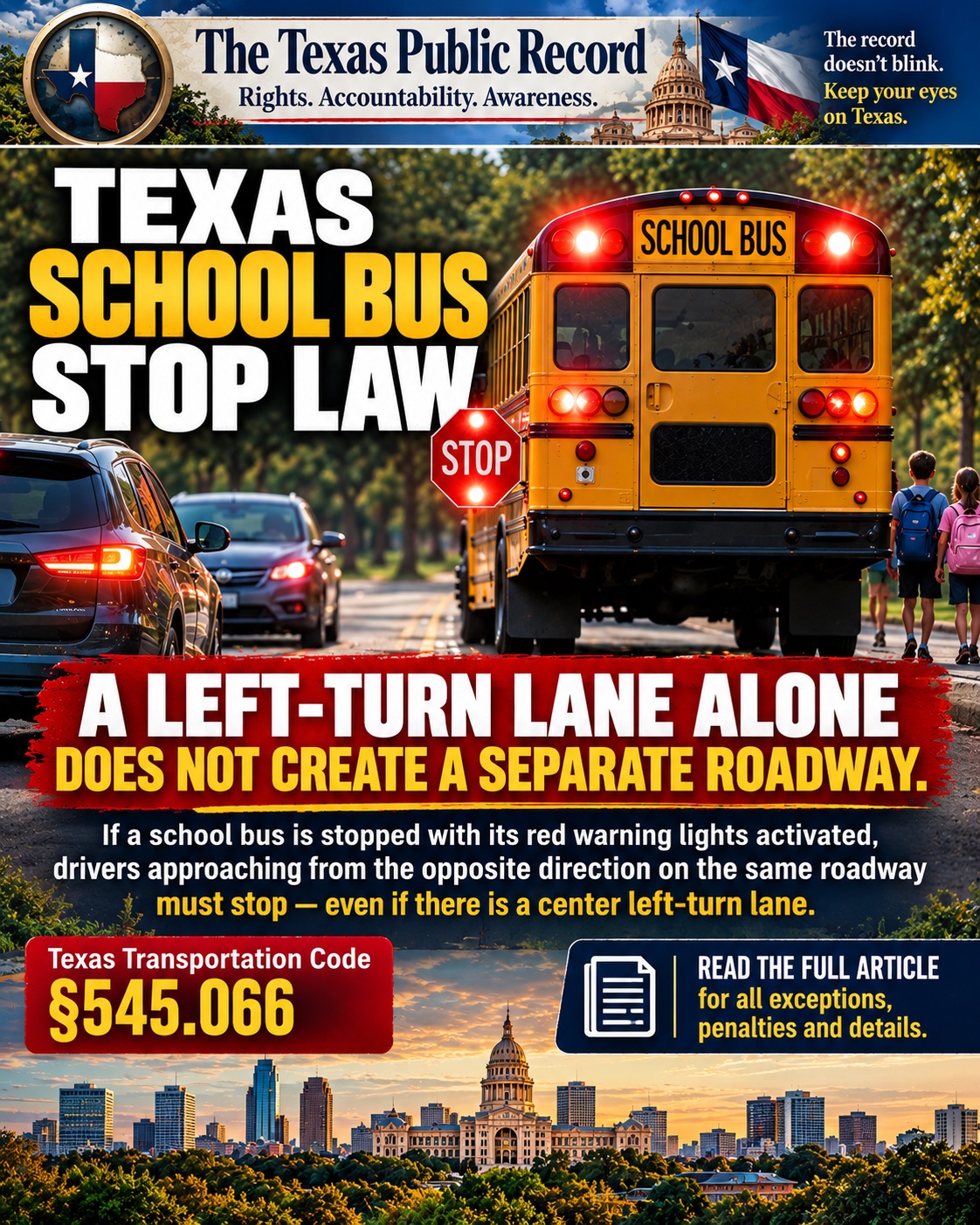
Owner-supplied educational illustration, reproduced unchanged. It is not a photograph of a documented incident or a diagram of a particular road. The article explains the statutory exceptions and penalties.
AUSTIN, Texas — A school bus stops. Its red warning lights begin flashing. Children prepare to step onto the roadway, and traffic approaches from both directions.
For Texas motorists, the legal obligation may depend on a distinction that is easy to misunderstand: whether the vehicles are traveling on the same roadway.
Texas Transportation Code §545.066 generally requires drivers approaching a stopped school bus from either direction to stop before reaching it when the bus is receiving or discharging a student and operating the visual signal required by state law.
The rule applies to more than vehicles following a bus. Motorists approaching from the opposite direction may also be required to stop, even when several lanes separate them from the bus.
The distinction is particularly relevant during National School Bus Safety Week, October 19–23, 2026.
On October 19, the Texas Department of Public Safety issued a statewide reminder urging drivers to prioritize school bus safety and remain alert for children entering and leaving buses.
But understanding the law requires more than knowing that flashing red lights mean stop. Drivers must also understand when Texas law recognizes an exception and when it does not.
When Texas Law Requires Drivers to Stop
Under §545.066, a driver approaching a school bus from either direction must stop before reaching the bus when it is stopped to receive or discharge a student and is operating the visual signal required by §547.701.
Once stopped, the motorist may not proceed until one of three conditions occurs:
The school bus resumes motion.
The bus driver signals the motorist to proceed.
The bus’s required visual signal is no longer activated.
The statute does not permit a motorist to proceed merely because no children are immediately visible.
Nor does the presence of several lanes automatically eliminate the stopping requirement.
The controlling question is whether the circumstances satisfy the statute, including any applicable exception.
The Divided-Highway Exception: What Actually Counts?
One of the most consequential provisions in Texas school bus law concerns highways with separate roadways.
Section 545.066(b)(1) provides an exception when a driver is on a highway having separate roadways and the school bus is stopped on a different roadway.
That language is narrower than simply saying motorists do not have to stop on divided roads.
Under §545.066(f), separate roadways must be divided by an intervening space on which vehicles are not permitted to operate, a physical barrier, or a clearly indicated dividing section constructed to impede vehicular traffic.
The statute expressly states that a highway is not considered to have separate roadways merely because it has a left-turn lane.
This matters on Texas roads where opposing traffic may be separated by painted lines or a shared center turning lane.
A driver approaching a stopped school bus from the opposite direction cannot assume that a center turn lane creates a legal exemption.
By contrast, when opposing traffic is traveling on genuinely separate roadways divided in the manner recognized by the statute, the exception may apply to a motorist on the roadway different from the one where the bus has stopped.
The number of lanes is not the determining factor. The statutory definition of separate roadways is.
Another Exception on Controlled-Access Highways
Texas law recognizes a second exception under §545.066(b)(2).
Section 545.066(b) begins by specifying an operator on a highway having separate roadways. Under its controlled-access provision, that operator is not required to stop for a school bus stopped in a loading zone that is part of or adjacent to the controlled-access highway and where pedestrians are not permitted to cross the roadway.
The separate-roadway requirement and both loading-zone and pedestrian-crossing conditions must be satisfied.
A school bus stopping near a highway does not automatically create an exception. The location must meet the statute’s requirements.
The distinction prevents motorists from treating every highway bus stop as exempt from the general stopping rule.
What Happens When a Driver Violates the Law?
Texas law establishes substantial financial penalties for unlawfully passing a stopped school bus.
For an ordinary first offense under §545.066, the statutory fine ranges from $500 to $1,250.
For a second or subsequent offense committed within five years of the date the most recent previous offense was committed, the fine increases to $1,000 to $2,000.
The five-year period is measured between the dates the offenses were committed, not between conviction dates.
The statute also authorizes a court to suspend a driver’s license for up to six months following a second or subsequent conviction.
That suspension is discretionary under the provision, not an automatic consequence of every violation.
The penalties become more serious when a violation causes serious bodily injury to another person.
Under §545.066(c)(2), an offense causing serious bodily injury is classified as a Class A misdemeanor.
Under §545.066(c)(3), a subsequent offense under the school bus stopping statute is classified as a state jail felony if the person previously was convicted under the serious-bodily-injury provision. That felony provision does not expressly require the subsequent offense to cause another serious bodily injury.
These distinctions are significant. Not every violation of the school bus stopping law is a felony, and enhanced criminal penalties depend on the specific circumstances established by law.
Why the Roadway Distinction Matters
Consider a common roadway configuration: two lanes traveling in each direction, with a shared center lane designated for left turns.
A motorist approaching a stopped school bus from the opposite direction might believe that the center lane separates the roadway sufficiently to permit continued travel.
Texas law expressly rejects the proposition that a left-turn lane alone establishes separate roadways.
Now consider opposing traffic separated by a physical median or barrier that meets the statute’s definition.
In that situation, the separate-roadway exception may apply to motorists traveling on the roadway opposite the stopped bus.
The difference is not merely technical.
It determines whether the statute requires a driver to stop.
The exception, however, is not a guarantee that continuing through the area is safe. Children can behave unpredictably, and motorists remain responsible for complying with other applicable traffic laws and exercising appropriate care.
DPS Urges Additional Caution During School Bus Safety Week
The Texas Department of Public Safety’s October 19 reminder places the statutory requirements within a broader public-safety concern.
School buses operate in neighborhoods, along rural highways, near intersections and on roads where motorists may encounter children crossing or walking beside traffic.
DPS encourages drivers to slow down in school zones, remain attentive around school buses and avoid distractions.
The agency also emphasizes the importance of recognizing when motorists must stop for a bus displaying its warning signals.
Those precautions matter beyond the five days designated for National School Bus Safety Week.
Texas students board and exit school buses throughout the academic year, often during morning and afternoon traffic when visibility, congestion and driver distraction can complicate roadway conditions.
Know the Law Before You Reach the Bus
The central requirement of Texas Transportation Code §545.066 is straightforward: motorists approaching a qualifying stopped school bus displaying its required visual signal generally must stop, regardless of their direction of travel.
The exceptions require closer attention.
A painted center line does not automatically create separate roadways. A left-turn lane alone does not qualify. And the controlled-access-highway exception applies only when its specific conditions are met.
Violating the law can result in substantial fines, possible license suspension for repeat offenders and enhanced criminal penalties for serious bodily injury or a qualifying prior conviction.
For Texas motorists, understanding these distinctions is not simply about avoiding a citation.
It is about recognizing the legal obligation before reaching a stopped school bus, when there may be little time to correct a dangerous decision.
The law establishes when a driver must stop. Awareness and caution remain essential whenever children are near traffic.
Statutory text and DPS guidance reviewed October 20, 2026. This article provides general legal education, not advice about a particular citation, roadway or criminal case.
EDITORIAL NOTICE: This report reflects records and information available at publication. Allegations, charges, and disputed claims are not findings of wrongdoing. Submit documented correction or clarification requests. Material errors will be corrected transparently.
The Texas Public Record Rights. Accountability. Awareness. The record doesn’t blink. Keep your eyes on Texas.
Independent studies document improvements in livestock production, agricultural practices and household diets in evaluated Heifer International programs. A chance encounter at a Texas retail store prompted a closer examination of the organization’s mission, finances and measurable results.
Railroad Commission records show more drilling permits issued in September 2026, even as the number of oil and gas completion reports processed by state regulators remained substantially below September 2025 levels.